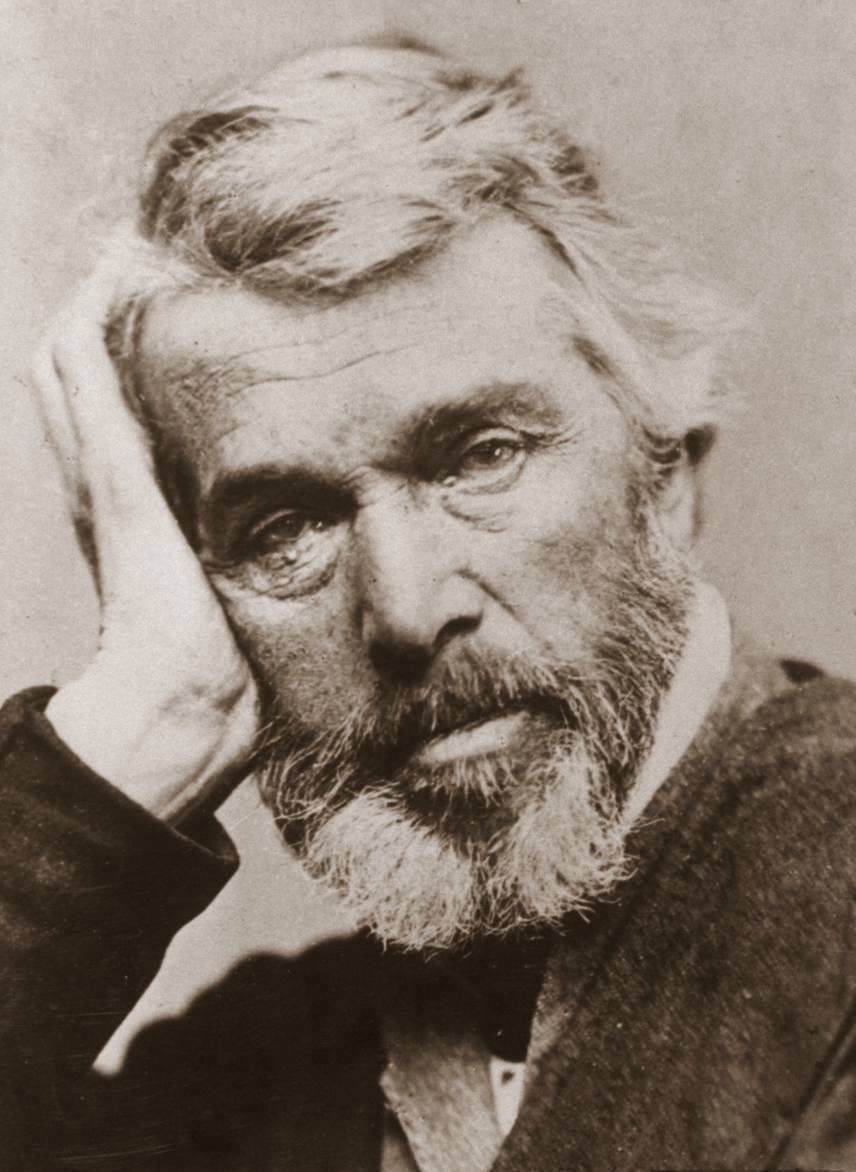
Źródło: Wielka księga mądrości, wybór Jacek i Tomasz Ilga
Thomas Carlyle: 494 cytaty6 Polubień
Thomas Carlyle słynne cytaty
Thomas Carlyle cytaty
Thomas Carlyle książka Past and Present
Captains of Industry. (ang.)
Źródło: Przeszłość i teraźniejszość (ang. Past and Present) 4, 4
„Szczęśliwi ludzie, których dzieje nie wypełniają podręczników historii.”
Happy the people whose annals are blank in history books! (ang.)
Thomas Carlyle: Cytaty po angielsku
1840s, Heroes and Hero-Worship (1840), The Hero as Priest
1840s, Heroes and Hero-Worship (1840), The Hero as Priest
1840s, Heroes and Hero-Worship (1840), The Hero as Poet
1840s, Heroes and Hero-Worship (1840), The Hero as Prophet
1840s, Heroes and Hero-Worship (1840), The Hero as Divinity
1840s, Heroes and Hero-Worship (1840), The Hero as Divinity
1820s, Critical and Miscellaneous Essays (1827–1855)
Oh! when I think that all the area in boundless space he had seen was limited to a circle of some fifty miles' diameter (he never in his life was farther or elsewhere so far from home as at Craigenputtoch), and all his knowledge of the boundless time was derived from his Bible and what the oral memories of old men could give him, and his own could gather; and yet, that he was such, I could take shame to myself. I feel to my father — so great though so neglected, so generous also towards me — a strange tenderness, and mingled pity and reverence peculiar to the case, infinitely soft and near my heart. Was he not a sacrifice to me? Had I stood in his place, could he not have stood in mine, and more? Thou good father! well may I forever honor thy memory. Surely that act was not without its reward. And was not nature great, out of such materials to make such a man?
1880s, Reminiscences (1881)
I call a man remarkable who becomes a true workman in this vineyard of the Highest. Be his work that of palace-building and kingdom-founding, or only of delving and ditching, to me it is no matter, or next to none. All human work is transitory, small in itself, contemptible. Only the worker thereof, and the spirit that dwelt in him, is significant. I proceed without order, or almost any forethought, anxious only to save what I have left and mark it as it lies in me.
1880s, Reminiscences (1881)
The poor neat-herd's son, if he were a Noble of Nature, might rise to Priesthood, to High-priesthood, to the top of this world,—and best of all, he had still high Heaven lying high enough above him, to keep his head steady, on whatever height or in whatever depth his way might lie!
1850s, Latter-Day Pamphlets (1850), The New Downing Street (April 15, 1850)
1840s, Heroes and Hero-Worship (1840), The Hero as Priest
“Love not Pleasure; love God.”
Bk. II, ch. 9.
1830s, Sartor Resartus (1833–1834)
1850s, Latter-Day Pamphlets (1850), Model Prisons (March 1, 1850)
His wishes, the pitifulest whipster's, are to be fulfilled for him; his days, the pitifulest whipster's, are to flow on in an ever-gentle current of enjoyment, impossible even for the gods. The prophets preach to us, Thou shalt be happy; thou shalt love pleasant things, and find them. The people clamor, Why have we not found pleasant things? ...God's Laws are become a Greatest Happiness Principle. There is no religion; there is no God; man has lost his soul.
Bk. III, ch. 4.
1840s, Past and Present (1843)
1840s, Heroes and Hero-Worship (1840), The Hero as Prophet
These Arabs believe their religion, and try to live by it! No Christians, since the early ages, or only perhaps the English Puritans in modern times, have ever stood by their Faith as the Moslem do by theirs, — believing it wholly, fronting Time with it, and Eternity with it.
1840s, Heroes and Hero-Worship (1840), The Hero as Prophet
Thomas Carlyle książka Latter-Day Pamphlets
1850s, Latter-Day Pamphlets (1850), Stump Orator (May 1, 1850)
Thomas Carlyle książka Latter-Day Pamphlets
1850s, Latter-Day Pamphlets (1850), The Present Time (February 1, 1850)
“The sincere alone can recognize sincerity. Not a Hero only is needed, but a world fit for him;”
1840s, Heroes and Hero-Worship (1840), The Hero As King
“Such laughter, like sunshine on the deep sea, is very beautiful to me.”
1840s, Heroes and Hero-Worship (1840), The Hero as Poet
Thomas Carlyle książka Sartor Resartus
As the Swiss inscription says: Sprechen ist silbern, Schweigen ist golden
Bk. III, ch. 3.
1830s, Sartor Resartus (1833–1834)
Cut down the proud towering thoughts that you get into you, or see they be pure as well as high. There is a nobler ambition than the gaining of all California would be, or the getting of all the suffrages that are on the planet just now.
1860s, On The Choice Of Books (1866)
1840s, Heroes and Hero-Worship (1840), The Hero as Man of Letters
“Till we know that, what is all our knowledge; how shall we even so much as "detect?”
For the vulpine sharpness, which considers itself to be knowledge, and "detects" in that fashion, is far mistaken. Dupes indeed are many: but, of all dupes, there is none so fatally situated as he who lives in undue terror of being duped.
1840s, Heroes and Hero-Worship (1840), The Hero As King
Thomas Carlyle książka Latter-Day Pamphlets
1850s, Latter-Day Pamphlets (1850), The Present Time (February 1, 1850)


