The New Marvel in Photography (1896)
Kontextus: Having discovered the existence of a new kind of rays, I of course began to investigate what they would do. … It soon appeared from tests that the rays had penetrative power to a degree hitherto unknown. They penetrated paper, wood, and cloth with ease; and the thickness of the substance made no perceptible difference, within reasonable limits. … The rays passed through all the metals tested, with a facility varying, roughly speaking, with the density of the metal. These phenomena I have discussed carefully in my report to the Würzburg society, and you will find all the technical results therein stated.
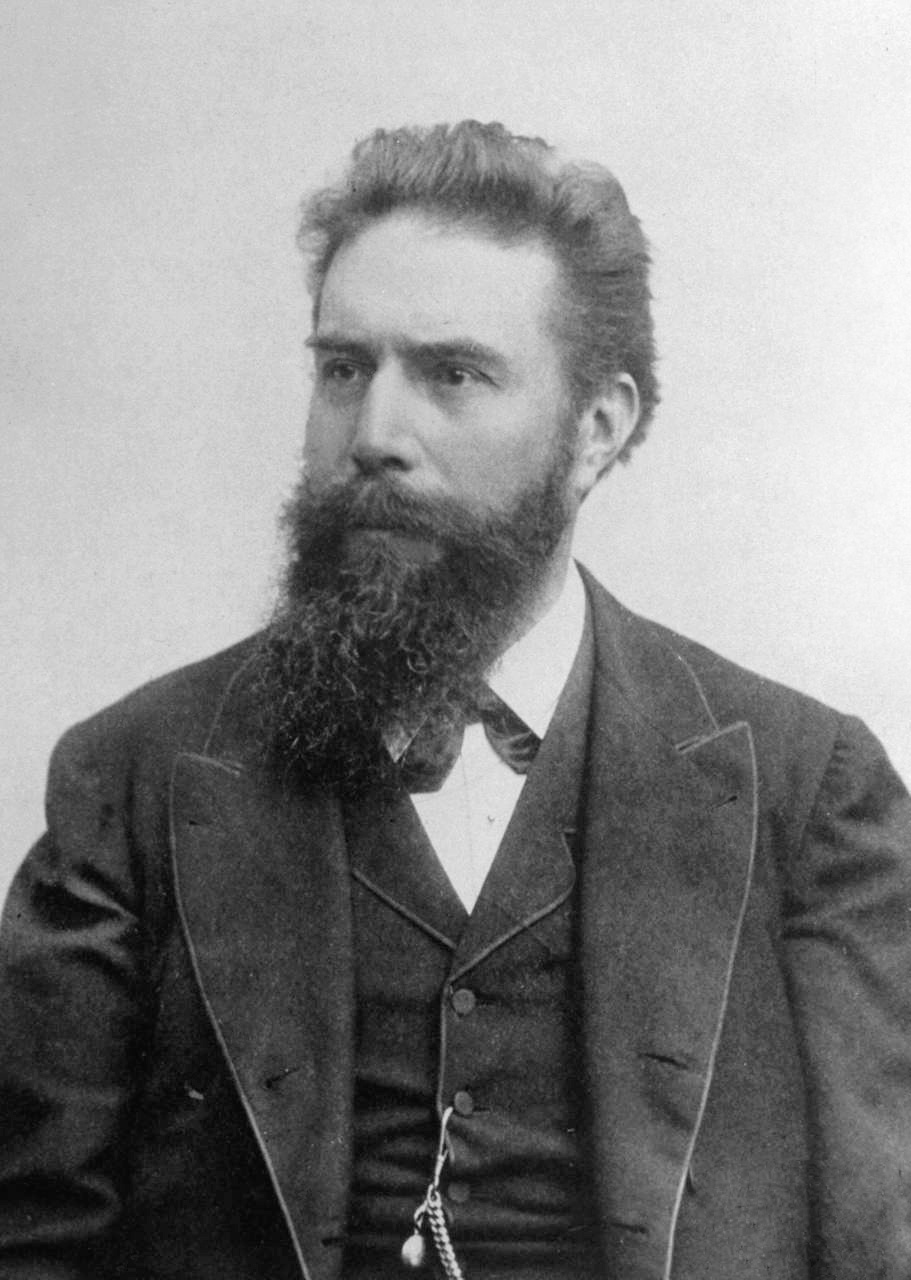
Wilhelm Conrad Röntgen: 6 idézet0 Kedvelés
Wilhelm Conrad Röntgen: Idézetek angolul
“We shall see what we shall see. We have the start now; the developments will follow in time.”
The New Marvel in Photography (1896)
The New Marvel in Photography (1896)
Kontextus: I was working with a Crookes tube covered by a shield of black cardboard. A piece of barium platino-cyanide paper lay on the bench there. I had been passing a current through the tube, and I noticed a peculiar black line across the paper. … The effect was one which could only be produced, in ordinary parlance, by the passage of light. No light could come from the tube, because the shield which covered it was impervious to any light known, even that of the electric arc. … I did not think; I investigated. I assumed that the effect must have come from the tube, since its character indicated that it could come from nowhere else. I tested it. In a few minutes there was no doubt about it. Rays were coming from the tube which had a luminescent effect upon the paper. I tried it successfully at greater and greater distances, even at two metres. It seemed at first a new kind of invisible light. It was clearly something new, something unrecorded.
“I did not think; I investigated.”
The New Marvel in Photography (1896)
Kontextus: I was working with a Crookes tube covered by a shield of black cardboard. A piece of barium platino-cyanide paper lay on the bench there. I had been passing a current through the tube, and I noticed a peculiar black line across the paper. … The effect was one which could only be produced, in ordinary parlance, by the passage of light. No light could come from the tube, because the shield which covered it was impervious to any light known, even that of the electric arc. … I did not think; I investigated. I assumed that the effect must have come from the tube, since its character indicated that it could come from nowhere else. I tested it. In a few minutes there was no doubt about it. Rays were coming from the tube which had a luminescent effect upon the paper. I tried it successfully at greater and greater distances, even at two metres. It seemed at first a new kind of invisible light. It was clearly something new, something unrecorded.
“I am pursuing my investigations, and as fast as my results are verified I shall make them public.”
The New Marvel in Photography (1896)
Kontextus: I am not a prophet, and I am opposed to prophesying. I am pursuing my investigations, and as fast as my results are verified I shall make them public.
The New Marvel in Photography (1896)
Kontextus: I was working with a Crookes tube covered by a shield of black cardboard. A piece of barium platino-cyanide paper lay on the bench there. I had been passing a current through the tube, and I noticed a peculiar black line across the paper. … The effect was one which could only be produced, in ordinary parlance, by the passage of light. No light could come from the tube, because the shield which covered it was impervious to any light known, even that of the electric arc. … I did not think; I investigated. I assumed that the effect must have come from the tube, since its character indicated that it could come from nowhere else. I tested it. In a few minutes there was no doubt about it. Rays were coming from the tube which had a luminescent effect upon the paper. I tried it successfully at greater and greater distances, even at two metres. It seemed at first a new kind of invisible light. It was clearly something new, something unrecorded.


