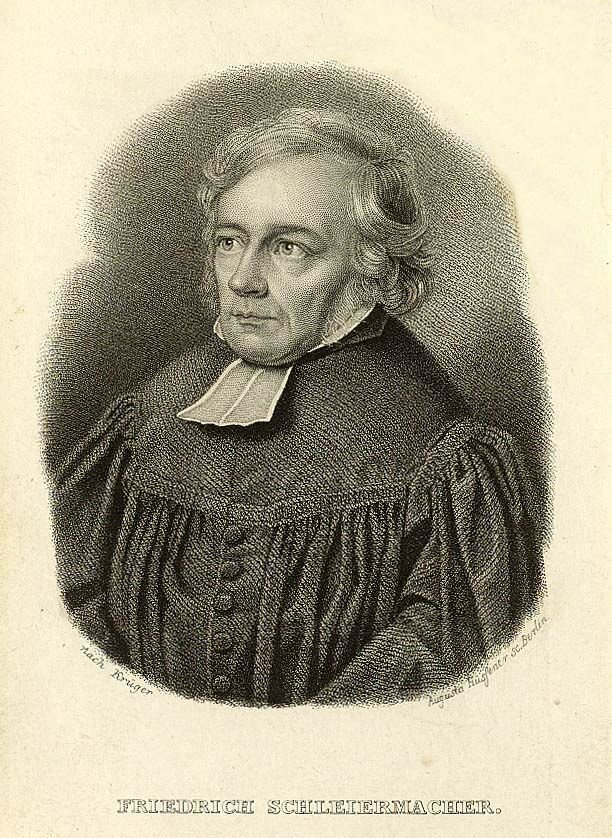
Friedrich Schleiermacher, A Critical Essay on the Gospel of St. Luke https://archive.org/details/gospelofstluke00schluoft, 1825, pp. 185–186
Friedrich Schleiermacher: 6 idézet0 Kedvelés
Friedrich Schleiermacher: Idézetek angolul
The Necessity of the New Birth, Selected sermons of Schleiermacher https://archive.org/details/selectedsermonso00schl, translated by Mary Wilson 1890, p. 89 <br class="br">Kontextus: Between the beginning of our existence and our present life and aims there lies a time in which lust was the prevailing power; in which it conceived and brought forth sin. If we are honest, we can say that there is a period on which we look back only with the feeling that we appear to ourselves to have become since then different men. That which was then our innermost I and Self has now become something far off and strange to us; and the law of divine appointment, which has now through the grace of God become the law of our life, which we love and obey, was then far off and strange. We were only aware of it as an external force, impeding the free course of our life, just as now the separate stirrings of the flesh and of sin are a force which we do not ascribe to our real life. Thus, then, it is true that one life has ceased and another has begun. But the beginning of the new life is the new birth; and this holds good universally, If any man be in Christ, he is a new creature; the old is passed away, behold all is become new.
Friedrich Schleiermacher, On The Social Element in Religion (1799), The German Classics of the Nineteenth and Twentieth Centuries, Volume 5 http://www.gutenberg.org/ebooks/12888 <br class="br">Kontextus: But the imparting of religion is not to be sought in books, like that of intellectual conceptions and scientific knowledge. The pure impression of the original product is too far destroyed in this medium, which, in the same way that dark-colored objects absorb the greatest proportion of the rays of light, swallows up everything belonging to the pious emotions of the heart, which cannot be embraced in the insufficient symbols from which it is intended again to proceed. Nay, in the written communications of religious feeling, everything needs a double and triple representation; for that which originally represented, must be represented in its turn; and yet the effect on the whole man, in its complete unity, can only be imperfectly set forth by continued and varied reflections. It is only when religion is driven out from the society of the living, that it must conceal its manifold life under the dead letter. Neither can this intercourse of heart with heart, on the deepest feelings of humanity, be carried on in common conversation.
[On Religion: Speeches to its Cultured Despisers, 1893, London, Paul, Trench, Trubner, 23, Second Speech: The Nature of Religion]
On Religion: Speeches to its Cultured Despisers (1799)
Jämmerlich ist freilich jene praktische Philosophie der Franzosen und Engländer, von denen man meint, sie wüßten so gut, was der Mensch sei, unerachtet sie nicht darüber spekulierten, was er sein solle.
Cited in Lucinde and the Fragments, P. Firchow, trans. (1991), "Athenaeum Fragments" (1798), § 355.
Friedrich Schleiermacher, Christ's Resurrection an Image of Our New Life The World's Great Sermons, Volume 3 http://www.gutenberg.org/ebooks/11713 by Grenville Kleiser


