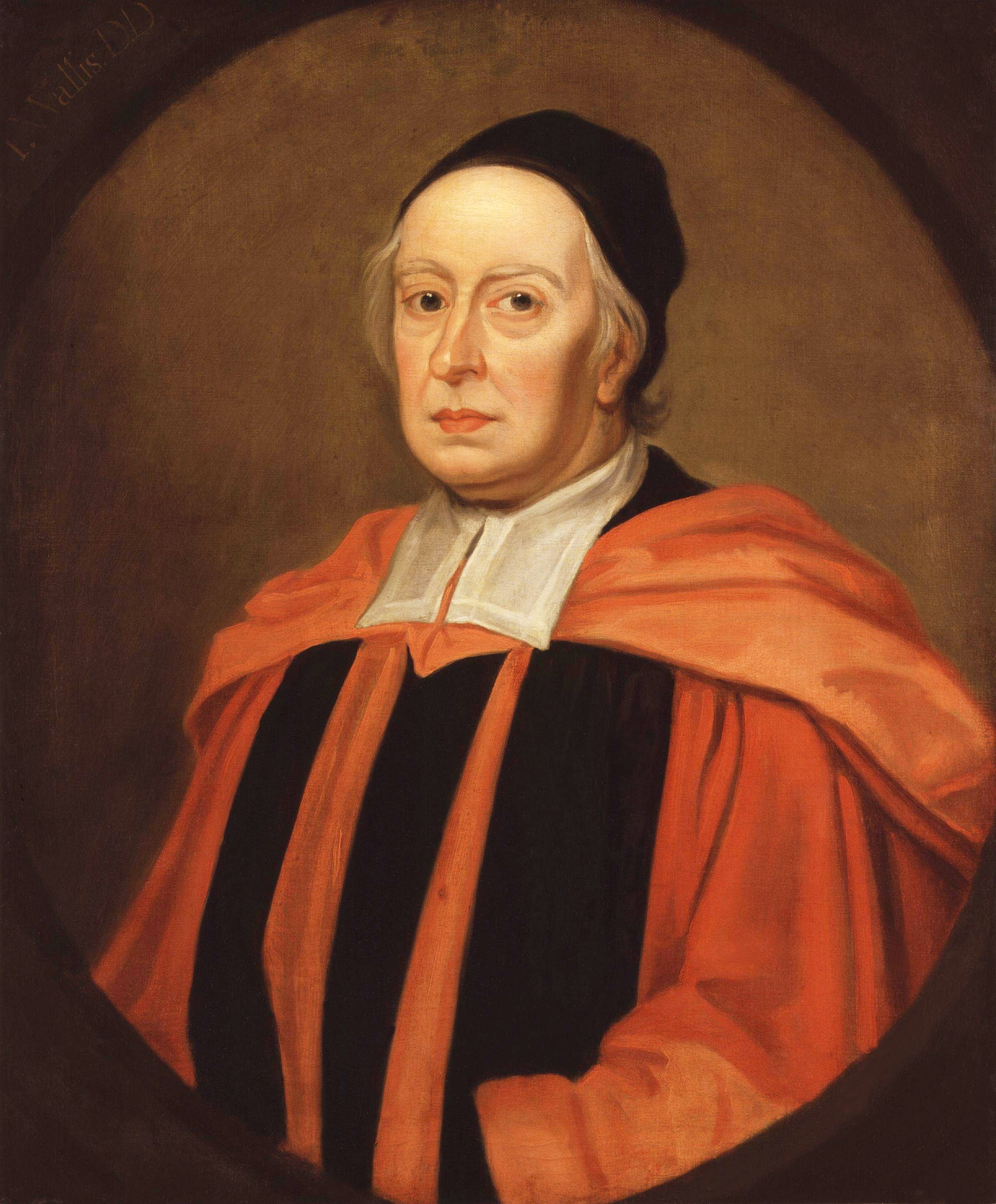
John Wallis citations
Page 2

John Wallis, né le 23 novembre 1616 à Ashford, et mort le 28 octobre 1703 à Oxford, est un mathématicien anglais. Ses travaux sont précurseurs de ceux de Newton. Il est également précurseur de la phonétique, de l'éducation des sourds et de l'orthophonie. Wikipedia  

✵ 23. novembre 1616 – 28. octobre 1703
John Wallis photo
John Wallis: 34   citations 0   J'aime

John Wallis: Citations en anglais

“Let as many Numbers, as you please, be proposed to be Combined: Suppose Five, which we will call a b c d e. Put, in so many Lines, Numbers, in duple proportion, beginning with 1. The Sum (31) is the Number of Sumptions, or Elections; wherein, one or more of them, may several ways be taken. Hence subduct (5) the Number of the Numbers proposed; because each of them may once be taken singly. And the Remainder (26) shews how many ways they may be taken in Combination; (namely, Two or more at once.) And, consequently, how many Products may be had by the Multiplication of any two or more of them so taken. But the same Sum (31) without such Subduction, shews how many Aliquot Parts there are in the greatest of those Products, (that is, in the Number made by the continual Multiplication of all the Numbers proposed,) a b c d e.”

For every one of those Sumptions, are Aliquot Parts of a b c d e, except the last, (which is the whole,) and instead thereof, 1 is also an Aliquot Part; which makes the number of Aliquot Parts, the same with the Number of Sumptions. Only here is to be understood, (which the Rule should have intimated;) that, all the Numbers proposed, are to be Prime Numbers, and each distinct from the other. For if any of them be Compound Numbers, or any Two of them be the same, the Rule for Aliquot Parts will not hold.
Source: A Discourse of Combinations, Alterations, and Aliquot Parts (1685), Ch.I Of the variety of Elections, or Choice, in taking or leaving One or more, out of a certain Number of things proposed.

“This method of mine takes its beginnings where Cavalieri ends his Method of indivisibles.”

...for as his was the Geometry of indivisibles, so I have chosen to call my method the Arithmetic of infinitesimals.
Arithmetica Infinitorum (1656)

Auteurs similaires

Francis Bacon photo
Francis Bacon 12
homme d’État et philosophe anglais
John Milton photo
John Milton 5
poète, essayiste et pamphlétaire anglais
William Shakespeare photo
William Shakespeare 34
dramaturge et comédien anglais
Blaise Pascal photo
Blaise Pascal 66
mathématicien, physicien, inventeur, écrivain et philosophe…
Samuel Johnson photo
Samuel Johnson 8
écrivain anglais, poète, essayiste, biographe, lexicographe
John Locke photo
John Locke 3
philosophe britannique
Thomas Paine photo
Thomas Paine 2
intellectuel, pamphlétaire, révolutionnaire anglais puis am…
Galileo Galilei photo
Galileo Galilei 2
physicien, philosophe et astronome italien
Molière photo
Molière 98
Jean-Baptiste Poquelin, dit Molière, auteur et homme de thé…
Christian Huygens photo
Christian Huygens 2
mathématicien et philosophe néerlandais