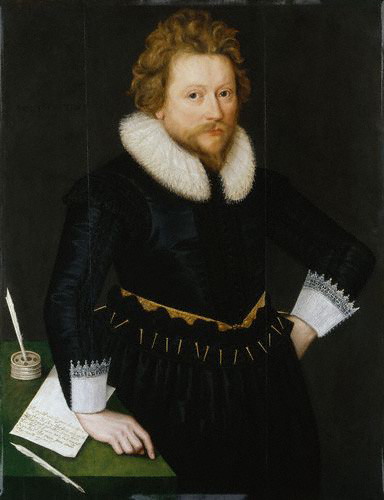
John Fletcher citations
Page 2

John Fletcher est un dramaturge anglais, fils de l'évêque de Londres Richard Fletcher.

✵ 1579 – 1625
John Fletcher photo
John Fletcher: 52 citations0 J'aime

John Fletcher: Citations en anglais

“Let's meet and either do or die.”

John Fletcher The Island Princess

The Island Princess (c. 1620; published 1647), Act II, scene 2. Compare: "Let us do or die", Robert Burns, Bannockburn; same in Thomas Campbell, Gertrude of Wyoming, part iii. stanza 37.

“Three merry boys, and three merry boys,
And three merry boys are we,
As ever did sing in a hempen string
Under the gallow-tree.”

John Fletcher

Act III, scene 2. Song.
Rollo, Duke of Normandy, or The Bloody Brother, (c. 1617; revised c. 1627–30; published 1639)
Variante: Three merry boys, and three merry boys,
And three merry boys are we,
As ever did sing in a hempen string
Under the gallow-tree.

“Death hath so many doors to let out life.”

John Fletcher The Custom of the Country

The Custom of the Country (with Philip Massinger; c. 1619–23; published 1647), Act II, scene 2
Compare: "I know death hath ten thousand several doors / For men to take their exits.", John Webster, Dutchess of Malfi (1623); act IV, scene ii

“And he that will to bed go sober
Falls with the leaf in October.”

John Fletcher

Act II, scene ii. The following well-known catch, or glee, is formed on this song: "He who goes to bed, and goes to bed sober, Falls as the leaves do, and dies in October; But he who goes to bed, and goes to bed mellow, Lives as he ought to do, and dies an honest fellow".
Rollo, Duke of Normandy, or The Bloody Brother, (c. 1617; revised c. 1627–30; published 1639)

“Of all the paths lead to a woman's love
Pity's the straightest.”

John Fletcher

The Knight of Malta (1647), Act I, sc. i.

“There's nothing that allays an angry mind
So soon as a sweet beauty.”

John Fletcher The Elder Brother

Act III, scene 5.
The Elder Brother (c. 1625; published 1637)

“As high as Heaven, as deep as Hell.”

John Fletcher The Honest Man's Fortune

Act IV, scene 1.
The Honest Man's Fortune, (1613; published 1647)

“What mare's nest hast thou found?”

John Fletcher

Act IV, scene 2.
The Tragedy of Bonduca (1611–14; published 1647)

“Whistle, and she'll come to you.”

John Fletcher Wit Without Money

Act IV, scene 4.
Wit Without Money (c. 1614; published 1639)

“All things that are
Made for our general uses are at war,—
Even we among ourselves.”

John Fletcher The Honest Man's Fortune

The Honest Man's Fortune, (1613; published 1647)

“Hide, oh, hide those hills of snow
Which thy frozen bosom bears,
On whose tops the pinks that grow
Are of those that April wears!
But first set my poor heart free,
Bound in those icy chains by thee.”

John Fletcher

Act IV, scene i. Compare: "Take, O, take those lips away, That so sweetly were forsworn; And those eyes, the break of day, Lights that do mislead the morn: But my kisses bring again, bring again; Seals of love, but sealed in vain, sealed in vain", William Shakespeare, Measure for Measure.
Rollo, Duke of Normandy, or The Bloody Brother, (c. 1617; revised c. 1627–30; published 1639)

“Lie lightly on my ashes, gentle earthe.”

John Fletcher

Act IV, scene 3. ("Sit tibi terra levis," familiar inscription).
The Tragedy of Bonduca (1611–14; published 1647)

“Oh, woman, perfect woman! what distraction
Was meant to mankind when thou wast made a devil!
What an inviting hell invented.”

John Fletcher

Comedy of Monsieur Thomas (c. 1610–16; published 1639), Act III, scene 1.

“Something given that way.”

John Fletcher

The Lover's Progress (licensed 6 December 1623; revised 1634; published 1647), Act I, scene 1.

“He 'as had a stinger.”

John Fletcher Wit Without Money

Act IV, scene 1.
Wit Without Money (c. 1614; published 1639)

“The foot in the grave.”

John Fletcher The Little French Lawyer

Act I, scene 1.
The Little French Lawyer (c. 1619–23; published 1647)

“I'll have a fling.”

John Fletcher Rule a Wife and Have a Wife

Rule a Wife and Have a Wife (licensed 19 October 1624; 1640), Act III, scene 5.

“Sing a song of sixpence.”

John Fletcher

Act V, scene 2.
The Tragedy of Bonduca (1611–14; published 1647)

“First come, first served.”

John Fletcher The Little French Lawyer

Act II, scene 1.
The Little French Lawyer (c. 1619–23; published 1647)

“Let the world slide.”

John Fletcher Wit Without Money

Act V, scene 2. Compare William Shakespeare, The Taming of the Shrew, introduction, scene 1, line 5. Also Scene 2, line 146. ("Slip" in folio).
Wit Without Money (c. 1614; published 1639)

“Vow me no vows.”

John Fletcher Wit Without Money

Act IV, scene 4.
Wit Without Money (c. 1614; published 1639)

Auteurs similaires

William Shakespeare photo
William Shakespeare34
dramaturge et comédien anglais None
John Milton photo
John Milton5
poète, essayiste et pamphlétaire anglais None
Francis Bacon photo
Francis Bacon12
homme d’État et philosophe anglais None
Jean de La Fontaine photo
Jean de La Fontaine55
poète, fabuliste, conteur et auteur dramatique français None
Molière photo
Molière98
Jean-Baptiste Poquelin, dit Molière, auteur et homme de thé… None
Samuel Johnson photo
Samuel Johnson8
écrivain anglais, poète, essayiste, biographe, lexicographe None
John Locke photo
John Locke3
philosophe britannique None
Thomas Paine photo
Thomas Paine2
intellectuel, pamphlétaire, révolutionnaire anglais puis am… None
Pierre-Augustin Caron de Beaumarchais photo
Pierre-Augustin Caron de Beaumarchais20
écrivain, musicien, homme d'affaires et poète français None
Adam Smith photo
Adam Smith22
philosophe et économiste écossais (1723-1790) None