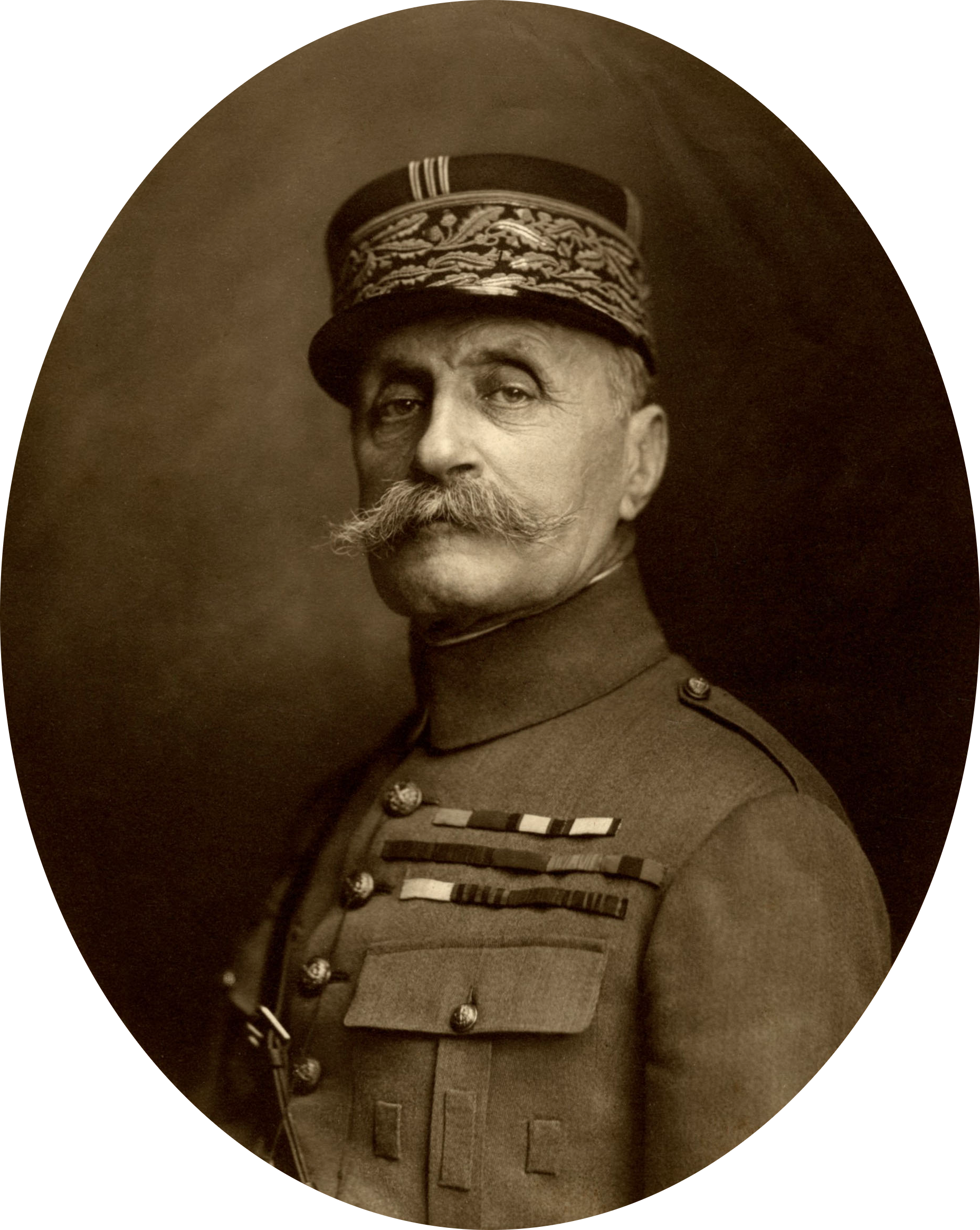
Ferdinand Foch Citations
Ferdinand Foch: Citations en anglais
Source: Precepts and Judgments (1919), p. 147
“My centre is giving way, my right is retreating, situation excellent, I am attacking.”
Mon centre cède, ma droite recule, situation excellente, j'attaque.
Message to Marshal Joseph Joffre during the First Battle of the Marne (8 September 1914), as quoted in Foch : Le Vainqueur de la Guerre (1919) by Raymond Recouly, Ch. 6
“The most powerful weapon on earth is the human soul on fire.”
As quoted in The 32d Infantry Division in World War II (1956) by Harold Whittle Blakeley, p. 3
direction and vigour
Source: Precepts and Judgments (1919), p. 138
“Everything in war is linked together, is mutually interdependent, mutually interpenetrating.”
Source: Precepts and Judgments (1919), p. 214
Contexte: The military art is not an accomplishment, an art for dilettante, a sport. You do not make war without reason, without an object, as you would give yourself up to music, painting, hunting, lawn tennis, where there is no great harm done whether you stop altogether or go on, whether you do little or much. Everything in war is linked together, is mutually interdependent, mutually interpenetrating. When you are at war you have no power to act at random. Each operation has a raison d'etre, that is an object; that object, once determined, fixes the nature and the value of the means to be resorted to as well as the use which ought to be made of the forces.
Source: Precepts and Judgments (1919), p. 211
Contexte: A war not only arises, but derives its nature, from the political ideas, the moral sentiments, and the international relations obtaining at the moment when it breaks out.
This amounts to saying : try and know why and with the help of what you are going to act; then you will find out how to act.
“The laurels of victory are at the point of the enemy bayonets.”
Source: Precepts and Judgments (1919), p. 105
Contexte: The laurels of victory are at the point of the enemy bayonets. They must be plucked there; they must be carried by a hand-to-hand fight if one really means to conquer.
“The military art is not an accomplishment, an art for dilettante, a sport.”
Source: Precepts and Judgments (1919), p. 214
Contexte: The military art is not an accomplishment, an art for dilettante, a sport. You do not make war without reason, without an object, as you would give yourself up to music, painting, hunting, lawn tennis, where there is no great harm done whether you stop altogether or go on, whether you do little or much. Everything in war is linked together, is mutually interdependent, mutually interpenetrating. When you are at war you have no power to act at random. Each operation has a raison d'etre, that is an object; that object, once determined, fixes the nature and the value of the means to be resorted to as well as the use which ought to be made of the forces.
Source: Precepts and Judgments (1919), p.
Contexte: To be disciplined does not mean being silent, abstaining, or doing only what one thinks one may undertake without risk; it is not the art of eluding responsibility; it means acting in compliance with orders received, and therefore finding in one's own mind, by effort and reflection, the possibility to carry out such orders. It also means finding in one's own will the energy to face the risks involved in execution.
“The first obstacle is the enemy gun. It will be the first objective assigned to artillery masses.”
Source: Precepts and Judgments (1919), p. 108
Contexte: Against what should fire be opened? Against the obstacles which may delay the march of infantry.
The first obstacle is the enemy gun. It will be the first objective assigned to artillery masses.
“The will to conquer is the first condition of victory.”
The Book of Positive Quotations (2007) by John Cook, Steve Deger, and Leslie Ann Gibson, p. 370
Victory is a thing of the will.
perhaps a different and better translation of the same remark) quoted by Barbara Tuchman in The Guns of August (Random House, 1962
“One does simply what one can in order to apply what one knows.”
The Principles of War (1913)
“A radish will never stand in the way of victory.”
As quoted in M*A*S*H, Season 3, Episode 1, "The General Flipped At Dawn"; this seems to be a jocular fabrication.
Misattributed
“Airplanes are interesting toys, but of no military value.”
Les avions sont des jouets intéressants mais n'ont aucune utilité militaire
Said in 1911 as quoted Time : A Traveler's Guide (1998) by Clifford A. Pickover, p. 249
To Alvin C. York, on his extraordinary capture of over a hundred enemy troops behind enemy lines, as quoted in the Preface of Sergeant York And His People (1922) http://www.gutenberg.org/ebooks/19117 by Sam K. Cowan
“This is not a peace. It is an armistice for 20 years.”
Said after the Treaty of Versailles, as quoted in Memoires (1963) by Paul Reynaud, vol. 2, p. 457
“The unknown is the governing condition of war.”
Source: Precepts and Judgments (1919), p. 209
Source: Precepts and Judgments (1919), p. 83
“Every manoeuvre must be the development of a scheme; it must aim at a goal.”
Source: Precepts and Judgments (1919), p. 175
“None but a coward dares to boast that he has never known fear.”
As quoted in Encarta Book of Quotations (2000) by Bill Swainson and Anne H. Soukhanov, p. 338
“I am conscious of having served England as I served my own country.”
As engraved on the statue of Ferdinand Foch on Grosvenor Square, London.
Source: Precepts and Judgments (1919), p. 154
Source: Precepts and Judgments (1919), p. 175
Source: Precepts and Judgments (1919), p. 110
Source: Precepts and Judgments (1919), p. 209
Source: Precepts and Judgments (1919), p. 152
Variant translation: In our time, which thinks it can do without ideals, that it can reject what it calls abstractions, and nourish itself on realism, rationalism and positivism; which thinks it can reduce all questions to matters of science or to the employing of more or less ingenious expedients; at such a time, I say, there is but one resource if you are to avoid disaster, and only one which will make you certain of what course to hold upon a given day. It is the worship — to the exclusion of all others — of two Ideas in the field of morals: duty and discipline. And that worship further needs, if it is to bear fruit and produce results, knowledge and reason.
As quoted in "A Sketch of the Military Career of Marshal Foch" by Major A. Grasset
Source: Precepts and Judgments (1919), p. 150
Source: Precepts and Judgments (1919), p. 140
“In tactics, action is the governing rule of war.”
Source: Precepts and Judgments (1919), p. 79
Source: Precepts and Judgments (1919), p. 199


