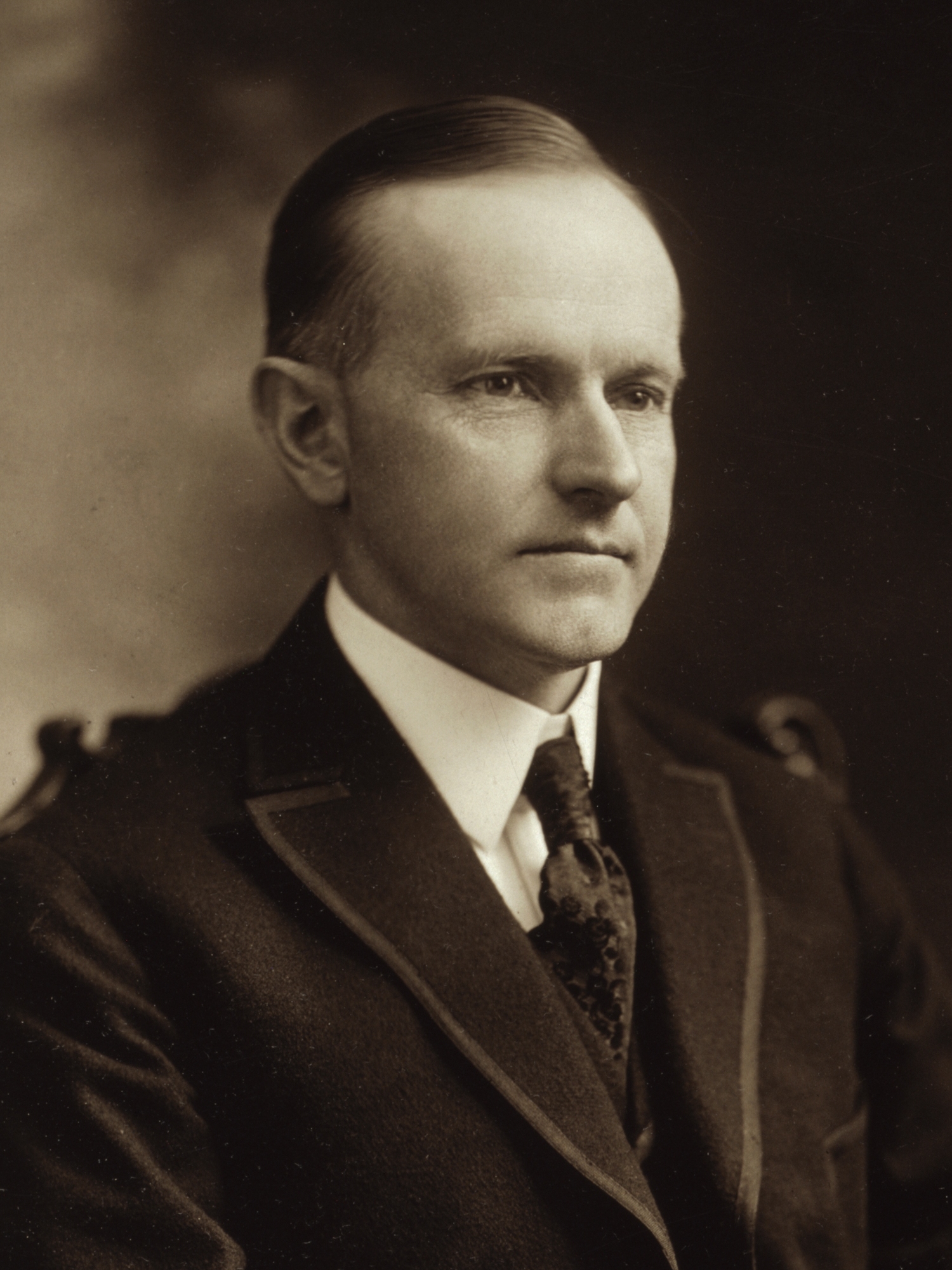
Calvin Coolidge citations
Page 9

John Calvin Coolidge, Jr., né le 4 juillet 1872 à Plymouth et mort le 5 janvier 1933 à Northampton , est un homme d'État américain, 30e président des États-Unis en fonction du 2 août 1923 au 4 mars 1929.

Originaire du nord-est des États-Unis, Coolidge gravit les échelons de la politique dans le Massachusetts, dont il devient finalement le gouverneur républicain. Ses actions durant la grève de la police de Boston en 1919 le propulsent sur la scène nationale. Il est par la suite élu vice-président en 1920, puis il accède à la présidence après la mort soudaine de Warren G. Harding en 1923. Il est réélu en 1924 et gagne une réputation d'homme austère et taciturne.

Coolidge restaure la confiance du public envers la Maison-Blanche après les nombreux scandales de l'administration de son prédécesseur et il quitte ses fonctions avec une popularité importante. Un de ses biographes écrit qu'« il incarnait l'esprit et les espoirs de la classe moyenne, pouvait interpréter leurs attentes et exprimer leurs opinions ». Coolidge est par la suite critiqué [Par qui ?]pour sa politique de laissez-faire qui aurait été une des causes de la Grande Dépression. Son héritage est réévalué sous l'administration de Ronald Reagan, mais les appréciations finales sur son mandat restent partagées entre ceux qui approuvent sa réduction des programmes fédéraux et ceux qui considèrent que l'État devrait être plus impliqué dans le contrôle et la réglementation de l'économie. Wikipedia  

✵ 4. juillet 1872 – 5. janvier 1933
Calvin Coolidge photo
Calvin Coolidge: 412   citations 0   J'aime

Calvin Coolidge: Citations en anglais

“It is characteristic of the unlearned that they are forever proposing something which is old, and because it has recently come to their own attention, supposing it to be new.”

From 'Address at Holy Cross' (25 June 1919), published in Have Faith In Massachusetts: A Collection of Speeches and Messages (2nd Ed.) http://www.archive.org/details/havefaithinmassa00cooluoft, Coolidge, Houghton Mifflin, p. 231.
1910s, Address at Holy Cross (1919)

“We have acted in the name of world peace and of humanity. Always the obstacles to be encountered have been distrust, suspicion and hatred. The great effort has been to allay and remove these sentiments. I believe that America can assist the world in this direction by her example. We have never forgotten the service done us by Lafayette, but we have long ago ceased to bear an enmity toward Great Britain by reason of two wars that were fought out between us. We want Europe to compose its difficulties and liquidate its hatreds. Would it not be well if we set the example and liquidated some of our own? The war is over. The militarism of Central Europe which menaced the security of the world has been overthrown. In its place have sprung up peaceful republics. Already we have assisted in refinancing Austria. We are about to assist refinancing Germany. We believe that such action will be helpful to France, but we can give further and perhaps even more valuable assistance both to ourselves and to Europe by bringing to an end our own hatreds. The best way for us who wish all our inhabitants to be single-minded in their Americanism is for us to bestow upon each group of our inhabitants that confidence and fellowship which is due to all Americans. If we want to get the hyphen out of our country, we can best begin by taking it out of our own minds. If we want France paid, we can best work towards that end by assisting in the restoration of the German people, now shorn of militarism, to their full place in the family of peaceful mankind.”

1920s, Ordered Liberty and World Peace (1924)

“Nothing in the world can take the place of persistence. Talent will not; nothing is more common than unsuccessful men with talent. Genius will not; unrewarded genius is almost a proverb. Education will not; the world is full of educated derelicts. Persistence and determination alone are omnipotent. The slogan "press on" has solved and always will solve the problems of the human race.”

Quote from a program at a Coolidge memorial service (1933); cited in The Oxford Dictionary of Quotations (1999). The passage did not originate with Coolidge, but evolved over several decades, appearing as early as 1881 in a youth guidance book. From [Garson O’Toole, https://quoteinvestigator.com/2016/01/12/persist/, Purpose and Persistence Are Required for Success: Unrewarded Genius Is Almost a Proverb, Quote Investigator, January 12, 2016]
1930s

“You lose.”

In response to a dinner companion who had bet that she could persuade Coolidge to talk to her (in later versions, to say at least three words to her)
According to Quote Investigator http://quoteinvestigator.com/2016/01/10/few-words, this story originated in a speech made at an Associated Press luncheon in 1924. Coolidge responded to the speech by declaring that the story was "without any foundation".
Disputed

“There is far more danger of harm than there is hope of good in any radical changes.”

Source: 1920s, Speech on the Anniversary of the Declaration of Independence (1926)

“To live under the American Constitution is the greatest political privilege that was ever accorded to the human race.”

Message to the National Security League in honor of Constitution Day, quoted in New York Times (17 September 1923) "Ceremonies Mark Constitution Day".
1920s

Auteurs similaires

Khalil Gibran photo
Khalil Gibran 13
poète et peintre libanais
Erich Maria Remarque photo
Erich Maria Remarque 6
écrivain allemand
Mustafa Kemal Atatürk photo
Mustafa Kemal Atatürk 17
fondateur et le premier président de la République turque
Charles de Gaulle photo
Charles de Gaulle 21
militaire français et 1er président de la cinquième Républi…
Nelson Mandela photo
Nelson Mandela 12
ancien Président d'Afrique du Sud
Winston Churchill photo
Winston Churchill 23
homme d'État britannique
Fidel Castro photo
Fidel Castro 5
Premier secrétaire du Parti communiste de Cuba
Imre Kertész photo
Imre Kertész 68
écrivain hongrois
George Carlin photo
George Carlin 35
humoriste américain
Vladimir Poutine photo
Vladimir Poutine 13
personnalité politique russe