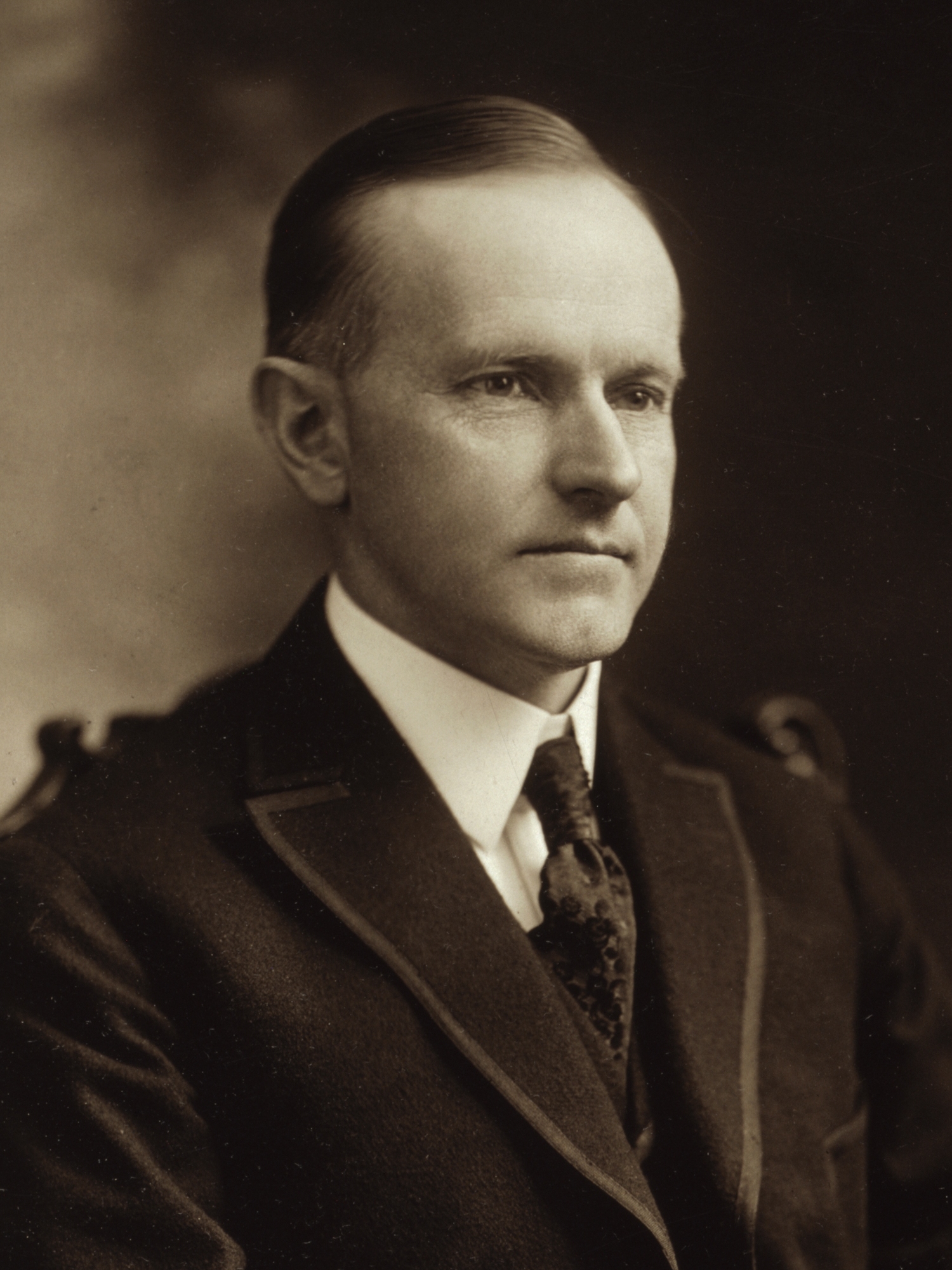
Calvin Coolidge citations
Page 10

John Calvin Coolidge, Jr., né le 4 juillet 1872 à Plymouth et mort le 5 janvier 1933 à Northampton , est un homme d'État américain, 30e président des États-Unis en fonction du 2 août 1923 au 4 mars 1929.

Originaire du nord-est des États-Unis, Coolidge gravit les échelons de la politique dans le Massachusetts, dont il devient finalement le gouverneur républicain. Ses actions durant la grève de la police de Boston en 1919 le propulsent sur la scène nationale. Il est par la suite élu vice-président en 1920, puis il accède à la présidence après la mort soudaine de Warren G. Harding en 1923. Il est réélu en 1924 et gagne une réputation d'homme austère et taciturne.

Coolidge restaure la confiance du public envers la Maison-Blanche après les nombreux scandales de l'administration de son prédécesseur et il quitte ses fonctions avec une popularité importante. Un de ses biographes écrit qu'« il incarnait l'esprit et les espoirs de la classe moyenne, pouvait interpréter leurs attentes et exprimer leurs opinions ». Coolidge est par la suite critiqué [Par qui ?]pour sa politique de laissez-faire qui aurait été une des causes de la Grande Dépression. Son héritage est réévalué sous l'administration de Ronald Reagan, mais les appréciations finales sur son mandat restent partagées entre ceux qui approuvent sa réduction des programmes fédéraux et ceux qui considèrent que l'État devrait être plus impliqué dans le contrôle et la réglementation de l'économie. Wikipedia  

✵ 4. juillet 1872 – 5. janvier 1933
Calvin Coolidge photo
Calvin Coolidge: 412   citations 0   J'aime

Calvin Coolidge: Citations en anglais

“Excellent poetry, but not a good working philosophy. Goldsmith would have been right, if, in fact, the accumulation of wealth meant the decay of men. It is rare indeed that the men who are accumulating wealth decay. It is only when they cease production, when accumulation stops, that an irreparable decay begins. Wealth is the product of industry, ambition, character and untiring effort. In all experience, the accumulation of wealth means the multiplication of schools, the increase of knowledge, the dissemination of intelligence, the encouragement of science, the broadening of outlook, the expansion of liberties, the widening of culture. Of course, the accumulation of wealth cannot be justified as the chief end of existence. But we are compelled to recognize it as a means to well-nigh every desirable achievement. So long as wealth is made the means and not the end, we need not greatly fear it. And there never was a time when wealth was so generally regarded as a means, or so little regarded as an end, as today. Just a little time ago we read in your newspapers that two leaders of American business, whose efforts at accumulation had been most astonishingly successful, had given fifty or sixty million dollars as endowments to educational works. That was real news. It was characteristic of our American experience with men of large resources. They use their power to serve, not themselves and their own families, but the public. I feel sure that the coming generations, which will benefit by those endowments, will not be easily convinced that they have suffered greatly because of these particular accumulations of wealth.”

1920s, The Press Under a Free Government (1925)

“That these ideas were prevalent in Virginia is further revealed by the Declaration of Rights, which was prepared by George Mason and presented to the general assembly on May 27, 1776. This document asserted popular sovereignty and inherent natural rights, but confined the doctrine of equality to the assertion that "All men are created equally free and independent." It can scarcely be imagined that Jefferson was unacquainted with what had been done in his own Commonwealth of Virginia when he took up the task of drafting the Declaration of Independence. But these thoughts can very largely be traced back to what John Wise was writing in 1710. He said, "Every man must be acknowledged equal to every man." Again, "The end of all good government is to cultivate humanity and promote the happiness of all and the good of every man in all his rights, his life, liberty, estate, honor, and so forth…". And again, "For as they have a power every man in his natural state, so upon combination they can and do bequeath this power to others and settle it according as their united discretion shall determine." And still again, "Democracy is Christ's government in church and state."”

Here was the doctrine of equality, popular sovereignty, and the substance of the theory of inalienable rights clearly asserted by Wise at the opening of the eighteenth century, just as we have the principle of the consent of the governed stated by Hooker as early as 1638.
1920s, Speech on the Anniversary of the Declaration of Independence (1926)

“Coolidge: Sins.
Mrs. Coolidge: Well, what did he say about it?
Coolidge: He was against it.”

when asked by his wife what a preacher's sermon had been about
John H. McKee, Coolidge: Wit and Wisdom, 1933
Author Nigel Rees claims this is apocryphal:
The taciturn President became famous for monosyllabic replies. A story from the twenties has Mrs. Coolidge asking him the subject of a sermon he had heard. "Sin," he answered. When prompted to elaborate on the clergyman's theme, Coolidge is said to have replied: "He was against it." Coolidge remarked that this story would have been funnier if it had been true.
Nigel Rees, Sayings of the Century, page 67.
Misattributed

“But we have an opportunity before us to reassert our desire and to lend the force of our example for the peaceful adjudication of differences between nations. Such action would be in entire harmony with the policy which we have long advocated. I do not look upon it as a certain guaranty against war, but it would be a method of disposing of troublesome questions, an accumulation of which leads to irritating conditions and results in mutually hostile sentiments. More than a year ago President Harding proposed that the Senate should authorize our adherence to the protocol of the Permanent Court of International Justice, with certain conditions. His suggestion has already had my approval. On that I stand. I should not oppose other reservations, but any material changes which would not probably receive the consent of the many other nations would be impracticable. We can not take a step in advance of this kind without assuming certain obligations. Here again if we receive anything we must surrender something. We may as well face the question candidly, and if we are willing to assume these new duties in exchange for the benefits which would accrue to us, let us say so. If we are not willing, let us say that. We can accomplish nothing by taking a doubtful or ambiguous position. We are not going to be able to avoid meeting the world and bearing our part of the burdens of the world. We must meet those burdens and overcome them or they will meet us and overcome us. For my part I desire my country to meet them without evasion and without fear in an upright, downright, square, American way.”

1920s, Freedom and its Obligations (1924)

Auteurs similaires

Khalil Gibran photo
Khalil Gibran 13
poète et peintre libanais
Erich Maria Remarque photo
Erich Maria Remarque 6
écrivain allemand
Mustafa Kemal Atatürk photo
Mustafa Kemal Atatürk 17
fondateur et le premier président de la République turque
Charles de Gaulle photo
Charles de Gaulle 21
militaire français et 1er président de la cinquième Républi…
Nelson Mandela photo
Nelson Mandela 12
ancien Président d'Afrique du Sud
Winston Churchill photo
Winston Churchill 23
homme d'État britannique
Fidel Castro photo
Fidel Castro 5
Premier secrétaire du Parti communiste de Cuba
Imre Kertész photo
Imre Kertész 68
écrivain hongrois
George Carlin photo
George Carlin 35
humoriste américain
Vladimir Poutine photo
Vladimir Poutine 13
personnalité politique russe