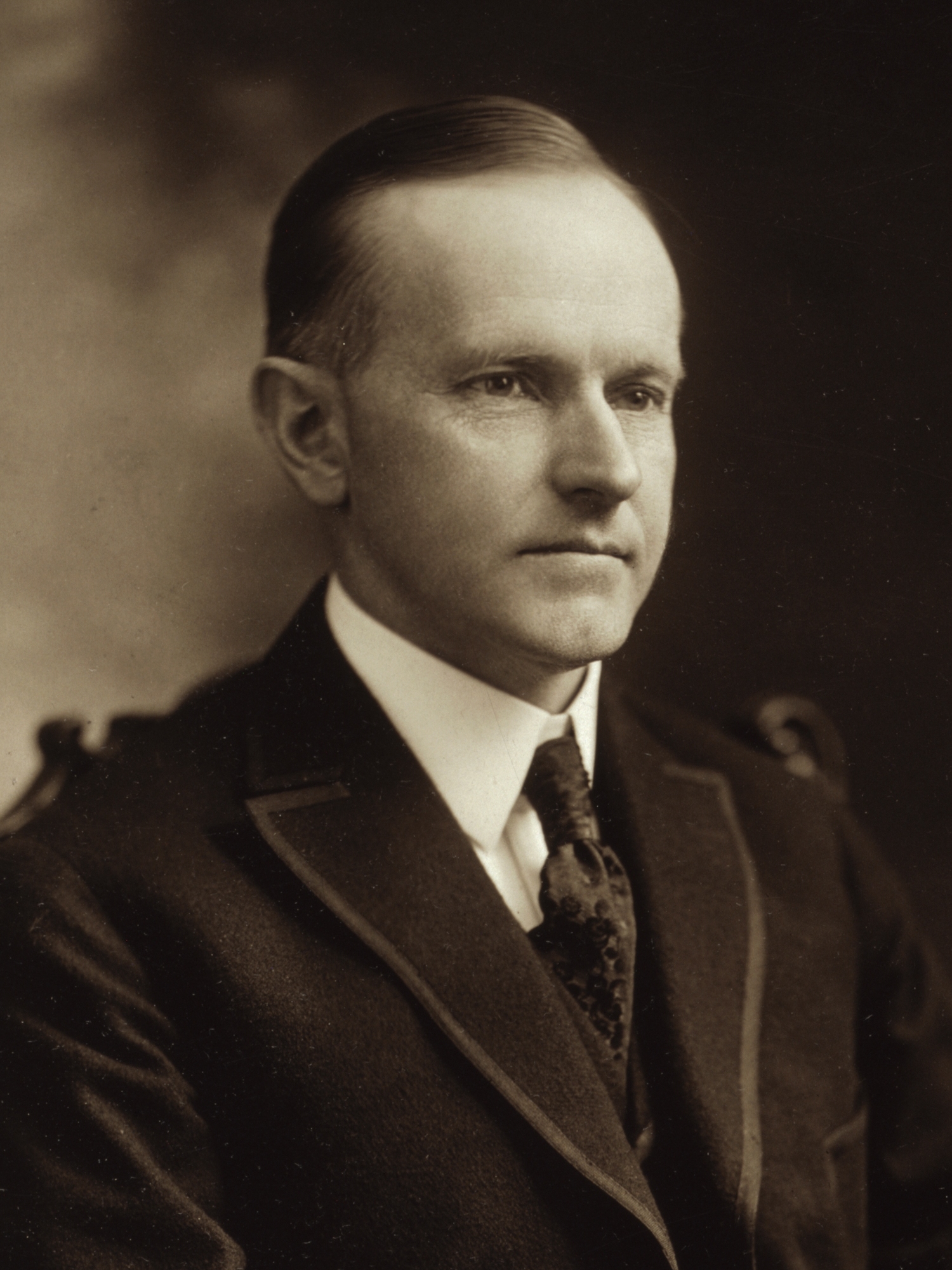
Calvin Coolidge citations
Page 8

John Calvin Coolidge, Jr., né le 4 juillet 1872 à Plymouth et mort le 5 janvier 1933 à Northampton , est un homme d'État américain, 30e président des États-Unis en fonction du 2 août 1923 au 4 mars 1929.

Originaire du nord-est des États-Unis, Coolidge gravit les échelons de la politique dans le Massachusetts, dont il devient finalement le gouverneur républicain. Ses actions durant la grève de la police de Boston en 1919 le propulsent sur la scène nationale. Il est par la suite élu vice-président en 1920, puis il accède à la présidence après la mort soudaine de Warren G. Harding en 1923. Il est réélu en 1924 et gagne une réputation d'homme austère et taciturne.

Coolidge restaure la confiance du public envers la Maison-Blanche après les nombreux scandales de l'administration de son prédécesseur et il quitte ses fonctions avec une popularité importante. Un de ses biographes écrit qu'« il incarnait l'esprit et les espoirs de la classe moyenne, pouvait interpréter leurs attentes et exprimer leurs opinions ». Coolidge est par la suite critiqué [Par qui ?]pour sa politique de laissez-faire qui aurait été une des causes de la Grande Dépression. Son héritage est réévalué sous l'administration de Ronald Reagan, mais les appréciations finales sur son mandat restent partagées entre ceux qui approuvent sa réduction des programmes fédéraux et ceux qui considèrent que l'État devrait être plus impliqué dans le contrôle et la réglementation de l'économie. Wikipedia  

✵ 4. juillet 1872 – 5. janvier 1933
Calvin Coolidge photo
Calvin Coolidge: 412   citations 0   J'aime

Calvin Coolidge: Citations en anglais

“When we look over the rest of the world, in spite of all its devastation there is encouragement to believe it is on a firmer moral foundation than it was in 1914. Much of the old despotism has been swept away, While some of it comes creeping back disguised under new names, no one can doubt that the general admission of the right of the people to self-government has made tremendous progress in nearly every quarter of the globe. In spite of the staggering losses and the grievous burden of taxation, there is a new note of hope for the individual to be more secure in his rights, which is unmistakably clearer than ever before. With all the troubles that beset the Old World, the former cloud of fear is evidently not now so appalling. It is impossible to believe that any nation now feels that it could better itself by war, and it is apparent to me that there has been a very distinct advance in the policy of peaceful and honorable adjustment of international differences. War has become less probable; peace has become more secure. The price which has been paid to bring about this new condition is utterly beyond comprehension. We can not see why it should not have come in orderly and peaceful methods without the attendant shock of fire and sword and carnage. We only know that it is here. We believe that on the ruins of the old order a better civilization is being constructed.”

1920s, Toleration and Liberalism (1925)

“It has been in accordance with these principles that we have made generous settlements of our foreign debts. The little sentiment of "live and let live" expresses a great truth. It has been thought wise to extend the payment of our debts over a long period of years, with a very low rate of interest, in order to relieve foreign peoples of the burden of economic pressure beyond their capacity to bear. An adjustment has now been made of all these major obligations, and they have all but one been mutually ratified. The moral principle of the payment of international debts has been preserved. Every dollar that we have advanced to these countries they have promised to repay with some interest. Our National Treasury is not in the banking business. We did not make these loans as a banking enterprise. We made them to a very large extent as an incident to the prosecution of the war. We have not sought to adjust them on a purely banking basis. We have taken into consideration all the circumstances and the elements that attended the original transaction and all the results that will probably flow from their settlement. They have been liquidated on this broad moral and humanitarian basis. We believe that the adjustments which have been made will be mutually beneficial to the trade relations of the countries involved and that out of these economic benefits there will be derived additional guaranties to the stability and peace of the world.”

1920s, Ways to Peace (1926)

“Well, they’re going to elect that Stupid Hoover, and he’s going to have some trouble. He’s going to have to spend money, but it won’t be enough. Then the Democrats will come in. But they don’t know anything about money.”

To Secret Service agent Edmund Starling, as quoted in The Forgotten Depression: 1921: The Crash That Cured Itself https://books.google.com/books?id=1PdtAwAAQBAJ&printsec=frontcover&dq=%22+Well,+they%E2%80%99re+going+to+elect+that+Superman+Hoover,+and+he%E2%80%99s+going+to+have+some+trouble.+He%E2%80%99s+going+to+have+to+spend+money,+but+it+won%E2%80%99t+be+enough.+Then+the+Democrats+will+come+in.+But+they+don%E2%80%99t+know+anything+about+money.%22&hl=en&sa=X&ved=0ahUKEwiz78rvs-3MAhVG8j4KHYm9AxAQ6AEIKjAC#v=onepage&q=%22know%20anything%20about%20money%22&f=false (2014), by James Grant

“I feel I no longer fit in with these times.”

To a friend, shortly before Coolidge's death, as quoted in Coolidge: An American Enigma (1998), by Robert Sobel, Regnery Publishing, p. 410.
1930s

“The thirteen Colonies were not unaware of the difficulties which these problems presented. We shall find a great deal of wisdom in the method by which they dealt with them. When they were finally separated from Great Britain, the allegiance of their citizens was not to the Nation, for there was none. It was to the States. For the conduct of the war there had been a voluntary confederacy loosely constructed and practically impotent. Continuing after peace was made, when the common peril which had been its chief motive no longer existed, it grew weaker and weaker. Each of the States could have insisted on an entirely separate and independent existence, having full authority over both their internal and external affairs, sovereign in every way. But such sovereignty would have been a vain and empty thing. It would have been unsupported by adequate resources either of property or population, without a real national spirit; ready to fall prey to foreign intrigue or foreign conquest. That kind of sovereignty meant but little. It had no substance in it. The people and their leaders naturally sought for a larger, more inspiring ideal. They realized that while to be a citizen of a State meant something, it meant a great deal more if that State were a part of a national union. The establishment of a Federal Constitution giving power and authority to create a real National Government did not in the end mean a detriment, but rather an increment to the sovereignty of the several States. Under the Constitution there was brought into being a new relationship, which did not detract from but added to the power and the position of each State. It is true that they surrendered the privilege of performing certain acts for themselves, like the regulation of commerce and the maintenance of foreign relations, but in becoming a part of the Union they received more than they gave.”

1920s, Freedom and its Obligations (1924)

Auteurs similaires

Khalil Gibran photo
Khalil Gibran 13
poète et peintre libanais
Erich Maria Remarque photo
Erich Maria Remarque 6
écrivain allemand
Mustafa Kemal Atatürk photo
Mustafa Kemal Atatürk 17
fondateur et le premier président de la République turque
Charles de Gaulle photo
Charles de Gaulle 21
militaire français et 1er président de la cinquième Républi…
Nelson Mandela photo
Nelson Mandela 12
ancien Président d'Afrique du Sud
Winston Churchill photo
Winston Churchill 23
homme d'État britannique
Fidel Castro photo
Fidel Castro 5
Premier secrétaire du Parti communiste de Cuba
Imre Kertész photo
Imre Kertész 68
écrivain hongrois
George Carlin photo
George Carlin 35
humoriste américain
Vladimir Poutine photo
Vladimir Poutine 13
personnalité politique russe