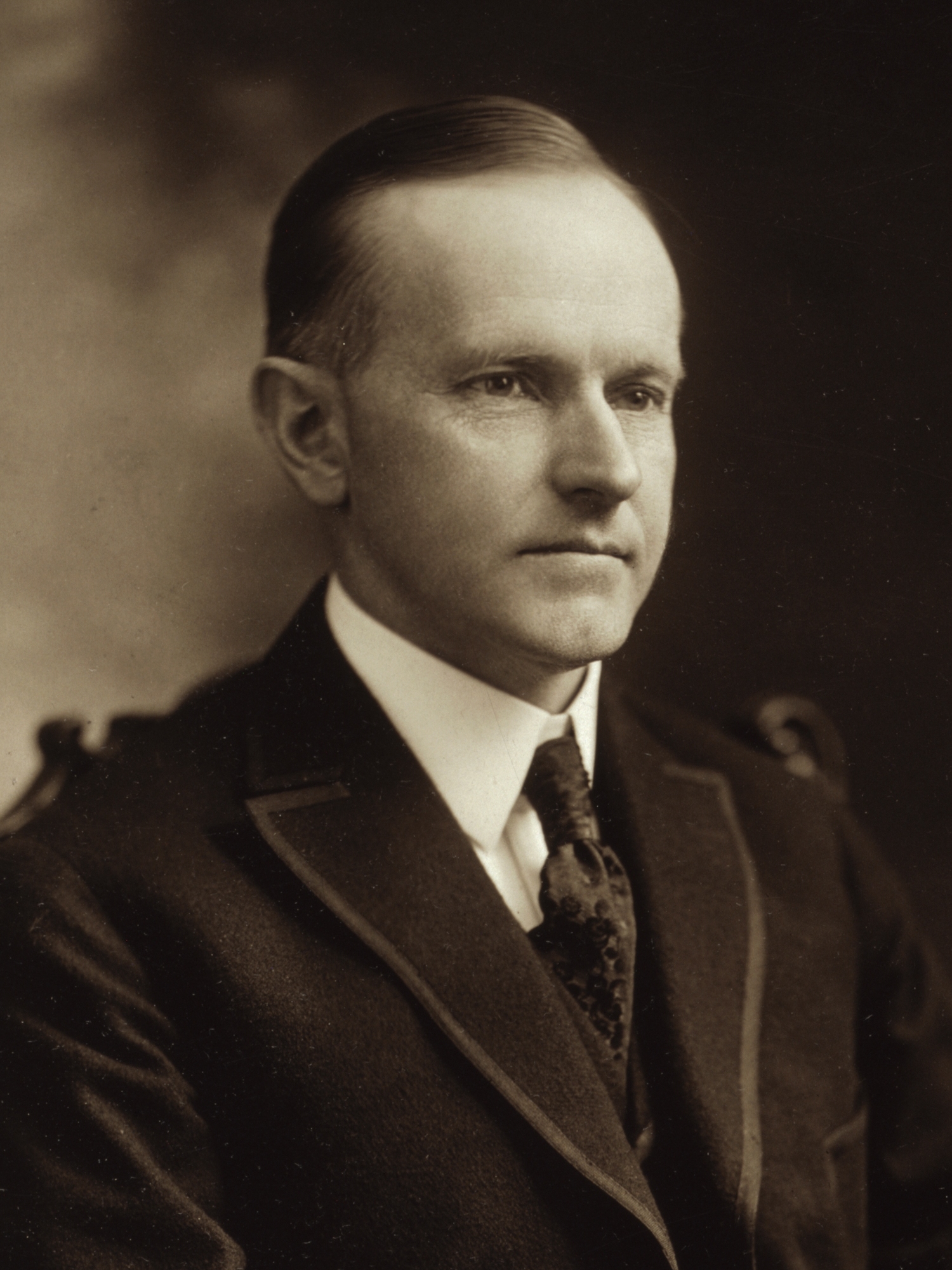
Calvin Coolidge citations
Page 5

John Calvin Coolidge, Jr., né le 4 juillet 1872 à Plymouth et mort le 5 janvier 1933 à Northampton , est un homme d'État américain, 30e président des États-Unis en fonction du 2 août 1923 au 4 mars 1929.

Originaire du nord-est des États-Unis, Coolidge gravit les échelons de la politique dans le Massachusetts, dont il devient finalement le gouverneur républicain. Ses actions durant la grève de la police de Boston en 1919 le propulsent sur la scène nationale. Il est par la suite élu vice-président en 1920, puis il accède à la présidence après la mort soudaine de Warren G. Harding en 1923. Il est réélu en 1924 et gagne une réputation d'homme austère et taciturne.

Coolidge restaure la confiance du public envers la Maison-Blanche après les nombreux scandales de l'administration de son prédécesseur et il quitte ses fonctions avec une popularité importante. Un de ses biographes écrit qu'« il incarnait l'esprit et les espoirs de la classe moyenne, pouvait interpréter leurs attentes et exprimer leurs opinions ». Coolidge est par la suite critiqué [Par qui ?]pour sa politique de laissez-faire qui aurait été une des causes de la Grande Dépression. Son héritage est réévalué sous l'administration de Ronald Reagan, mais les appréciations finales sur son mandat restent partagées entre ceux qui approuvent sa réduction des programmes fédéraux et ceux qui considèrent que l'État devrait être plus impliqué dans le contrôle et la réglementation de l'économie. Wikipedia  

✵ 4. juillet 1872 – 5. janvier 1933
Calvin Coolidge photo
Calvin Coolidge: 412   citations 0   J'aime

Calvin Coolidge: Citations en anglais

“In my message last year I emphasized the necessity for further legislation with a view to expediting the consolidation of our rail ways into larger systems. The principle of Government control of rates and profits, now thoroughly embedded in our governmental attitude toward natural monopolies such as the railways, at once eliminates the need of competition by small units as a method of rate adjustment. Competition must be preserved as a stimulus to service, but this will exist and can be increased tinder enlarged systems. Consequently the consolidation of the railways into larger units for the purpose of securing the substantial values to the public which will come from larger operation has been the logical conclusion of Congress in its previous enactments, and is also supported by the best opinion in the country. Such consolidation will assure not only a greater element of competition as to service, but it will afford economy in operation, greater stability in railway earnings, and more economical financing. It opens large possibilities of better equalization of rates between different classes of traffic so as to relieve undue burdens upon agricultural products and raw materials generally, which are now not possible without ruin to small units owing to the lack of diversity of traffic. It would also tend to equalize earnings in such fashion as to reduce the importance of section 15A, at which criticism, often misapplied, has been directed. A smaller number of units would offer less difficulties in labor adjustments and would contribute much to the, solution of terminal difficulties.”

1920s, Second State of the Union Address (1924)

“[Speaking of Chinese president Sun Yat-sen] …combined Benjamin Franklin and George Washington of China.”

Source: As quoted in The Human Odyssey: Volume 2 by Tanim Ansary et al, p. 653.

“The first duty of a government is to be true to itself. This does not mean perfection, it means a plan to strive for perfection. It means loyalty to ideals. The ideals of America were set out in the Declaration of Independence and adopted in the Constitution. They did not represent perfection at hand, but perfection found. The fundamental principle was freedom. The fathers knew that this was not yet apprehended. They formed a government firm in the faith that it was ever to press toward this high mark. In selfishness, in greed, in lust for gain, it turned aside. Enslaving others, it became itself enslaved. Bondage in one part consumed freedom in all parts. The government of the fathers, ceasing to be true to itself, was perishing. Five score and ten years ago, that divine providence which infinite repetition has made only the more a miracle, sent into the world a new life destined to save a nation. No star, no sign foretold his coming. About his cradle all was poor and mean, save only the source of all great men, the love of a wonderful woman. When she faded away in his tender years from her deathbed in humble poverty, she endowed her son with greatness. There can be no proper observance of a birthday which forgets the mother. Into his origin, as into his life, men long have looked and wondered. In wisdom great, but in humility greater, in justice strong, but in compassion stronger, he became a leader of men by being a follower of the truth. He overcame evil with good. His presence filled the nation. He broke the might of oppression. He restored a race to its birthright.”

1920s, Duty of Government (1920)

Auteurs similaires

Khalil Gibran photo
Khalil Gibran 13
poète et peintre libanais
Erich Maria Remarque photo
Erich Maria Remarque 6
écrivain allemand
Mustafa Kemal Atatürk photo
Mustafa Kemal Atatürk 17
fondateur et le premier président de la République turque
Charles de Gaulle photo
Charles de Gaulle 21
militaire français et 1er président de la cinquième Républi…
Nelson Mandela photo
Nelson Mandela 12
ancien Président d'Afrique du Sud
Winston Churchill photo
Winston Churchill 23
homme d'État britannique
Fidel Castro photo
Fidel Castro 5
Premier secrétaire du Parti communiste de Cuba
Imre Kertész photo
Imre Kertész 68
écrivain hongrois
George Carlin photo
George Carlin 35
humoriste américain
Vladimir Poutine photo
Vladimir Poutine 13
personnalité politique russe