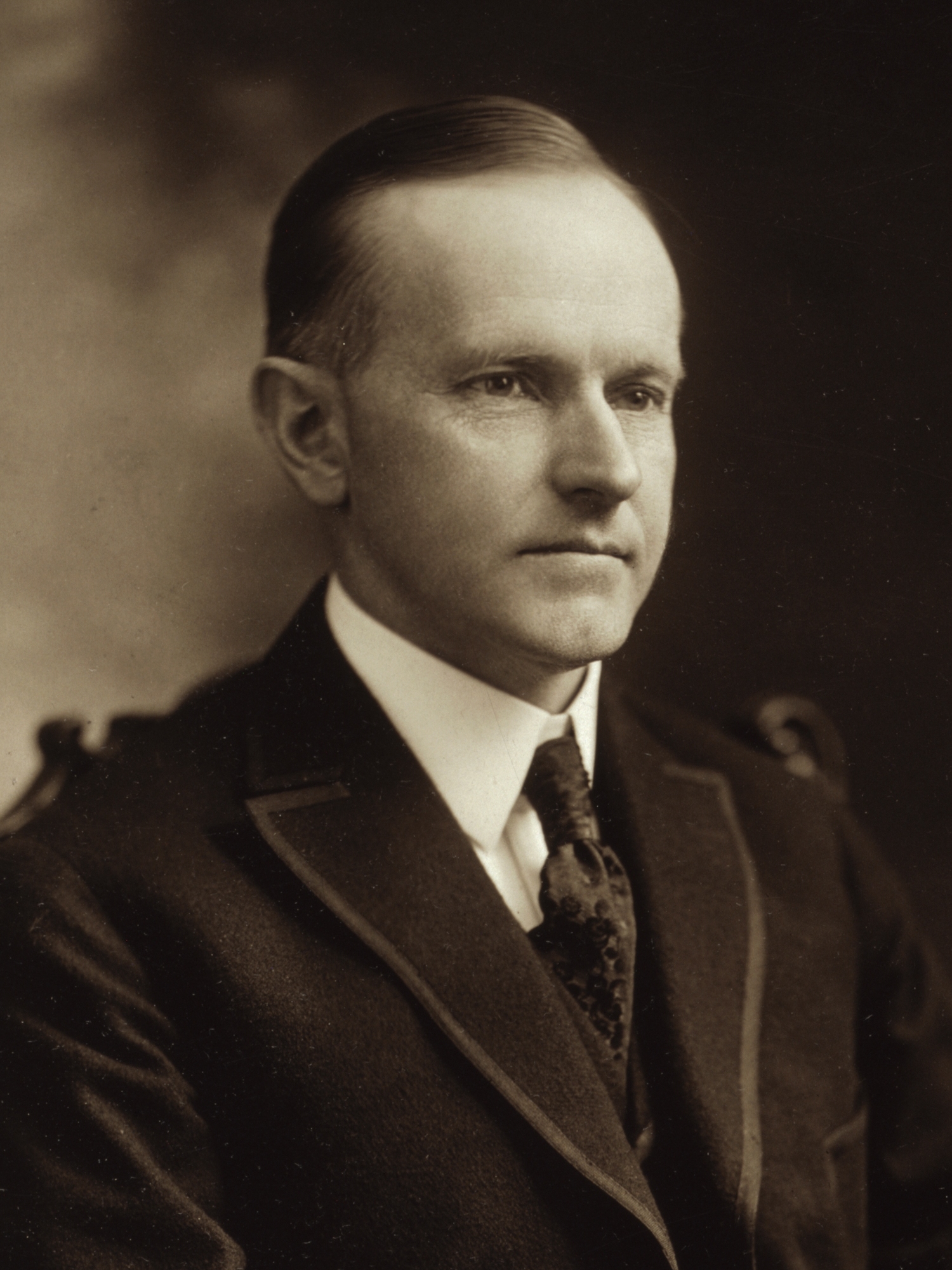
Calvin Coolidge citations
Page 6

John Calvin Coolidge, Jr., né le 4 juillet 1872 à Plymouth et mort le 5 janvier 1933 à Northampton , est un homme d'État américain, 30e président des États-Unis en fonction du 2 août 1923 au 4 mars 1929.

Originaire du nord-est des États-Unis, Coolidge gravit les échelons de la politique dans le Massachusetts, dont il devient finalement le gouverneur républicain. Ses actions durant la grève de la police de Boston en 1919 le propulsent sur la scène nationale. Il est par la suite élu vice-président en 1920, puis il accède à la présidence après la mort soudaine de Warren G. Harding en 1923. Il est réélu en 1924 et gagne une réputation d'homme austère et taciturne.

Coolidge restaure la confiance du public envers la Maison-Blanche après les nombreux scandales de l'administration de son prédécesseur et il quitte ses fonctions avec une popularité importante. Un de ses biographes écrit qu'« il incarnait l'esprit et les espoirs de la classe moyenne, pouvait interpréter leurs attentes et exprimer leurs opinions ». Coolidge est par la suite critiqué [Par qui ?]pour sa politique de laissez-faire qui aurait été une des causes de la Grande Dépression. Son héritage est réévalué sous l'administration de Ronald Reagan, mais les appréciations finales sur son mandat restent partagées entre ceux qui approuvent sa réduction des programmes fédéraux et ceux qui considèrent que l'État devrait être plus impliqué dans le contrôle et la réglementation de l'économie. Wikipedia  

✵ 4. juillet 1872 – 5. janvier 1933
Calvin Coolidge photo
Calvin Coolidge: 412   citations 0   J'aime

Calvin Coolidge: Citations en anglais

“The economic problems of society are important. On the whole, we are meeting them fairly well. They are so personal and so pressing that they never fail to receive constant attention. But they are only a part. We need to put a proper emphasis on the other problems of society. We need to consider what attitude of the public mind it is necessary to cultivate in order that a mixed population like our own may dwell together more harmoniously and the family of nations reach a better state of understanding. You who have been in the service know how absolutely necessary it is in a military organization that the individual subordinate some part of his personality for the general good. That is the one great lesson which results from the training of a soldier. Whoever has been taught that lesson in camp and field is thereafter the better equipped to appreciate that it is equally applicable in other departments of life. It is necessary in the home, in industry and commerce, in scientific and intellectual development. At the foundation of every strong and mature character we find this trait which is best described as being subject to discipline. The essence of it is toleration. It is toleration in the broadest and most inclusive sense, a liberality of mind, which gives to the opinions and judgments of others the same generous consideration that it asks for its own, and which is moved by the spirit of the philosopher who declared that 'To know all is to forgive all.”

It may not be given to infinite beings to attain that ideal, but it is none the less one toward which we should strive.
1920s, Toleration and Liberalism (1925)

“Peace has an economic foundation to which too little attention has been given. No student can doubt that it was to a large extent the economic condition of Europe that drove those overburdened countries headlong into the World War. They were engaged in maintaining competitive armaments. If one country laid the keel of one warship, some other country considered it necessary to lay the keel of two warships. If one country enrolled a regiment, some other country enrolled three regiments. Whole peoples were armed and drilled and trained to the detriment of their industrial life, and charged and taxed and assessed until the burden could no longer be borne. Nations cracked under the load and sought relief from the intolerable pressure by pillaging each other. It was to avoid a repetition of such a catastrophe that our Government proposed and brought to a successful conclusion the Washing- ton Conference for the Limitation of Naval Armaments. We have been altogether desirous of an extension of this principle and for that purpose have sent our delegates to a preliminary conference of nations now sitting at Geneva. Out of that conference we expect some practical results. We believe that other nations ought to join with us in laying aside their suspicions and hatreds sufficiently to agree among themselves upon methods of mutual relief from the necessity of the maintenance of great land and sea forces. This can not be done if we constantly have in mind the resort to war for the redress of wrongs and the enforcement of rights. Europe has the League of Nations. That ought to be able to provide those countries with certain political guaranties which our country does not require. Besides this there is the World Court, which can certainly be used for the determination of all justifiable disputes. We should not underestimate the difficulties of European nations, nor fail to extend to them the highest degree of patience and the most sympathetic consideration. But we can not fail to assert our conviction that they are in great need of further limitation of armaments and our determination to lend them every assistance in the solution of their problems. We have entered the conference with the utmost good faith on our part and in the sincere belief that it represents the utmost good faith on their part. We want to see the problems that are there presented stripped of all technicalities and met and solved in a way that will secure practical results. We stand ready to give our support to every effort that is made in that direction.”

1920s, Ways to Peace (1926)

“Knowledge comes, but wisdom lingers”

Widely misattributed and misquoted. Coolidge was quoting Tennyson in a June 3, 1925 speech to the US Naval Academy. Foundations of the Republic pp 237 : THE NAVY AS AN INSTRUMENT OF PEACE The poet reminds us that "Knowledge comes, but wisdom lingers." It may not be difficult to store up in the mind a vast ...
Misattributed

“The Constitution is the sole source and guaranty of national freedom.”

Address accepting nomination as Republican candidate for president, Washington, D.C. (4 August 1924); published as Address of Acceptance (1924), p. 15.
1920s

Auteurs similaires

Khalil Gibran photo
Khalil Gibran 13
poète et peintre libanais
Erich Maria Remarque photo
Erich Maria Remarque 6
écrivain allemand
Mustafa Kemal Atatürk photo
Mustafa Kemal Atatürk 17
fondateur et le premier président de la République turque
Charles de Gaulle photo
Charles de Gaulle 21
militaire français et 1er président de la cinquième Républi…
Nelson Mandela photo
Nelson Mandela 12
ancien Président d'Afrique du Sud
Winston Churchill photo
Winston Churchill 23
homme d'État britannique
Fidel Castro photo
Fidel Castro 5
Premier secrétaire du Parti communiste de Cuba
Imre Kertész photo
Imre Kertész 68
écrivain hongrois
George Carlin photo
George Carlin 35
humoriste américain
Vladimir Poutine photo
Vladimir Poutine 13
personnalité politique russe