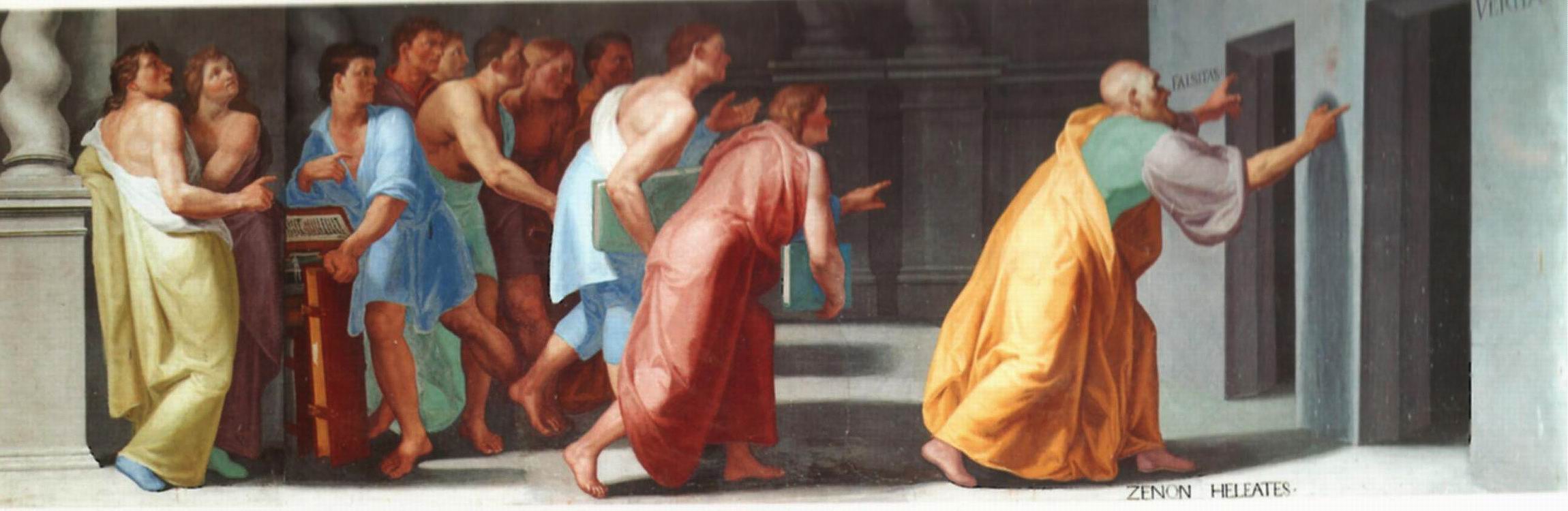
Zeno of Elea Quotes

Zeno of Elea was a pre-Socratic Greek philosopher. He was a student of Parmenides and one of the Eleatics. Born in Elea, Zeno defended his instructor's belief in monism, the idea that only one single entity exists that makes up all of reality. He rejected the existence of space, time, and motion. To disprove these concepts, he developed a series of paradoxes to demonstrate why these are impossible. Though his original writings are lost, subsequent descriptions by Plato, Aristotle, Diogenes Laertius, and Simplicius of Cilicia have allowed study of his ideas.

Zeno's arguments are divided into two different types: his arguments against plurality, or the existence of multiple objects, and his arguments against motion. Those against plurality suggest that for anything to exist, it must be divisible infinitely, meaning it would necessarily have both infinite mass and no mass simultaneously. Those against motion invoke the idea that distance must be divisible infinitely, meaning infinite steps would be required to cross any distance.

Zeno's philosophy is still debated in the present day, and no solution to his paradoxes has been agreed upon by philosophers. His paradoxes have influenced philosophy and mathematics, both in ancient and modern times. Many of his ideas have been challenged by modern developments in physics and mathematics, such as atomic theory, mathematical limits, and set theory. Wikipedia  

✵ 490 BC – 425 BC
Zeno of Elea photo
Zeno of Elea: 1 quote2 likes

Zeno of Elea Quotes

“The truth is, that these writings of mine were meant to protect the arguments of Parmenides against those who make fun of him and seek to show the many ridiculous and contradictory results which they suppose to follow from the affirmation of the one.”

Zeno of Elea

As quoted in Parmenides by Plato, a portrayal of a discussion which begins between Socrates and Zeno, and then primarily Parmenides; as translated by Benjamin Jowett, Parmenides (1871)
My writing is an answer to the partisans of the many and it returns their attack with interest, with a view to showing that the hypothesis of the many, if examined sufficiently in detail, leads to even more ridiculous results than the hypothesis of the One.
As translated in A History of Philosophy, Vol. I : Greece and Rome (1953) by Frederick Charles Copleston.
Context: The truth is, that these writings of mine were meant to protect the arguments of Parmenides against those who make fun of him and seek to show the many ridiculous and contradictory results which they suppose to follow from the affirmation of the one. My answer is addressed to the partisans of the many, whose attack I return with interest by retorting upon them that their hypothesis of the being of many, if carried out, appears to be still more ridiculous than the hypothesis of the being of one. Zeal for my master led me to write the book in the days of my youth, but some one stole the copy; and therefore I had no choice whether it should be published or not; the motive, however, of writing, was not the ambition of an elder man, but the pugnacity of a young one.

Similar authors

Xenophon photo
Xenophon21
ancient Greek historian and philosopher None
Epicurus photo
Epicurus30
ancient Greek philosopher None
Isocrates photo
Isocrates23
ancient greek rhetorician None
Plato photo
Plato80
Classical Greek philosopher None
Thales photo
Thales9
ancient Greek philosopher and mathematician None
Pythagoras photo
Pythagoras121
ancient Greek mathematician and philosopher None
Plutarch photo
Plutarch251
ancient Greek historian and philosopher None
Hippocrates photo
Hippocrates33
ancient Greek physician None
Protagoras photo
Protagoras6
pre-Socratic Greek philosopher None
Aesop photo
Aesop36
ancient Greek storyteller None