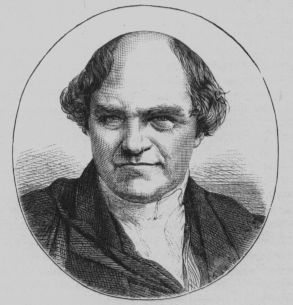
William Whewell Quotes

Rev Dr William Whewell DD HFRSE was an English polymath, scientist, Anglican priest, philosopher, theologian, and historian of science. He was Master of Trinity College, Cambridge. In his time as a student there, he achieved distinction in both poetry and mathematics.

What is most often remarked about Whewell is the breadth of his endeavours. In a time of increasing specialisation, Whewell appears as a vestige of an earlier era when natural philosophers dabbled in a bit of everything. He researched ocean tides , published work in the disciplines of mechanics, physics, geology, astronomy, and economics, while also finding the time to compose poetry, author a Bridgewater Treatise, translate the works of Goethe, and write sermons and theological tracts. In mathematics, Whewell introduced what is now called the Whewell equation, an equation defining the shape of a curve without reference to an arbitrarily chosen coordinate system.

One of Whewell's greatest gifts to science was his wordsmithing. He often corresponded with many in his field and helped them come up with new terms for their discoveries. Whewell contributed the terms scientist, physicist, linguistics, consilience, catastrophism, uniformitarianism, and astigmatism amongst others; Whewell suggested the terms electrode, ion, dielectric, anode, and cathode to Michael Faraday.Whewell died in Cambridge in 1866 as a result of a fall from his horse.


Wikipedia  

✵ 24. May 1794 – 6. March 1866
William Whewell photo
William Whewell: 12 quotes0 likes

Famous William Whewell Quotes

“It is a test of true theories not only to account for but to predict phenomena.”

William Whewell

Aphorism 39.
Philosophy of the Inductive Sciences (1840)

“The catastrophist constructs theories, the uniformitarian demolishes them.”

William Whewell

Aphorism 36.
Philosophy of the Inductive Sciences (1840)

“And so no force however great can stretch a cord however fine into an horizontal line which is accurately straight.”

William Whewell

Elementary Treatise on Mechanics, The Equilibrium of Forces on a Point (1819).

“In art, truth is a means to an end; in science, it is the only end.”

William Whewell

Aphorism 25.
Philosophy of the Inductive Sciences (1840)

William Whewell Quotes

“Man is the interpreter of nature, science the right interpretation.”

William Whewell

Aphorism 17.
Philosophy of the Inductive Sciences (1840)

Similar authors

Thomas Carlyle photo
Thomas Carlyle481
Scottish philosopher, satirical writer, essayist, historian… None
Auguste Comte photo
Auguste Comte23
French philosopher None
John Stuart Mill photo
John Stuart Mill179
British philosopher and political economist None
Samuel Taylor Coleridge photo
Samuel Taylor Coleridge220
English poet, literary critic and philosopher None
Arthur Schopenhauer photo
Arthur Schopenhauer261
German philosopher None
Theodor Mommsen photo
Theodor Mommsen65
German classical scholar, historian, jurist, journalist, po… None
Henri-Frédéric Amiel photo
Henri-Frédéric Amiel50
Swiss philosopher and poet None
Percy Bysshe Shelley photo
Percy Bysshe Shelley246
English Romantic poet None
Ludwig Feuerbach photo
Ludwig Feuerbach36
German philosopher and anthropologist None
William James photo
William James246
American philosopher, psychologist, and pragmatist None