“Transform the Animal into the Driver of the herds; let all thyself be Krishna. This is thy goal.”
Thoughts and Glimpses (1916-17)
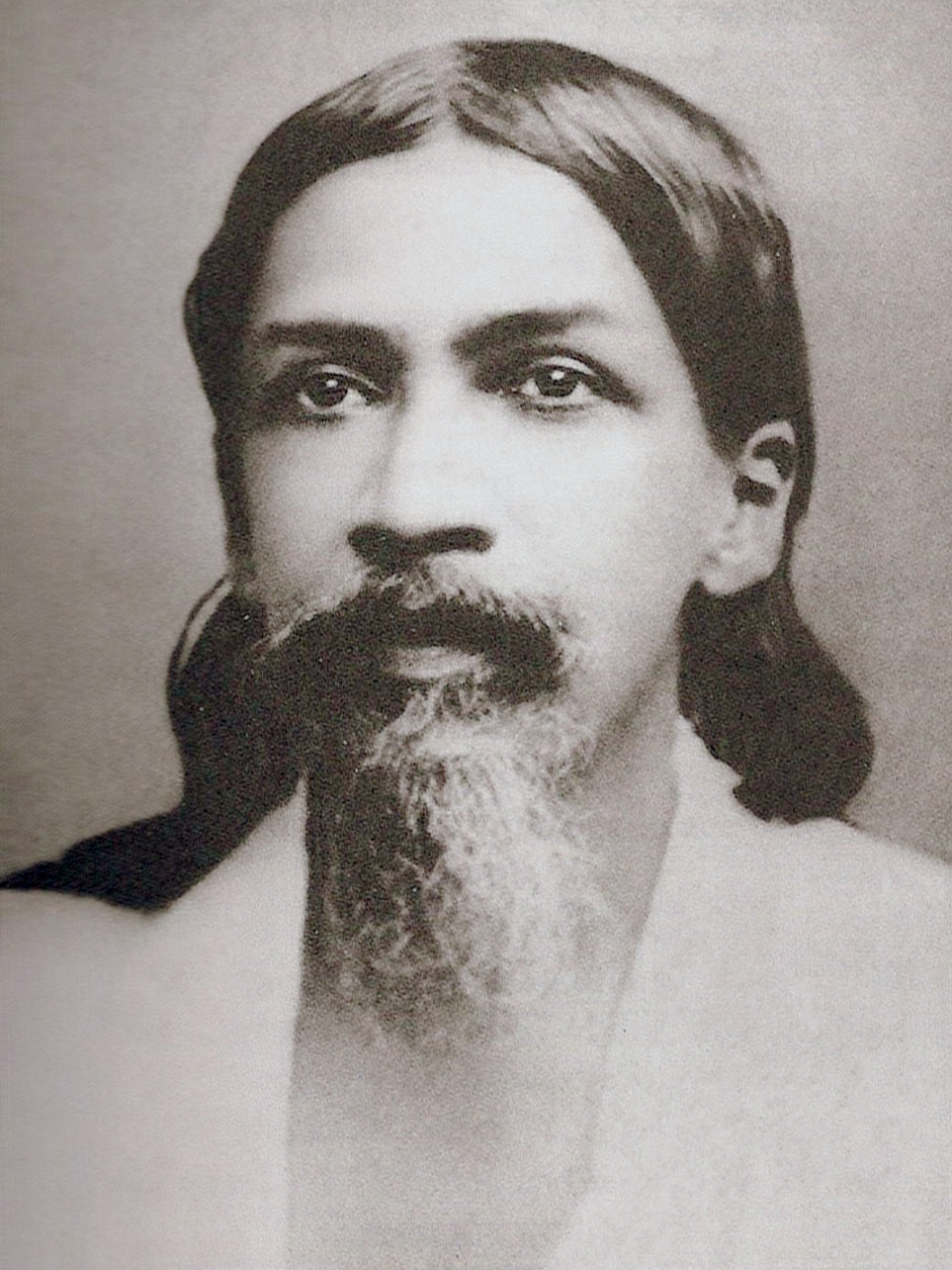
Sri Aurobindo was an Indian philosopher, yogi, guru, poet, and nationalist. He joined the Indian movement for independence from British rule, for a while was one of its influential leaders and then became a spiritual reformer, introducing his visions on human progress and spiritual evolution.
Aurobindo studied for the Indian Civil Service at King's College, Cambridge, England. After returning to India he took up various civil service works under the maharaja of the princely state of Baroda and became increasingly involved in nationalist politics and the nascent revolutionary movement in Bengal. He was arrested in the aftermath of a number of bomb outrages linked to his organisation, but in a highly public trial where he faced charges of treason, Aurobindo could only be convicted and imprisoned for writing articles against British rule in India. He was released when no evidence could be provided, following the murder of a prosecution witness, Narendranath Goswami during the trial. During his stay in the jail, he had mystical and spiritual experiences, after which he moved to Pondicherry, leaving politics for spiritual work.
At Pondicherry, Sri Aurobindo developed a spiritual practice he called Integral Yoga. The central theme of his vision was the evolution of human life into a life divine. He believed in a spiritual realisation that not only liberated but transformed human nature, enabling a divine life on earth. In 1926, with the help of his spiritual collaborator, Mirra Alfassa , he founded the Sri Aurobindo Ashram.
His main literary works are The Life Divine, which deals with theoretical aspects of Integral Yoga; Synthesis of Yoga, which deals with practical guidance to Integral Yoga; and Savitri: A Legend and a Symbol, an epic poem. Wikipedia
“Transform the Animal into the Driver of the herds; let all thyself be Krishna. This is thy goal.”
Thoughts and Glimpses (1916-17)
Thoughts and Aphorisms (1913), Jnana
“Life has no 'isms' in it, Supermind also has no 'isms.”
It is the mind that introduces all 'isms' and creates confusion. That is the difference between a man who lives and a thinker who can't: a leader who thinks too much and is busy with ideas, trying all the time to fit the realities of life to his ideas, hardly succeeds, while the leader who is destined to succeed does not bother his head about ideas. He sees the forces at work and knows by intuition those that make for success. He also knows the right combination of forces and the right moment when he should act.... At one time it was thought that the mind could grasp the whole Truth and solve all the problems that face humanity. The mind had its full play and we find that it is not able to solve the problems. Now, we find that it is possible to go beyond mind and there is the Supermind which is the organization of the Infinite Consciousness. There you find the truth of all that is in mind and life.... For instance, you find that Democracy, Socialism and Communism have each some truth behind it, but it is not the whole Truth. What you have to do is to find out the forces that are at work and understand what it is of which all these mental ideas and 'isms' are a mere indication. You have to know the mistakes which people commit in dealing with the truth of these forces and the truth that is behind the mistakes also. I am, at present, speaking against democracy; that does not mean that there is no truth behind it. I know the truth [behind democracy], but I speak against democracy because that mentality is at present against the Truth that is trying to come down.
May 18, 1926
India's Rebirth


