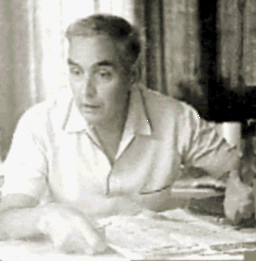
Richard "Ric" Berger was a Swiss professor of design, decoration, and art history. He is best known for his numerous newspaper articles about historical monuments, mainly in the French-speaking part of Switzerland, including his own drawings of the buildings. Through these articles, he contributed to an increased interest in historical monuments and settings among many hitherto uninformed people, and probably also contributed indirectly to a wider interest in preserving and saving historical monuments from destruction.
Around the early 1970s, he published samples of his newspaper writings in books that were, and still are, prized by amateur historians and archeologists. He is read with more caution in university circles, being known as a "vulgarizer" and reflecting essentially the state of knowledge at the period of his publications, chiefly the 1950s. Being an active teacher as well, he wrote papers on heraldry, on the history of the alphabet and on the drawing habits of children.
In 1912, at the age of 18, he became interested in universal languages as an Esperantist. He changed to Ido in 1918 and to Occidental in 1928. He was co-editor of the Occidental magazine "Cosmoglotta" from 1934 to 1950. In 1945 he began considering changing the name of the language, proposing the possible names Auli and Wahl. He eventually succeeded in changing the name of the language to Interlingue in 1949. Finally, in 1956, he took an interest in Interlingua.
From January 1959 to December 1963, Berger was secretary general of the Union Mundial pro Interlingua and editor of the Interlingua magazine Currero. He authored more than 20 books about art and historic monuments in Switzerland and a large number of thematic notebooks in Interlingua, especially on the history of international auxiliary languages. He edited the Revista de Interlingua, which ceased with his death, from 1966 to 1983. This magazine grew to more than 6,000 pages sent to 60 countries. As head of his own publishing firm, Editiones Interlingua, he published Interlingua manuals in several languages, ensuring that manuals in the "minor languages" were included.
Europe is divided by the walls of 30 languages. Happily, among these national languages, about 10,000 words of Greek and Latin origin are common. This precious linguistic treasure should be used to the utmost without mutilating a single word or inventing others.
Revista de Interlingua no 48, 1970 Wikipedia
✵ 16. August 1894 – 4. August 1984