René Girard Quotes

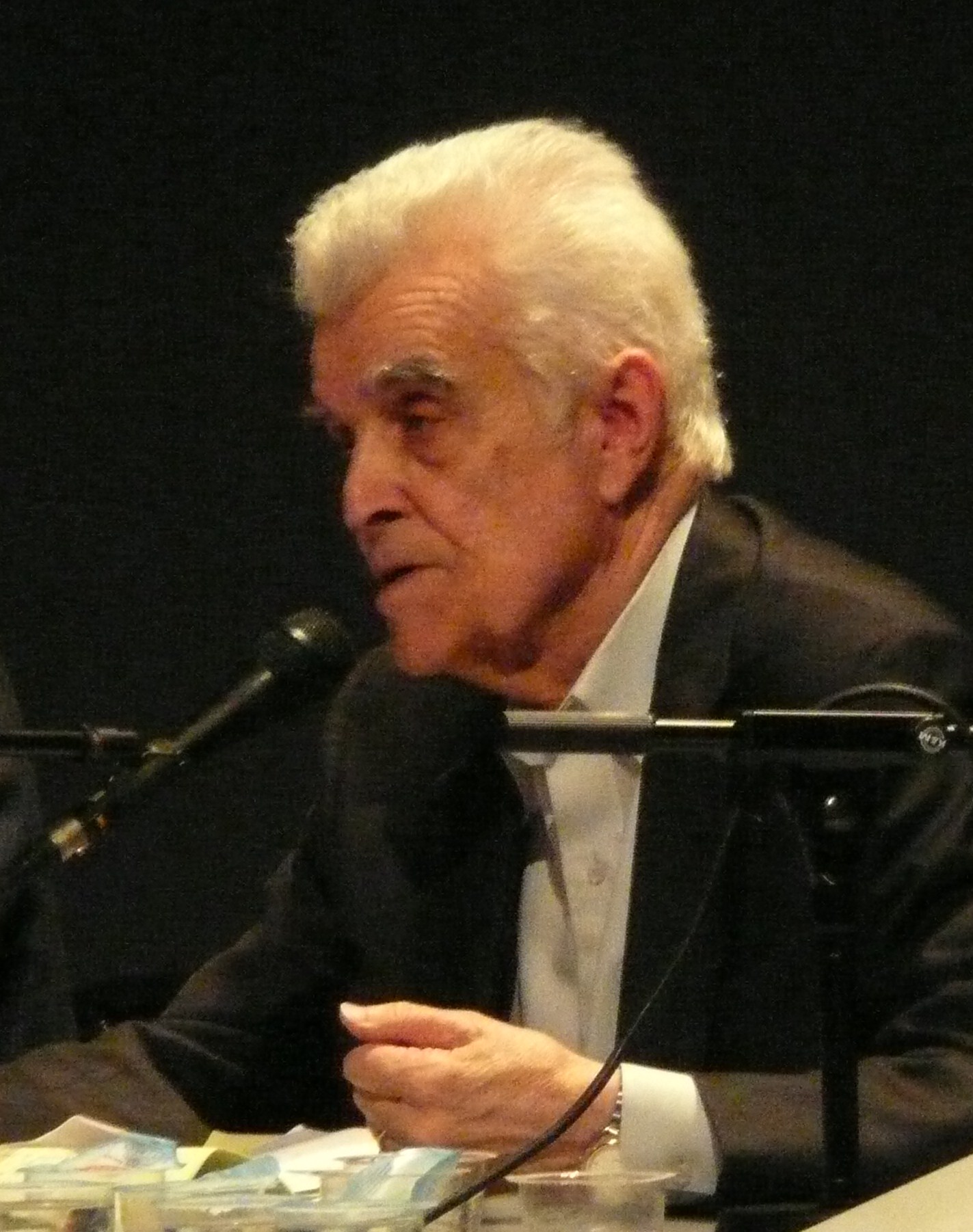
René Noël Théophile Girard was a French historian, literary critic, and philosopher of social science whose work belongs to the tradition of anthropological philosophy. Girard was the author of nearly thirty books, with his writings spanning many academic domains. Although the reception of his work is different in each of these areas, there is a growing body of secondary literature on his work and his influence on disciplines such as literary criticism, critical theory, anthropology, theology, psychology, mythology, sociology, economics, cultural studies, and philosophy.

Girard's fundamental ideas, which he had developed throughout his career and provided the foundation for his thinking, were that desire is mimetic , that all conflict originates in mimetic desire , that the scapegoat mechanism is the origin of sacrifice and the foundation of human culture, and religion was necessary in human evolution to control the violence that can come from mimetic rivalry, and that the Bible reveals these ideas and denounces the scapegoat mechanism.

Girard was also a member of the Académie française from 2005 until his death on 4 November 2015.

✵ 25. December 1923 – 4. November 2015
René Girard photo

Works

René Girard: 9 quotes7 likes

Famous René Girard Quotes

“An examination of our terms, such as competition, rivalry, emulation, etc., reveals that the traditional perspective remains inscribed in the language. Competitors are fundamentally those who run or walk together, rivals who dwell on opposite banks of the same river, etc…The modern view of competition and conflict is the unusual and exceptional view, and our incomprehension is perhaps more problematic than the phenomenon of primitive prohibition. Primitive societies have never shared our conception of violence. For us, violence has a conceptual autonomy, a specificity that is utterly unknown to primitive societies. We tend to focus on the individual act, whereas primitive societies attach only limited importance to it and have essentially pragmatic reasons for refusing to isolate such an act from its context. This context is one of violence. What permits us to conceive abstractly of an act of violence and view it as an isolated crime is the power of a judicial institution that transcends all antagonists. If the transcendence of the judicial institution is no longer there, if the institution loses its efficacy or becomes incapable of commanding respect, the imitative and repetitious character of violence becomes manifest once more; the imitative character of violence is in fact most manifest in explicit violence, where it acquires a formal perfection it had not previously possessed. At the level of the blood feud, in fact, there is always only one act, murder, which is performed in the same way for the same reasons in vengeful imitation of the preceding murder. And this imitation propagates itself by degrees. It becomes a duty for distant relatives who had nothing to do with the original act, if in fact an original act can be identified; it surpasses limits in space and time and leaves destruction everywhere in its wake; it moves from generation to generation. In such cases, in its perfection and paroxysm mimesis becomes a chain reaction of vengeance, in which human beings are constrained to the monotonous repetition of homicide. Vengeance turns them into doubles.”

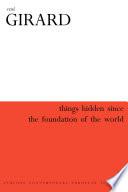
René Girard book Things Hidden Since the Foundation of the World

Source: Things Hidden Since the Foundation of the World (1978), p. 11-12.

“The God of Christianity isn’t the violent God of archaic religion, but the non-violent God who willingly becomes a victim in order to free us from our violence.”

René Girard

"The Scandal of Christianity" in Evolution and Conversion: Dialogues on the Origins of Culture (2007), p. 219

Similar authors

Walter Benjamin photo
Walter Benjamin70
German literary critic, philosopher and social critic (1892… None
Jean Paul Sartre photo
Jean Paul Sartre321
French existentialist philosopher, playwright, novelist, sc… None
Fernando Pessoa photo
Fernando Pessoa288
Portuguese poet, writer, literary critic, translator, publi… None
Umberto Eco photo
Umberto Eco120
Italian semiotician, essayist, philosopher, literary critic… None
Michel Foucault photo
Michel Foucault128
French philosopher None
Henri Bergson photo
Henri Bergson18
French philosopher None
Romain Rolland photo
Romain Rolland43
French author None
Cesare Pavese photo
Cesare Pavese137
Italian poet, novelist, literary critic, and translator None
Kenzaburō Ōe photo
Kenzaburō Ōe43
Japanese author None
Marcel Proust photo
Marcel Proust41
French novelist, critic, and essayist None