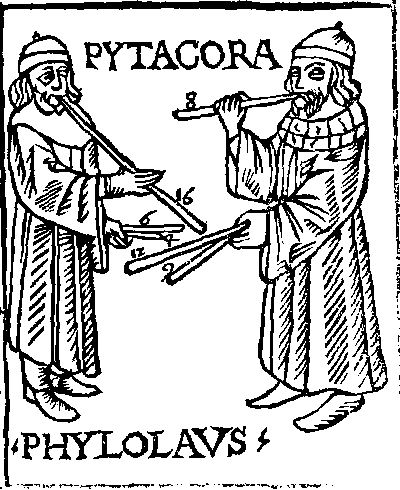
Nicom.Arith.2:509
The Life of Pythagoras (1919)
Philolaus: 7 quotes1 like
Famous Philolaus Quotes
“The essence of things is eternal”
The Life of Pythagoras (1919)
Context: Fragment 4. This is the state of affairs about nature and harmony. The essence of things is eternal; it is a unique and divine nature, the knowledge of which does not belong to man. Still it would not not be possible that any of the things that are, and are known by us, should arrive to our knowledge, if this essence was not the internal foundation of the principles of which the world was founded, that is, of the finite and infinite elements. Now since these principles are not mutually similar, neither of similar nature, it would be impossible that the order of the world should have been formed by them, unless the harmony had intervened... the dissimilar things, which have neither a similar nature, nor an equivalent function, must be organized by the harmony, if they are to take their place in the connected totality of the world.
“All things, at least those we know, contain number”
The Life of Pythagoras (1919)
Context: Fragment 2. All things, at least those we know, contain number; for it is evident that nothing whatever can either be thought or known, without number. Number has two distinct kinds: the odd, and the even, and a third, derived from a mingling of the other two kinds, the even-odd. Each of its subspecies is susceptible of many very numerous varieties; which each manifests individually.
“The world's nature is a harmonious compound of infinite and finite elements”
The Life of Pythagoras (1919)
Context: Fragment 1. (Stob.21.7; Diog.#.8.85) The world's nature is a harmonious compound of infinite and finite elements; similar is the totality of the world in itself, and of all it contains.
b. All beings are necessarily finite or infinite, or simultaneously finite and infinite; but they could not all be infinite only.
Quoted by Clemens Alexandrinus, Stromata, Book III (ca. 190 AD) Tr. Thomas Taylor, The Eleusinian and Bacchic Mysteries: A Dissertation https://books.google.com/books?id=vEt0LaOue8IC (1891)
Quoted by Johannes Stobaeus, Eclogues (5th-century CE) Phys. p. 51, Tr. Thomas Taylor, The Mystical Hymns of Orpheus https://books.google.com/books?id=MNEIAAAAQAAJ (1824) p.156.
Quoted by Aristotle, Metaphysics (ca. 350 BC) Tr. Thomas Taylor, The Philosophical and Mathematical Commentaries of Proclus on the First Book of Euclid's Elements (1792) Vol. 1 https://books.google.com/books?id=AD1WAAAAYAAJ, p. xix.


