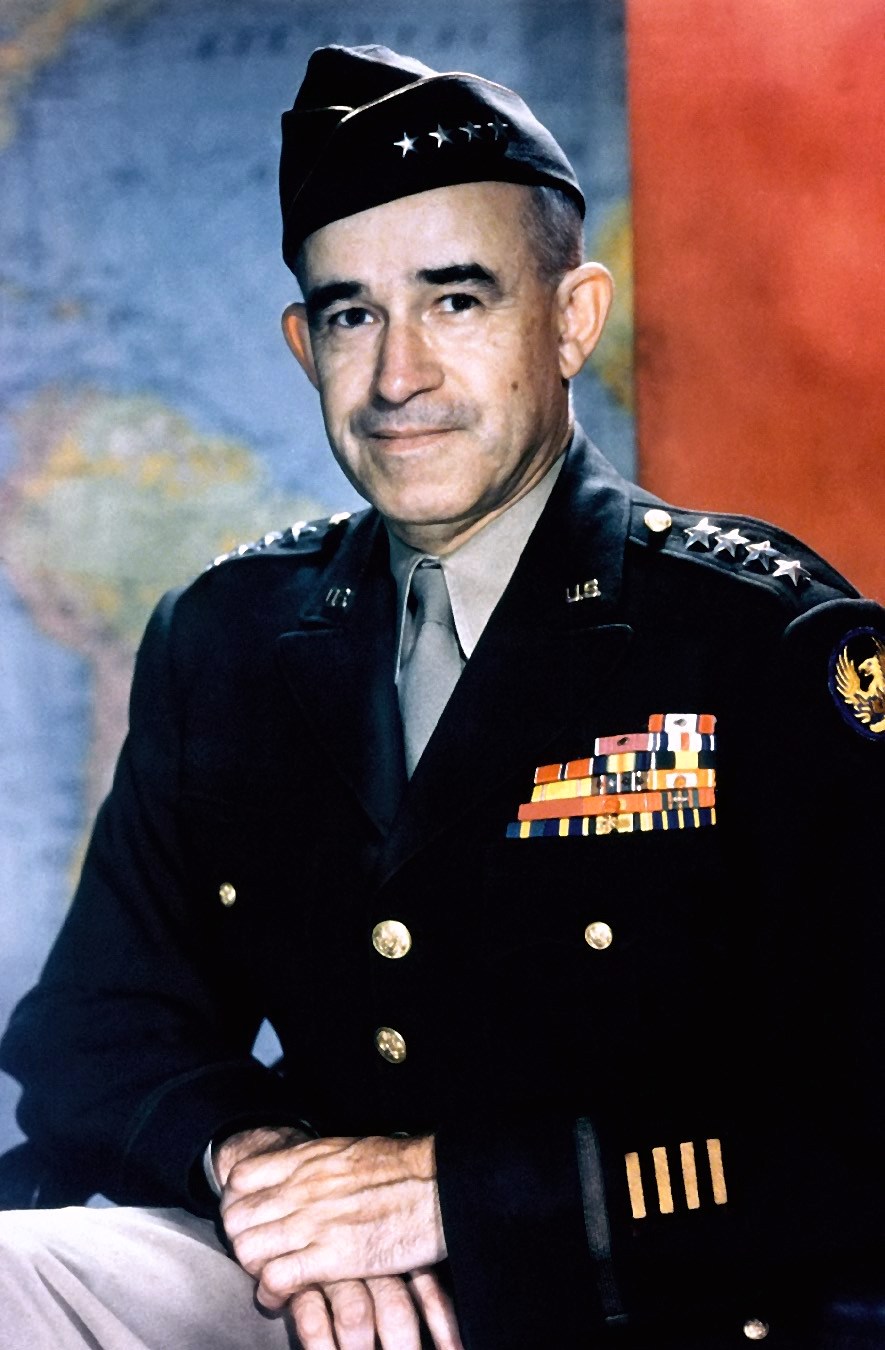
Source: A Soldier's Story (1951), p. x.
Omar Bradley: 26 quotes21 likes
Famous Omar Bradley Quotes
“It is time that we steered by the stars, not by the lights of each passing ship.”
Statement (31 May 1948), quoted in An Inconvenient Truth : The Planetary Emergency Of Global Warming And What We Can Do About It (2006) by Al Gore
Dedication
A Soldier's Story (1951)
Source: A Soldier's Story (1951), p. ix.
Source: A Soldier's Story (1951), p. 278.
Source: A Soldier's Story (1951), p. xi.
Omar Bradley Quotes about war
Testimony before the Senate Committees on Armed Services and Foreign Relations (15 May 1951), published in Military Situation in the Far East, hearings, 82d Congress, 1st session, part 2 (1951), p. 732.
Variation: "… a wrong war at the wrong place and against a wrong enemy."
Military Situation, p. 753.
As quoted in Peace Pilgrim: Her Life and Work in Her Own Words (1992) by Peace Pilgrim, p. 113.
Closing words, p. 554.
A Soldier's Story (1951)
Context: A canvas map lay under my helmet with its four silver stars. Only five years before on May 7, as a lieutenant colonel in civilian clothes, I had ridden a bus down Connecticut Avenue to my desk in the old Munitions building. I opened the mapboard and smoothed out the tabs of the 43 divisions now under my command. They stretched across a 640-mile front of the 12th Army Group. With a china-marking pencil, I wrote in the new date: D plus 335. I walked to the window and ripped open the blackout blinds. Outside the sun was climbing into the sky. The war in Europe had ended.
Armistice Day speech (11 November 1948), published in Omar Bradley's Collected Writings, Volume 1 (1967).
Context: We have men of science, too few men of God. We have grasped the mystery of the atom and rejected the Sermon on the Mount. The world has achieved brilliance without conscience. Ours is a world of nuclear giants and ethical infants. We know more about war than we know about peace, more about killing than we know about living. If we continue to develop our technology without wisdom or prudence, our servant may prove to be our executioner.
Source: A Soldier's Story (1951), p. xi.
Source: A Soldier's Story (1951), p. 310
Omar Bradley Quotes about the world
Source: A Soldier's Story (1951), p. x-xi.
Context: During the last six years the United States Army has not only matured greatly, but its officers have grown vastly more aware of their world-wide responsibilities as military men. Allied command has become the accepted pattern of military operation, and many of the insular differences that once caused us to question the motives of our allies have now been completely resolved. If we will only remember that from time to time some difficulties do exist, we shall be better prepared to settle them without exaggerating their dangers.
Source: A Soldier's Story (1951), p. x-xi
Armistice Day speech (11 November 1948), published in Omar Bradley's Collected Writings, Volume 1 (1967)
Omar Bradley Quotes
On military character, in 19 Stars : A Study in Military Character and Leadership (1981) by Edgar F. Puryear Jr.
Context: Dependability, integrity, the characteristic of never knowingly doing anything wrong, that you would never cheat anyone, that you would give everybody a fair deal. Character is a sort of an all-inclusive thing. If a man has character, everyone has confidence in him. Soldiers must have confidence in their leader.
Source: A Soldier's Story (1951), p. xii.
Context: I have attempted to write of my long association with George Patton as fairly and as honestly as I could. General Patton was one of my staunchest friends and the most unhesitatingly loyal of my commanders. He was a magnificent soldier, one whom the American people can admire not only as a great commander but as a unique and remarkable man. In recollecting our experiences together, I may offend those who prefer to remember Patton not as a human being but as a heroic-size statue in a public park. I prefer to remember Patton as a man, as a man with all the frailties and faults of a human being, as a man whose greatness is therefore all the more of a triumph.
Source: A Soldier's Story (1951), p. 5.
Context: Precisely at 7 Patton boomed in to breakfast. His vigor was always infectious, his wit barbed, his conversation a mixture of obscenity and good humor. He was at once stimulating and overbearing. George was a magnificent soldier.
Source: A Soldier's Story (1951), p. 238.
Source: A Soldier's Story (1951), p. 5-6.
“We are dealing with [veterans], not procedures; with their problems, not ours.”
While Administrator of the U.S. Department of Veterans Affairs <br class="br"> "General Bradley Speaks of Personnel Affairs," http://babel.hathitrust.org/cgi/pt?id=uiug.30112055973280;view=1up;seq=232 Veterans Administration Personnel Bulletin IB-5, Volume 11 http://books.google.com/books?id=Hu5U5jSnPhIC&q=%22We+are+dealing+with+men+not+procedures+with+their+problems+not+ours%22&pg=PT11-PA14#v=onepage (31 May 1947)
Source: A Soldier's Story (1951), p. viii
Closing words, p. 554
A Soldier's Story (1951)
Source: A Soldier's Story (1951), p. xii


