Maurice Merleau-Ponty book Phenomenology of Perception
Source: Phenomenology of Perception
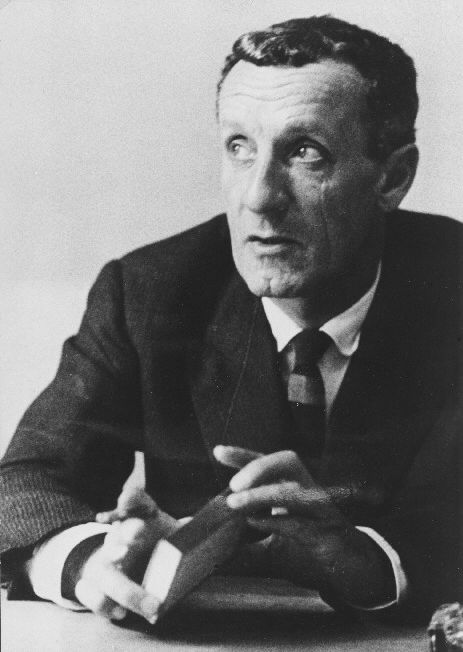
Maurice Merleau-Ponty was a French phenomenological philosopher, strongly influenced by Edmund Husserl and Martin Heidegger. The constitution of meaning in human experience was his main interest and he wrote on perception, art, and politics. He was on the editorial board of Les Temps modernes, the leftist magazine established by Jean-Paul Sartre in 1945.
At the core of Merleau-Ponty's philosophy is a sustained argument for the foundational role perception plays in understanding the world as well as engaging with the world. Like the other major phenomenologists, Merleau-Ponty expressed his philosophical insights in writings on art, literature, linguistics, and politics. He was the only major phenomenologist of the first half of the twentieth century to engage extensively with the sciences and especially with descriptive psychology. It is through this engagement that his writings have become influential in the recent project of naturalizing phenomenology, in which phenomenologists use the results of psychology and cognitive science.
Merleau-Ponty emphasized the body as the primary site of knowing the world, a corrective to the long philosophical tradition of placing consciousness as the source of knowledge, and maintained that the body and that which it perceived could not be disentangled from each other. The articulation of the primacy of embodiment led him away from phenomenology towards what he was to call “indirect ontology” or the ontology of “the flesh of the world” , seen in his final and incomplete work, The Visible and Invisible, and his last published essay, “Eye and Mind”.
Maurice Merleau-Ponty book Phenomenology of Perception
Source: Phenomenology of Perception
“The world is nothing but 'world-as-meaning.”
Maurice Merleau-Ponty book Phenomenology of Perception
Source: Phenomenology of Perception (1945), p. xi
“The body is our general medium for having a world.”
Maurice Merleau-Ponty book Phenomenology of Perception
Source: Phenomenology of Perception
Source: In Praise of Philosophy (1963), p. 44
Maurice Merleau-Ponty book Phenomenology of Perception
Source: Phenomenology of Perception (1945), p. 374
Source: In Praise of Philosophy (1963), pp. 45-46
Maurice Merleau-Ponty book Phenomenology of Perception
Source: Phenomenology of Perception
“It is a great good fortune, as Stendhal said, for one “to have his passion as a profession.””
Source: In Praise of Philosophy (1963), p. 4
Source: In Praise of Philosophy (1963), p. 5
Context: Even those who have desired to work out a completely positive philosophy have been philosophers only to the extent that, at the same time, they have refused the right to install themselves in absolute knowledge. They taught not this knowledge, but its becoming in us, not the absolute but, at most, our absolute relation to it, as Kierkegaard said. What makes a philosopher is the movement which leads back without ceasing from knowledge to ignorance, from ignorance to knowledge, and a kind of rest in this movement.
Source: In Praise of Philosophy (1963), p. 59
Context: Machiavelli is the complete contrary of a machiavellian, since he describes the tricks of power and “gives the whole show away.” The seducer and the politician, who live in the dialectic and have a feeling and instinct for it, try their best to keep it hidden.
“Language transcends us and yet, we speak.”
Maurice Merleau-Ponty book Phenomenology of Perception
Source: Phenomenology of Perception (1945), p. 349
Source: In Praise of Philosophy (1963), p. 57
Source: In Praise of Philosophy (1963), p. 45
Source: In Praise of Philosophy (1963), p. 8
Source: In Praise of Philosophy (1963), p. 46
The Visible and the Invisible, trans. A. Lingis (Evanston: 1968), p. 135
Signs, trans. R. McCleary (Evanston: 1964), p. 203


