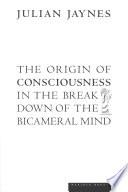
Julian Jaynes book The Origin of Consciousness in the Breakdown of the Bicameral Mind
Book I, Chapter 2, p. 66
The Origin of Consciousness in the Breakdown of the Bicameral Mind (1976)
Julian Jaynes was an American psychologist, best known for his book The Origin of Consciousness in the Breakdown of the Bicameral Mind , in which he argued that ancient peoples were not conscious.
Jaynes' definition of consciousness is synonymous with what philosophers call "meta-consciousness" or "meta-awareness", i.e., awareness of awareness, thoughts about thinking, desires about desires, beliefs about beliefs. This form of reflection is also distinct from the kinds of "deliberations" seen in other higher animals such as crows insofar as it is dependent on linguistic cognition.
Jaynes wrote that ancient humans before roughly 1000 BC were not reflectively meta-conscious and operated by means of automatic, nonconscious habit-schemas. Instead of having meta-consciousness, these humans were constituted by what Jaynes calls the "bicameral mind". For bicameral humans, when habit did not suffice to handle novel stimuli and stress rose at the moment of decision, neural activity in the "dominant" hemisphere was modulated by auditory verbal hallucinations originating in the so-called "silent" hemisphere , which were heard as the voice of a chieftain or god and immediately obeyed.
Jaynes wrote, "[For bicameral humans], volition came as a voice that was in the nature of a neurological command, in which the command and the action were not separated, in which to hear was to obey." Jaynes argued that the change from bicamerality to consciousness occurred over a period of ten centuries beginning around 1800 BC. The selection pressure for Jaynesian consciousness as a means for cognitive control is due, in part, to chaotic social disorganizations and the development of new methods of behavioral control such as writing."
Julian Jaynes book The Origin of Consciousness in the Breakdown of the Bicameral Mind
Book I, Chapter 2, p. 66
The Origin of Consciousness in the Breakdown of the Bicameral Mind (1976)
Julian Jaynes book The Origin of Consciousness in the Breakdown of the Bicameral Mind
Book I, Chapter 6, p. 137
The Origin of Consciousness in the Breakdown of the Bicameral Mind (1976)
Julian Jaynes book The Origin of Consciousness in the Breakdown of the Bicameral Mind
Book III, Chapter 6, p. 439
The Origin of Consciousness in the Breakdown of the Bicameral Mind (1976)
“Indeed, it is sometimes almost as if the problem had to be forgotten to be solved.”
Julian Jaynes book The Origin of Consciousness in the Breakdown of the Bicameral Mind
Book I, Chapter 1, p. 44
The Origin of Consciousness in the Breakdown of the Bicameral Mind (1976)
“The very reason we need logic at all is because most reasoning is not conscious at all.”
Julian Jaynes book The Origin of Consciousness in the Breakdown of the Bicameral Mind
Book I, Chapter 1, p. 41
The Origin of Consciousness in the Breakdown of the Bicameral Mind (1976)
“We know too much to command ourselves very far.”
Julian Jaynes book The Origin of Consciousness in the Breakdown of the Bicameral Mind
Book III, Chapter 4, p. 402
The Origin of Consciousness in the Breakdown of the Bicameral Mind (1976)
Julian Jaynes book The Origin of Consciousness in the Breakdown of the Bicameral Mind
Book I, Chapter 5, p. 103-104
The Origin of Consciousness in the Breakdown of the Bicameral Mind (1976)
“Every god is a jealous god after the breakdown of the bicameral mind.”
Julian Jaynes book The Origin of Consciousness in the Breakdown of the Bicameral Mind
Book III, Chapter 1, p. 336
The Origin of Consciousness in the Breakdown of the Bicameral Mind (1976)
“The king dead is a living god.”
Julian Jaynes book The Origin of Consciousness in the Breakdown of the Bicameral Mind
Book I, Chapter 6, p. 143 ( See also: Rene Girard, and James George Frazer)
The Origin of Consciousness in the Breakdown of the Bicameral Mind (1976)
“In a sense, we have become our own gods.”
Julian Jaynes book The Origin of Consciousness in the Breakdown of the Bicameral Mind
Book I, Chapter 3, p. 79
The Origin of Consciousness in the Breakdown of the Bicameral Mind (1976)
Context: And when it is suggested that the inward feelings of power or inward monitions or losses of judgement are the germs out of which the divine machinery developed, I return that truth is just the reverse, that the presence of voices which had to be obeyed were the absolute prerequisite to the conscious stage of mind in which it is the self that is responsible and can debate within itself, can order and direct, and that the creation of such a self is the product of culture. In a sense, we have become our own gods.
Julian Jaynes book The Origin of Consciousness in the Breakdown of the Bicameral Mind
Book III, Chapter 1, p. 318
The Origin of Consciousness in the Breakdown of the Bicameral Mind (1976)
Context: Behavior now must be changed from within the new consciousness rather than from Mosaic laws carving behavior from without. Sin and desire are now within conscious desire and conscious contrition, rather than in the external behaviors of the decalogue and the penances of temple sacrifice and community punishment. The divine kingdom to be regained is psychological not physical. It is metaphorical not literal. It is "within" not in extenso.
Julian Jaynes book The Origin of Consciousness in the Breakdown of the Bicameral Mind
Book I, Chapter 6, p. 132 (Italics as per text...)
The Origin of Consciousness in the Breakdown of the Bicameral Mind (1976)
Julian Jaynes book The Origin of Consciousness in the Breakdown of the Bicameral Mind
Book II, Chapter 3, p. 213 ( See also: The Exodus and Minoan eruption)
The Origin of Consciousness in the Breakdown of the Bicameral Mind (1976)
“And in this development lies the origin of civilization.”
Julian Jaynes book The Origin of Consciousness in the Breakdown of the Bicameral Mind
Book I, Chapter 6, p. 126
The Origin of Consciousness in the Breakdown of the Bicameral Mind (1976)
Context: The bicameral mind with its controlling gods was evolved as a final stage of the evolution of language. And in this development lies the origin of civilization.
“Reading in the third millennium B.C. may therefore have been a matter of hearing the cuneiform,”
Julian Jaynes book The Origin of Consciousness in the Breakdown of the Bicameral Mind
Book II, Chapter 2, p. 182
The Origin of Consciousness in the Breakdown of the Bicameral Mind (1976)
Context: Reading in the third millennium B. C. may therefore have been a matter of hearing the cuneiform, that is, hallucinating the speech from looking at its picture symbols, rather than visual reading of syllables in our sense.
Julian Jaynes book The Origin of Consciousness in the Breakdown of the Bicameral Mind
Book I, Chapter 2, p. 66
The Origin of Consciousness in the Breakdown of the Bicameral Mind (1976)
Julian Jaynes book The Origin of Consciousness in the Breakdown of the Bicameral Mind
Book II, Chapter 5, p. 280
The Origin of Consciousness in the Breakdown of the Bicameral Mind (1976)
Julian Jaynes book The Origin of Consciousness in the Breakdown of the Bicameral Mind
Book II, Chapter 3, p. 210 (See also: Karl Polanyi)
The Origin of Consciousness in the Breakdown of the Bicameral Mind (1976)
Context: Such trade was not, however, a true market. There were no prices under the pressures of supply and demand, no buying and selling, and no money. It was trade in the sense of equivalences established by divine decree. There is a complete lack of reference to business profits or loss in any of the cuneiform tablets that have been so far translated.
“Subjective conscious mind is an analog of what is called the real world.”
Julian Jaynes book The Origin of Consciousness in the Breakdown of the Bicameral Mind
Book I, Chapter 2, p. 55
The Origin of Consciousness in the Breakdown of the Bicameral Mind (1976)
Context: Subjective conscious mind is an analog of what is called the real world. It is built up with a vocabulary or lexical field whose terms are all metaphors or analogs of behavior in the physical world. Its reality is of the same order as mathematics. It allows us to shortcut behavioral processes and arrive at more adequate decisions. Like mathematics, it is an operator rather than a thing or repository. And it is intimately bound up with volition and decision.
“I shall state my thesis plain. The first poets were gods. Poetry began with the bicameral mind.”
Julian Jaynes book The Origin of Consciousness in the Breakdown of the Bicameral Mind
Book III, Chapter 3, p. 361
The Origin of Consciousness in the Breakdown of the Bicameral Mind (1976)
Julian Jaynes book The Origin of Consciousness in the Breakdown of the Bicameral Mind
Book I, Chapter 3, p. 75
The Origin of Consciousness in the Breakdown of the Bicameral Mind (1976)
Julian Jaynes book The Origin of Consciousness in the Breakdown of the Bicameral Mind
Book I, Chapter 2, p. 51
The Origin of Consciousness in the Breakdown of the Bicameral Mind (1976)
Context: It is not always obvious that metaphor has played this all-important function. But this is because the concrete metaphiers become hidden in phonemic change, leaving the words to exist on their own. Even such an unmetaphorical-sounding word as the verb 'to be' was generated from a metaphor. It comes from the Sanskrit bhu, “to grow, or make grow,” while the English forms 'am' and 'is' have evolved from the same root as the Sanskrit asmi, “to breathe.” It is something of a lovely surprise that the irregular conjugation of our most nondescript verb is thus a record of a time when man had no independent word for 'existence' and could only say that something 'grows' or that it “breathes.”
“Idolatry is still a socially cohesive force - its original function.”
Julian Jaynes book The Origin of Consciousness in the Breakdown of the Bicameral Mind
Book III, Chapter 1, p. 337
The Origin of Consciousness in the Breakdown of the Bicameral Mind (1976)
“Memory is the medium of the must-have-been.”
Julian Jaynes book The Origin of Consciousness in the Breakdown of the Bicameral Mind
Book I, Chapter 1, p. 30
The Origin of Consciousness in the Breakdown of the Bicameral Mind (1976)
Julian Jaynes book The Origin of Consciousness in the Breakdown of the Bicameral Mind
Introduction, p. 16
The Origin of Consciousness in the Breakdown of the Bicameral Mind (1976)
Julian Jaynes book The Origin of Consciousness in the Breakdown of the Bicameral Mind
Book I, Chapter 1, p. 23
The Origin of Consciousness in the Breakdown of the Bicameral Mind (1976)
“It is by metaphor that language grows.”
Julian Jaynes book The Origin of Consciousness in the Breakdown of the Bicameral Mind
Book I, Chapter 2, p. 49
The Origin of Consciousness in the Breakdown of the Bicameral Mind (1976)
“Civilization is the art of living in towns of such size that everyone does not know everyone else.”
Julian Jaynes book The Origin of Consciousness in the Breakdown of the Bicameral Mind
Book II, Chapter 1, p. 149
The Origin of Consciousness in the Breakdown of the Bicameral Mind (1976)
Julian Jaynes book The Origin of Consciousness in the Breakdown of the Bicameral Mind
Book II, Chapter 5, p. 274
The Origin of Consciousness in the Breakdown of the Bicameral Mind (1976)
Julian Jaynes book The Origin of Consciousness in the Breakdown of the Bicameral Mind
Book II, Chapter 6, p. 313
The Origin of Consciousness in the Breakdown of the Bicameral Mind (1976)
Julian Jaynes book The Origin of Consciousness in the Breakdown of the Bicameral Mind
Book III, Chapter 6, p. 435
The Origin of Consciousness in the Breakdown of the Bicameral Mind (1976)
Julian Jaynes book The Origin of Consciousness in the Breakdown of the Bicameral Mind
Book II, Chapter 2, p. 197
The Origin of Consciousness in the Breakdown of the Bicameral Mind (1976)
“The vestiges of the bicameral mind do not exist in any empty psychological space.”
Julian Jaynes book The Origin of Consciousness in the Breakdown of the Bicameral Mind
Book III, Chapter 2, p. 355
The Origin of Consciousness in the Breakdown of the Bicameral Mind (1976)
Julian Jaynes book The Origin of Consciousness in the Breakdown of the Bicameral Mind
Book III, Chapter 3, p. 374
The Origin of Consciousness in the Breakdown of the Bicameral Mind (1976)
“There is no such thing as a complete consciousness.”
Julian Jaynes book The Origin of Consciousness in the Breakdown of the Bicameral Mind
Book II, Chapter 5, p. 281
The Origin of Consciousness in the Breakdown of the Bicameral Mind (1976)
Julian Jaynes book The Origin of Consciousness in the Breakdown of the Bicameral Mind
Book II, Chapter 6, p. 299 (See also: John Milton)
The Origin of Consciousness in the Breakdown of the Bicameral Mind (1976)
“We can only know in the nervous system what we have known in behavior first.”
Julian Jaynes book The Origin of Consciousness in the Breakdown of the Bicameral Mind
Introduction, p. 18
The Origin of Consciousness in the Breakdown of the Bicameral Mind (1976)
Julian Jaynes book The Origin of Consciousness in the Breakdown of the Bicameral Mind
Book II, Chapter 6, p. 302
The Origin of Consciousness in the Breakdown of the Bicameral Mind (1976)
Julian Jaynes book The Origin of Consciousness in the Breakdown of the Bicameral Mind
Book III, Chapter 6, p. 445
The Origin of Consciousness in the Breakdown of the Bicameral Mind (1976)
As quoted in LIFE magazine (December 1988) http://www.humancondition.info/Beyond/ScienceReligion.html
Julian Jaynes book The Origin of Consciousness in the Breakdown of the Bicameral Mind
Book I, Chapter 2, p. 65-66
The Origin of Consciousness in the Breakdown of the Bicameral Mind (1976)
Julian Jaynes book The Origin of Consciousness in the Breakdown of the Bicameral Mind
Book III, Chapter 5, p. 405
The Origin of Consciousness in the Breakdown of the Bicameral Mind (1976)
Julian Jaynes book The Origin of Consciousness in the Breakdown of the Bicameral Mind
Book II, Chapter 2, p. 182
The Origin of Consciousness in the Breakdown of the Bicameral Mind (1976)


