“A mathematician may say anything he pleases, but a physicist must be at least partially sane.”
Quoted in R. B. Lindsay, "On the Relation of Mathematics and Physics," Scientific Monthly 59, 456 (Dec. 1944)
Attributed
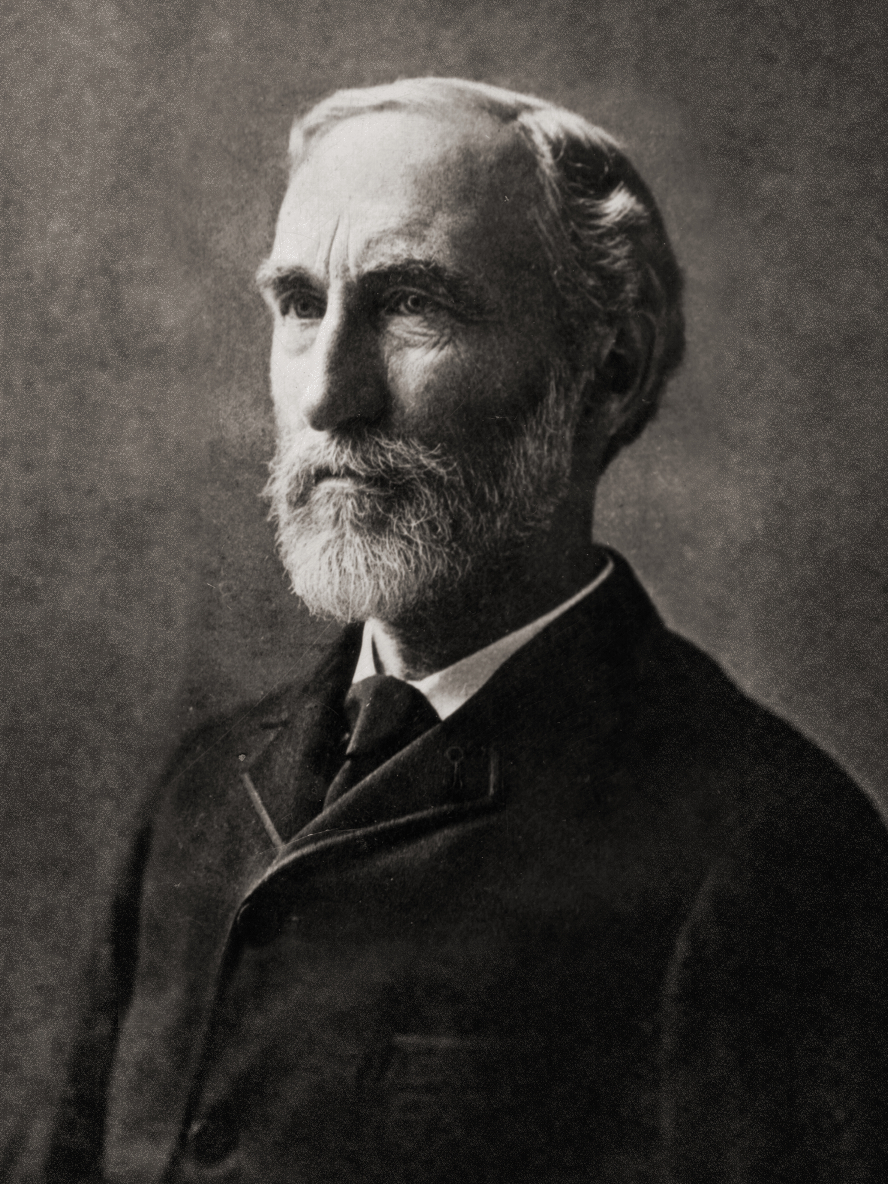
Josiah Willard Gibbs was an American scientist who made significant theoretical contributions to physics, chemistry, and mathematics. His work on the applications of thermodynamics was instrumental in transforming physical chemistry into a rigorous inductive science. Together with James Clerk Maxwell and Ludwig Boltzmann, he created statistical mechanics , explaining the laws of thermodynamics as consequences of the statistical properties of ensembles of the possible states of a physical system composed of many particles. Gibbs also worked on the application of Maxwell's equations to problems in physical optics. As a mathematician, he invented modern vector calculus .
In 1863, Yale awarded Gibbs the first American doctorate in engineering. After a three-year sojourn in Europe, Gibbs spent the rest of his career at Yale, where he was a professor of mathematical physics from 1871 until his death. Working in relative isolation, he became the earliest theoretical scientist in the United States to earn an international reputation and was praised by Albert Einstein as "the greatest mind in American history." In 1901, Gibbs received what was then considered the highest honour awarded by the international scientific community, the Copley Medal of the Royal Society of London, "for his contributions to mathematical physics."Commentators and biographers have remarked on the contrast between Gibbs's quiet, solitary life in turn of the century New England and the great international impact of his ideas. Though his work was almost entirely theoretical, the practical value of Gibbs's contributions became evident with the development of industrial chemistry during the first half of the 20th century. According to Robert A. Millikan, in pure science, Gibbs "did for statistical mechanics and thermodynamics what Laplace did for celestial mechanics and Maxwell did for electrodynamics, namely, made his field a well-nigh finished theoretical structure." Wikipedia
“A mathematician may say anything he pleases, but a physicist must be at least partially sane.”
Quoted in R. B. Lindsay, "On the Relation of Mathematics and Physics," Scientific Monthly 59, 456 (Dec. 1944)
Attributed
From the preface to Elementary Principles in Statististical Mechanics (1902), p. viii. Full book https://archive.org/details/elementaryprinc00gibbgoog
“The whole is simpler than its parts.”
Quoted by Irving Fisher in "The Applications of Mathematics to the Social Sciences," Bulletin of the American Mathematical Society 36, 225-243 (1930). Full article http://projecteuclid.org/euclid.bams/1183493954 <br class="br">Attributed
At a Yale faculty meeting, during a discussion of language requirements in the undergraduate curriculum. Quoted in Muriel Rukeyser, Willard Gibbs (Garden City, NY: Doubleday, Doran & Co., 1942), p. 280.
Attributed
From Gibbs's letter accepting the Rumford Medal (1881). Quoted in A. L. Mackay, Dictionary of Scientific Quotations (London, 1994).
Quoted by C. S. Hastings in "Biographical Memoir of Josiah Willard Gibbs 1839-1903," National Academy of Sciences Biographical Memoirs, vol. VI (Washington, D.C.: National Academy of Sciences, 1909), p. 390. Complete memoir http://books.nap.edu/html/biomems/jgibbs.pdf <br class="br">Attributed
From Gibbs's obituary for Rudolf Clausius (1889). See The Collected Works of J. Willard Gibbs, vol. 2 (New York: Longmans, Green and Co., 1928), p. 267. Complete volume http://www.archive.org/details/collectedworksj00longgoog
“Anyone having these desires will make these researches.”
About his own scientific work. Quoted in Muriel Rukeyser, Willard Gibbs (Garden City, NY: Doubleday, Doran & Co., 1942), p. 431.
Attributed
From Gibbs's obituary for Hubert Anson Newton (1897), in the Biographical Memoirs of the National Academy of Sciences http://www.nasonline.org/publications/biographical-memoirs/memoir-pdfs/hubert-newton.pdf.
From the preface to Elementary Principles in Statististical Mechanics (1902), p. ix.
Quoted in Muriel Rukeyser, Willard Gibbs (Garden City, NY: Doubleday, Doran & Co., 1942), p. 4.
Attributed


