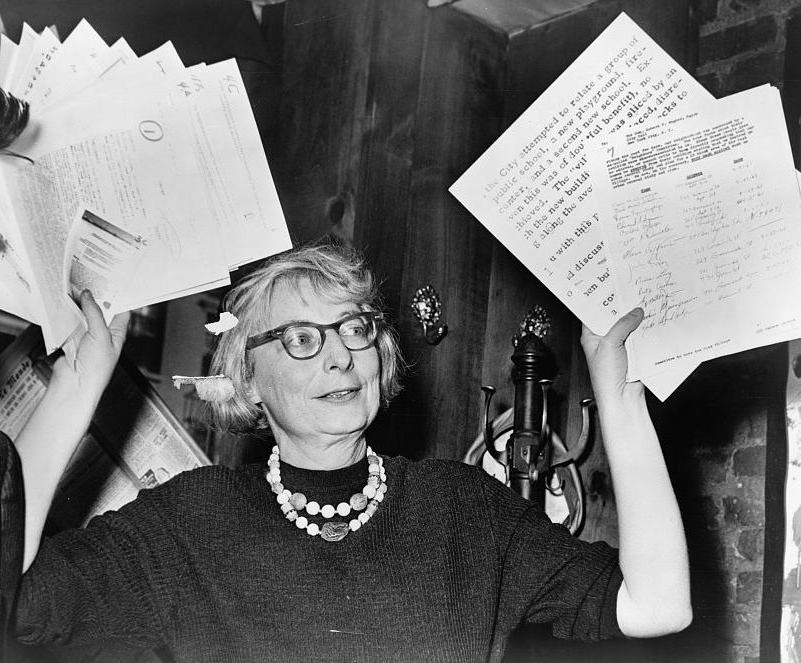
Political questionnaire response (1952)
Works
Dark Age Ahead
Jane Jacobs
The Death and Life of Great American Cities
Jane JacobsDark Age Ahead
Jane JacobsThe Death and Life of Great American Cities
Jane JacobsJane Jacobs: 26 quotes3 likes
Famous Jane Jacobs Quotes
“I did have an inkling that I was going to be a writer. That was my intention.”
Interview in Toronto Canada (6 September 2000), by Jim Kunstler, Metropolis Magazine (March 2001)
Jane Jacobs book Dark Age Ahead
Source: Dark Age Ahead (2004), Chapter One, The Hazard, p. 4
Jane Jacobs book Dark Age Ahead
Source: Dark Age Ahead (2004), Chapter Five, Dumb-Down Taxes, p. 115
Jane Jacobs book Dark Age Ahead
Source: Dark Age Ahead (2004), Chapter Four, Science Abandoned, p. 79
Jane Jacobs book Dark Age Ahead
Notes And Comments, p. 179
Dark Age Ahead (2004)
Jane Jacobs Quotes
Political questionnaire response (1952)
Context: I was brought up to believe that there is no virtue in conforming meekly to the dominant opinion of the moment. I was encouraged to believe that simple conformity results in stagnation for a society, and that American progress has been largely owing to the opportunity for experimentation, the leeway given initiative, and to a gusto and a freedom for chewing over odd ideas.
Jane Jacobs book Dark Age Ahead
Source: Dark Age Ahead (2004), Chapter Five, Dumb-Down Taxes, p. 103
Context: Subsidiarity is the principle that government works best — most responsibly and responsively — when it is closest to the people it serves and the needs it addresses. Fiscal accountability is the principle that institutions collecting and disbursing taxes work most responsibly when they are transparent to those providing the money.
Political questionnaire response (1952)
Context: I was taught that the American's right to be a free individual, not at the mercy of the state, was hard-won and that its price was eternal vigilance, that I too would have to be vigilant. I was made to feel that it would be a disgrace to me, as an individual, if I should not value or should give up rights that were dearly bought. I am grateful for that upbringing.
Political questionnaire response (1952)
Context: The other threat to the security of our tradition, I believe, lies at home. It is the current fear of radical ideas and of people who propound them. I do not agree with the extremists of either the left or the right, but I think they should be allowed to speak and to publish, both because they themselves have, and ought to have, rights, and once their rights are gone, the rights of the rest of us are hardly safe. Extremists typically want to squash not only those who disagree with them diametrically, but those who disagree with them at all. It seems to me that in every country where extremists of the left have gotten sufficiently in the saddle to squash the extremists of the right, they have ridden on to squash the center or terrorize it also. And the same goes for extremists of the right. I do not want that to happen in our country.
“This is both a gloomy and a hopeful book.”
Jane Jacobs book Dark Age Ahead
Source: Dark Age Ahead (2004), Chapter One, The Hazard, p. 3
Context: This is both a gloomy and a hopeful book.
The subject itself is gloomy. A Dark Age is a culture's dead end. We in North America and Western Europe, enjoying the many benefits of the culture conventionally known as the West, customarily think of a Dark Age as happening once, long ago, following the collapse of the Western Roman Empire. But in North America we live in a graveyard of lost aboriginal cultures, many of which were decisively finished off by mass amnesia in which even the memory of what was lost was also lost. Throughout the world Dark Ages have scrawled finis to successions of cultures receding far into the past.
Jane Jacobs book Dark Age Ahead
Source: Dark Age Ahead (2004), Chapter One, The Hazard, p. 3
Context: This is both a gloomy and a hopeful book.
The subject itself is gloomy. A Dark Age is a culture's dead end. We in North America and Western Europe, enjoying the many benefits of the culture conventionally known as the West, customarily think of a Dark Age as happening once, long ago, following the collapse of the Western Roman Empire. But in North America we live in a graveyard of lost aboriginal cultures, many of which were decisively finished off by mass amnesia in which even the memory of what was lost was also lost. Throughout the world Dark Ages have scrawled finis to successions of cultures receding far into the past.
“I had put a nickel in and just invested something.”
Interview in Toronto Canada (6 September 2000), by Jim Kunstler, Metropolis Magazine (March 2001) http://www.kunstler.com/mags_jacobs1.htm <br class="br">Context: I would spend a nickel on the subway and go arbitrarily to some other stop and look around there. So I was roaming the city in the afternoons and applying for jobs in the morning. And one day I found myself in a neighborhood I just liked so much…it was one of those times I had put a nickel in and just invested something. And where did I get out? I just liked the sound of the name: Christopher Street — so I got out at Christopher Street, and I was enchanted with this neighborhood, and walked around it all afternoon and then I rushed back to Brooklyn. And I said, "Betty I found out where we have to live."
“I would spend a nickel on the subway and go arbitrarily to some other stop and look around there.”
Interview in Toronto Canada (6 September 2000), by Jim Kunstler, Metropolis Magazine (March 2001) http://www.kunstler.com/mags_jacobs1.htm <br class="br">Context: I would spend a nickel on the subway and go arbitrarily to some other stop and look around there. So I was roaming the city in the afternoons and applying for jobs in the morning. And one day I found myself in a neighborhood I just liked so much…it was one of those times I had put a nickel in and just invested something. And where did I get out? I just liked the sound of the name: Christopher Street — so I got out at Christopher Street, and I was enchanted with this neighborhood, and walked around it all afternoon and then I rushed back to Brooklyn. And I said, "Betty I found out where we have to live."
“Credentialing, not education, has become the primary business of North American universities.”
Jane Jacobs book Dark Age Ahead
Source: Dark Age Ahead (2004), Chapter Three, Credentialing Versus Educating, p. 44
“Redundancy is expensive but indispensable.”
Jane Jacobs book Dark Age Ahead
Source: Dark Age Ahead (2004), Chapter Seven, Unwinding Vicious Spirals, p. 159
Jane Jacobs book Dark Age Ahead
Source: Dark Age Ahead (2004), Chapter Two, Families Rigged To Fail, p. 29
“In wretched outcomes, the devil is in the details.”
Jane Jacobs book Dark Age Ahead
Source: Dark Age Ahead (2004), Chapter Seven, Unwinding Vicious Spirals, p. 153
“A region is an area safely larger than the last one to whose problems we found no solution.”
Jane Jacobs book The Death and Life of Great American Cities
Source: The Death and Life of Great American Cities (1961), p. 410
Jane Jacobs book Dark Age Ahead
Source: Dark Age Ahead (2004), Chapter Eight, Dark Age Patterns, p. 175
Jane Jacobs book Dark Age Ahead
Source: Dark Age Ahead (2004), Chapter One, The Hazard, p. 5
Jane Jacobs book Dark Age Ahead
Notes And Comments, p. 189
Dark Age Ahead (2004)
Jane Jacobs book The Death and Life of Great American Cities
Source: The Death and Life of Great American Cities (1961), p. 71
Jane Jacobs book Dark Age Ahead
Source: Dark Age Ahead (2004), Chapter Four, Science Abandoned, p. 64-65
Jane Jacobs book The Death and Life of Great American Cities
Source: The Death and Life of Great American Cities (1961), p. 30
Jane Jacobs book Dark Age Ahead
Source: Dark Age Ahead (2004), Chapter Six, Self-Policing Subverted, p. 131


