
Gordon R. Dickson book Necromancer
Source: Necromancer (1962), Chapter 5 (p. 36)
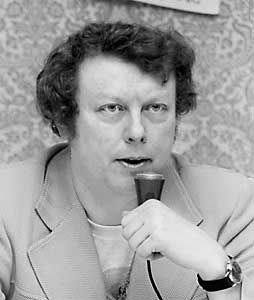
Gordon Rupert Dickson was a Canadian-American science fiction writer. He was inducted into the Science Fiction and Fantasy Hall of Fame in 2000. Wikipedia
Gordon R. Dickson book Necromancer
Source: Necromancer (1962), Chapter 5 (p. 36)
“Why should there be some sort of virtue always attributed to a frank admission of vice?”
Gordon R. Dickson book Dorsai!
“Protector II” (section 19, p. 490)
Dorsai! (1960)
Gordon R. Dickson book Tactics of Mistake
Epigram (p. 153)
Tactics of Mistake (1971)
The Mortal and the Monster, in Stellar Short Novels edited by Judy-Lynn del Rey, p. 23
Short fiction
Gordon R. Dickson book Necromancer
Source: Necromancer (1962), Chapter 22 (p. 142)
Gordon R. Dickson book Tactics of Mistake
Source: Tactics of Mistake (1971), Chapter 16 (p. 280)
Gordon R. Dickson book Tactics of Mistake
Source: Tactics of Mistake (1971), Chapter 22 (p. 328)
Gordon R. Dickson book Necromancer
Source: Necromancer (1962), Chapter 13 (p. 93)
Gordon R. Dickson book Dorsai!
“Mercenary II” (section 4, p. 386)
Dorsai! (1960)
“Exaggeration of confidence,” he said, “is a fault in people who don’t know their business.”
Gordon R. Dickson book Tactics of Mistake
This is an early statement of what would come to be known as the Dunning–Kruger effect.
Source: Tactics of Mistake (1971), Chapter 20 (p. 315).
Gordon R. Dickson book Tactics of Mistake
Source: Tactics of Mistake (1971), Chapter 22 (p. 334)
Gordon R. Dickson book Dorsai!
“Veteran” (section 8, p. 411)
Dorsai! (1960)
Gordon R. Dickson book Dorsai!
“Protector II” (section 19, p. 488)
Dorsai! (1960)
Gordon R. Dickson book Tactics of Mistake
Source: Tactics of Mistake (1971), Chapter 6 (p. 195)
Gordon R. Dickson book Tactics of Mistake
Source: Tactics of Mistake (1971), Chapter 24 (p. 349)
“And someone that brilliant must be a devil?”
Gordon R. Dickson book Dorsai!
queried Galt, dryly.
“Not at all,” explained Donal, patiently. “But having such intellectual capabilities, a man must show proportionately greater inclinations toward either good or evil than lesser people. If he tends toward evil, he may mask it in himself—he may even mask its effect on the people with which he surrounds himself. But he has no way of producing the reflections of good which would ordinarily be reflected from his lieutenants and initiates—and which, if he was truly good—he would have no reason to try and hide. And by that lack, you can read him.”
“Mercenary II” (section 4, p. 386)
Dorsai! (1960)


.jpg)