“Wisdom too often never comes, and so one ought not to reject it merely because it comes late.”
Dissenting, Henslee v. Union Planters National Bank & Trust Co., 335 U.S. 600 (1949).
Judicial opinions
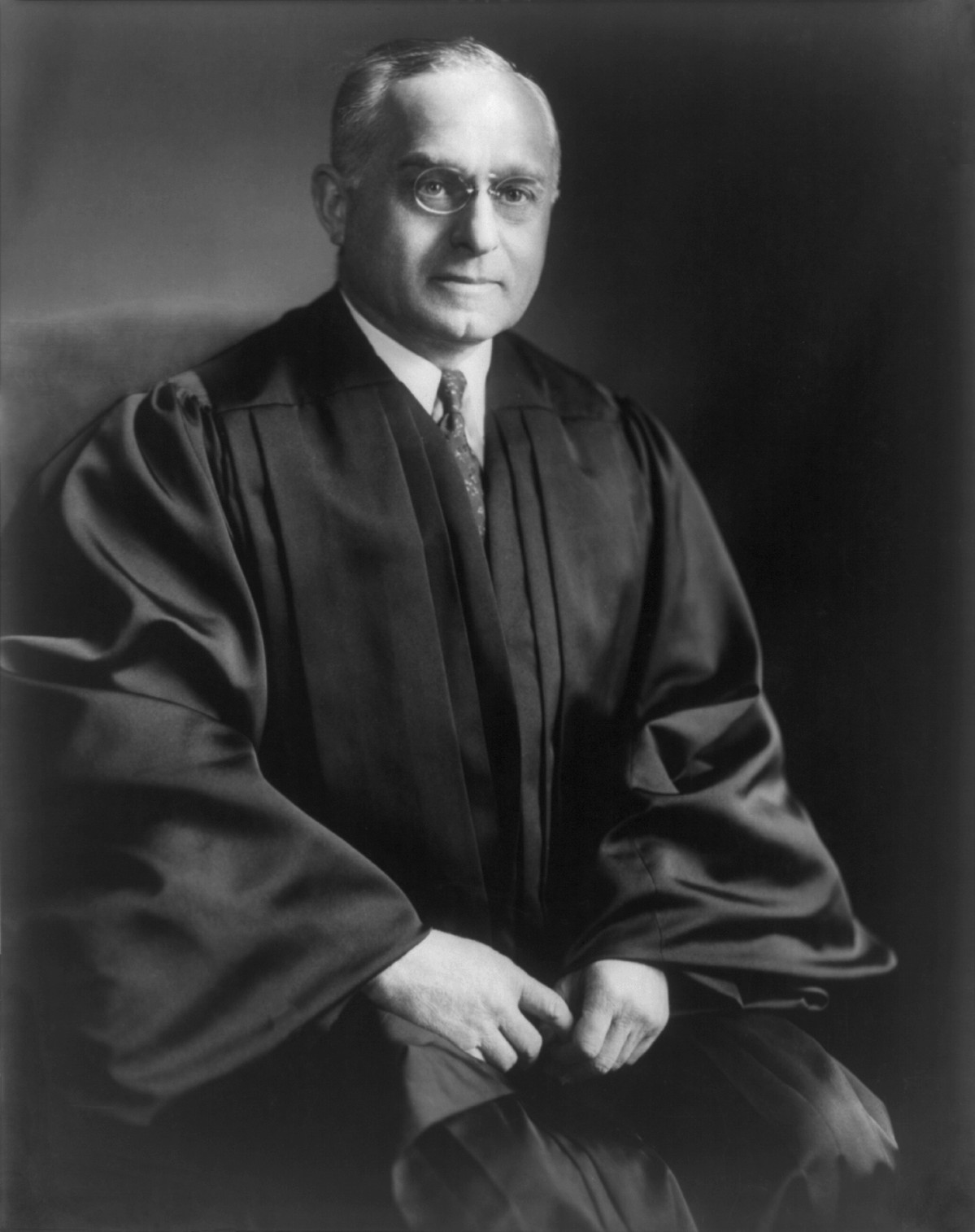
Felix Frankfurter was an Austrian-born American jurist who served as an Associate Justice of the Supreme Court of the United States from 1939 until 1962, during which period he was a noted advocate of judicial restraint in its judgements.
Frankfurter was born in Vienna, immigrating to New York City at the age of 12. After graduating from Harvard Law School, Frankfurter worked for Henry L. Stimson, the U.S. Secretary of War. During World War I, Frankfurter served as Judge Advocate General. After the war, he helped found the American Civil Liberties Union and returned to his position as a professor at Harvard Law School. He became a friend and adviser of President Franklin D. Roosevelt, who appointed him to fill the Supreme Court vacancy caused by the death of Benjamin N. Cardozo. His adherence to judicial restraint during an era where conservative justices wielded the judicial power through the derogation canon and the "plain meaning rule" to strike down progressive laws has been described as liberal by some commentators.Frankfurter served on the Court until his retirement in 1962, and was succeeded by Arthur Goldberg. Frankfurter wrote the Court's majority opinions in cases such as Minersville School District v. Gobitis, Gomillion v. Lightfoot, and Beauharnais v. Illinois. He wrote dissenting opinions in notable cases such as Baker v. Carr, West Virginia State Board of Education v. Barnette, Glasser v. United States, and Trop v. Dulles. Wikipedia
“Wisdom too often never comes, and so one ought not to reject it merely because it comes late.”
Dissenting, Henslee v. Union Planters National Bank & Trust Co., 335 U.S. 600 (1949).
Judicial opinions
Barsky v. Board of Regents, 347 U.S. 442, 470 (1954).
Judicial opinions
Watts v. Indiana, 338 U.S. 49, 52 (1949).
Judicial opinions
Phelps Dodge Corp. v. National Labor Relations Board, 313 U.S. 177, 185-186 (1941).
Judicial opinions
“To be effective, judicial administration must not be leaden-footed.”
Cobbledick v. United States, 309 U.S. 323, 324 (1940).
Judicial opinions
Dennis v. United States, 241 U.S. 494, 556 (1951).
Judicial opinions
Source: Other writings, Felix Frankfurter Reminisces (1960), P. 189.
A Heritage For All Who Love The Law 51 ABAJ 330 (1965); quoted by United States Senator Howell Heflin during the confirmation debate for Justice David Souter, on September 24, 1990, S13540.
Other writings
Twenty Years of Mr. Justice Holmes' Constitutional Opinions, 36 HARV. L. REV. 909, 931 (1923).
Other writings
Foreward, to "Memorial issue for Robert H. Jackson", 55 Columbia Law Review (April, 1955) p. 436; quoted by United States Senator Howell Heflin during the confirmation debate for Justice David Souter, on September 24, 1990, S13540.
Other writings
“I know of no title that I deem more honorable than that of Professor of the Harvard Law School.”
Of Law and Life and Other Things: Papers and Address of Felix Frankfurter (1965).
Other writings
Concurring, United States v. United Mine Workers, 330 U.S. 312 (1946).
Judicial opinions
“The history of liberty has largely been the history of the observance of procedural safeguards.”
Writing for the court, McNabb v. United States, 318 U.S. 332 (1943).
Judicial opinions
The Supreme Court, vol. 3, no. 1, Parliamentary Affairs (London, Winter 1949).
Other writings
Davis v. United States, 328 U.S. 582, 597 (1946).
Judicial opinions
United States v. Rabinowitz, 339 U.S. 56, 69 (1950).
Judicial opinions
Dissenting, West Virginia State Board of Education v. Barnett, 319 U.S. 624 (1943).
Judicial opinions
“Gratitude is one of the least articulate of the emotions, especially when it is deep.”
Speech accepting an award from the National Institute for Immigrant Welfare, Biltmore Hotel, New York (May 11, 1933).
Other writings
Context: Gratitude is one of the least articulate of the emotions, especially when it is deep. I can express with very limited adequacy the passionate devotion to this land that possesses millions of our people, born, like myself, under other skies, for the privilege that that this county has bestowed in allowing them to partake of its fellowship.
Writing for the court, Milk Wagon Drivers Union of Chicago, Local 753. v. Meadowmoor Dairies, Inc., 312 U.S. 287 (1941).
Judicial opinions
Context: It must never be forgotten, however, that the Bill of Rights was the child of the Enlightenment. Back of the guarantee of free speech lay faith in the power of an appeal to reason by all the peaceful means for gaining access to the mind. It was in order to avert force and explosions due to restrictions upon rational modes of communication that the guarantee of free speech was given a generous scope. But utterance in a context of violence can lose its significance as an appeal to reason and become part of an instrument of force. Such utterance was not meant to be sheltered by the Constitution.
“National unity is the basis of national security.”
Minersville School District v. Gobitis, 310 U.S. 586 (1940).
Judicial opinions
Context: National unity is the basis of national security. To deny the legislature the right to select appropriate means for its attainment presents a totally different order of problem from that of the propriety of subordinating the possible ugliness of littered streets to the free expression opinion through handbills.
Callanan v. United States, 364 U.S. 587, 594 (1961).
Judicial opinions
Reply to counsel who said a challenge from the bench was “just a matter of semantics,” Reader’s Digest (June 1964).
Other writings
“But answers are not obtained by putting the wrong question and thereby begging the real one.”
Dissenting, Priebe and Sons v. United States, 332 U.S. 407, 420 (1947).
Judicial opinions
Context: If one starts with the assumption that, in the absence of specific Congressional authority, a fixed rule of law precludes contracting officers from providing in a Government contract terms reasonably calculated to assure its performance even though there be no money loss through a particular default, there is no problem. But answers are not obtained by putting the wrong question and thereby begging the real one.
Quoted in National Observer (Silver Spring, Maryland, March 1, 1965).
Other writings
“Lines should not be drawn simply for the sake of drawing lines”
Dissenting in Pearce v. Commissioner of Internal Revenue, 315 U.S. 543, 558 (1942).
Judicial opinions
Context: The line must follow some direction of policy, whether rooted in logic or experience. Lines should not be drawn simply for the sake of drawing lines.
Rogers v. Richmond, 365 U.S. 534, 540-41 (1961).
Judicial opinions
Context: Convictions following the admission into evidence of confessions which are involuntary, i. e., the product of coercion, either physical or psychological, cannot stand. This is so not because such confessions are unlikely to be true but because the methods used to extract them offend an underlying principle in the enforcement of our criminal law: that ours is an accusatorial and not an inquisitorial system — a system in which the State must establish guilt by evidence independently and freely secured and may not by coercion prove its charges against an accused out of his own mouth.
Dissenting in New York v. United States, 331 U.S. 284, 353 (1947).
Judicial opinions
Writing for the court, Rochin v. California, 342 U.S. 165 (1952). The unanimous decision reversed the conviction of an alleged drug addict because evidence was obtained by forced stomach pumping.
Judicial opinions
“Ambiguity lurks in generality and may thus become an instrument of severity.”
McComb v. Jacksonville Paper Co., 336 U.S. 187, 197 (1949).
Judicial opinions
“The indispensible judicial requisite is intellectual humility.”
Concurring, American Federation of Labor v. American Sash & Door Co., 335 U.S. 538 (1949).
Judicial opinions
“The Amendment nullifies sophisticated as well as simple-minded modes of discrimination.”
On the Fifteenth Amendment; writing for the court, Lane v. Wilson, 307 U.S. 268, 275 (1939).
Judicial opinions
“Litigation is the pursuit of practical ends, not a game of chess.”
Indianapolis v. Chase Nat'l Bank, 314 U.S. 63, 69 (1941).
Other writings
Reported in Proceedings in honor of Mr. Justice Frankfurter and distinguished alumni at the meeting of the Council, Harvard Law School Association in Cambridge, April 30, 1960.
Other writings
Concurring, Dennis v. United States, 339 U.S. 162, 184 (1950).
Judicial opinions
First Iowa Coop. v. Power Comm'n., 328 U.S. 152, 187 (1946).
Judicial opinions
On Oliver Wendell Holmes, Jr. and Ralph Waldo Emerson, p. 59.
Other writings, Felix Frankfurter Reminisces (1960)
Concurring, Tiller v. Atlantic Coast Line Railroad Co., 318 U.S. 54 (1943).
Judicial opinions
“After all, this is the Nation's ultimate judicial tribunal, nor a super-legal-aid bureau.”
Dissent, Uveges v. Pennsylvania, 335 U.S. 437 (1948).
Judicial opinions
“No judge writes on a wholly clean slate.”
The Commerce Clause (1937), p. 12.
Other writings
“The most constructive way of resolving conflicts is to avoid them.”
Concurring, Western Pacific Railroad Corp. v. Western Pacific Railroad Co., 345 U.S. 247, 270 (1953).
Judicial opinions
Craig v. Harney, 331 U.S. 367, 392 (1947).
Judicial opinions
Dissenting, West Virginia State Board of Education v. Barnett, 319 U.S. 624, 642 (1943).
Judicial opinions
Alleghany Corp. v. Breswick & Co., 353 U.S. 151, 170 (1957).
Judicial opinions
“Morals are three-quarters manners.”
Source: Other writings, Felix Frankfurter Reminisces (1960), P. 12. In the interview, Phillips quotes the line to Frankfurter from a letter written by the Justice, and Frankfurter attributes the phrase to a friend named Matthew Arnold.
Quoted by Garson Kanin in Atlantic (March 1964).
Other writings
Holmes said, "That was the second great lesson — humility."
Source: Other writings, Felix Frankfurter Reminisces (1960), P. 59.
Frank v. Maryland, 359 U.S. 360, 372 (1959); majority opinion in 5-4 ruling that allowed health inspectors to enter a private home without a search warrant (May 4, 1959).
Judicial opinions
“In this Court dissents have gradually become majority opinions.”
Concurring, Graves v. New York ex rel. O'Keefe, 306 U.S. 446 (1939).
Judicial opinions
“Decisions of this Court do not have intrinsic authority.”
Adamson v. California, 332 U.S. 46, 59 (1947).
Judicial opinions
“No court can make time stand still.”
Writing for the court, Scripps-Howard Radio, Inc. v. FCC, 316 U.S. 4 (1942).
Judicial opinions
New York Times (November 28, 1954).
Judicial opinions
Concurring, Cooper v. Aaron, 358 U.S. 1 (1958).
Judicial opinions
Concurring, Graves v. New York ex rel. O'Keefe, 306 U.S. 446 (1939).
Judicial opinions
“In law also the emphasis makes the song.”
Bethlehem Steel Co. v. New York State Labor Relations Board 330 U.S. 767, 780 (1947).
Judicial opinions
Dissenting, Baker v. Carr, 369 U.S. 186 (1962).
Judicial opinions
Nashville, Chattanooga & St. Louis Railway. v. Browning, 310 U.S. 362, 369 (1940).
Judicial opinions
“Appeal must be to an informed, civically militant electorate.”
Dissenting, Baker v. Carr, 369 U.S. 186, 270 (1962).
Judicial opinions
"'The Administrative Side' of Chief Justice Hughes", 63 Harvard Law Review 1, 2 (1949).
Other writings
“If nowhere else, in the relation between Church and State, "good fences make good neighbors."”
McCollum v. Board of Education, 333 U.S. 203, 232 (1948).
Judicial opinions
Concurring, American Federation of Labor v. American Sash & Door Co., 335 U.S. 538, 557 (1949).
Judicial opinions
First Iowa Coop. v. Power Comm'n., 328 U.S. 152, 188 (1946).
Judicial opinions
"The Supreme Court in the Mirror of Justice," University of Pennsylvania Law Review (April, 1957), p. 786.
Other writings
“The mode by which the inevitable is reached is effort.”
Quoted by Garson Kanin in Atlantic (March 1964).
Other writings
Davis v. United States, 328 U.S. 582, 597 (1946).
Judicial opinions
Rogers v. Richmond, 365 U.S. 534, 540-41 (1961).
Judicial opinions
The scope and nature of the constitutional guarantee of the freedom of the press are to be viewed and applied in that light.
New York Times (November 28, 1954).
Judicial opinions


