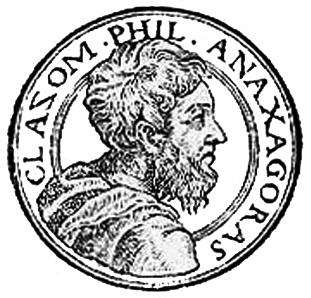
Anaxagoras Quotes

Anaxagoras was a Pre-Socratic Greek philosopher. Born in Clazomenae at a time when Asia Minor was under the control of the Persian Empire, Anaxagoras came to Athens. According to Diogenes Laërtius and Plutarch, in later life he was charged with impiety and went into exile in Lampsacus; the charges may have been political, owing to his association with Pericles, if they were not fabricated by later ancient biographers.Responding to the claims of Parmenides on the impossibility of change, Anaxagoras described the world as a mixture of primary imperishable ingredients, where material variation was never caused by an absolute presence of a particular ingredient, but rather by its relative preponderance over the other ingredients; in his words, "each one is... most manifestly those things of which there are the most in it". He introduced the concept of Nous as an ordering force, which moved and separated out the original mixture, which was homogeneous, or nearly so.

He also gave a number of novel scientific accounts of natural phenomena. He deduced a correct explanation for eclipses and described the sun as a fiery mass larger than the Peloponnese, as well as attempting to explain rainbows and meteors. Wikipedia  

✵ 500 BC – 428 BC
Anaxagoras photo
Anaxagoras: 7 quotes3 likes

Famous Anaxagoras Quotes

“All things were together, infinite both in number and in smallness; for the small too was infinite.”

Anaxagoras

Frag. B 1, quoted in John Burnet's Early Greek Philosophy, (1920), Chapter 6.

“The sun provides the moon with its brightness.”

Anaxagoras

Fragment in Plutarch De facie in orbe lunae, 929b, as quoted in The Riverside Dictionary of Biography (2005), p. 23

“Wrongly do the Greeks suppose that aught begins or ceases to be; for nothing comes into being or is destroyed; but all is an aggregation or secretion of pre-existent things: so that all-becoming might more correctly be called becoming-mixed, and all corruption, becoming-separate.”

Anaxagoras

quoted in Heinrich Ritter, Tr. from German by Alexander James William Morrison, The History of Ancient Philosophy, Vol.1 http://books.google.com/books?id=pUgXAQAAMAAJ&pg=PA284 (1838)

“Mind is infinite and self-ruled, and is mixed with nothing, but is alone itself by itself.”

Anaxagoras

Frag. B 12, quoted in John Burnet's Early Greek Philosophy, (1920), Chapter 6.

Similar authors

Xenophon photo
Xenophon21
ancient Greek historian and philosopher None
Epicurus photo
Epicurus30
ancient Greek philosopher None
Isocrates photo
Isocrates23
ancient greek rhetorician None
Thales photo
Thales9
ancient Greek philosopher and mathematician None
Protagoras photo
Protagoras6
pre-Socratic Greek philosopher None
Pythagoras photo
Pythagoras121
ancient Greek mathematician and philosopher None
Plato photo
Plato80
Classical Greek philosopher None
Hippocrates photo
Hippocrates33
ancient Greek physician None
Plutarch photo
Plutarch251
ancient Greek historian and philosopher None
Aesop photo
Aesop36
ancient Greek storyteller None