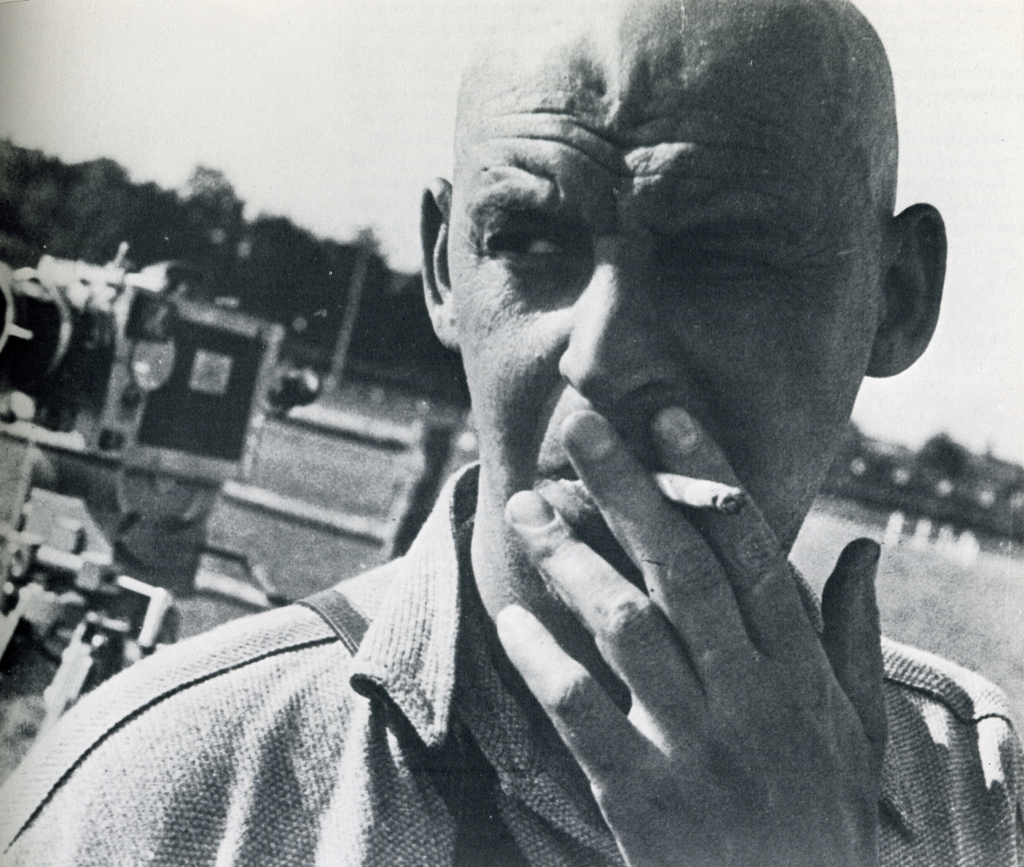
Alexander Rodchenko Quotes

Aleksander Mikhailovich Rodchenko was a Russian artist, sculptor, photographer and graphic designer. He was one of the founders of constructivism and Russian design; he was married to the artist Varvara Stepanova.

Rodchenko was one of the most versatile Constructivist and Productivist artists to emerge after the Russian Revolution. He worked as a painter and graphic designer before turning to photomontage and photography. His photography was socially engaged, formally innovative, and opposed to a painterly aesthetic. Concerned with the need for analytical-documentary photo series, he often shot his subjects from odd angles—usually high above or down below—to shock the viewer and to postpone recognition. He wrote: "One has to take several different shots of a subject, from different points of view and in different situations, as if one examined it in the round rather than looked through the same key-hole again and again." Wikipedia  

✵ 23. November 1891 – 3. December 1956
Alexander Rodchenko photo
Alexander Rodchenko: 3 quotes0 likes

Famous Alexander Rodchenko Quotes

“I reduced painting to its logical conclusion and exhibited three canvases: red, blue and yellow. I affirmed: it's all over. Basic colors. Every plane is a plane and there is to be no representation.”

Alexander Rodchenko

Quote in: &#x27;The Death of Painting&#x27;; from the MoMA-website: Interactives: texts https://www.moma.org/interactives/exhibitions/1998/rodchenko/texts/death_of_painting.html <br class="br">Rodchenko is looking back: in 1921 he executed what were arguably some of the first true monochromes (artworks of one color; source, Wikipedia:Rodchenko)

“[my goal is] to photograph not a factory but the work itself from the most effective point of view.... in order to show the grandness of a machine, one should photograph not all of it but give a series of snapshots.”

Alexander Rodchenko

Quote, 1930: from Rodchenko lecture at the October group's meeting; as quoted by Margarita Tupitsyn in Chapter 'Fragmentation versus Totality: The Politics of (De)framing', in The great Utopia - The Russian and Soviet Avant-Garde, 1915-1932; Guggenheim Museum, New York, 1992, p. 486
the issue was not to take 'photo pictures' of the entire object but to make 'photo stills' of characteristic parts of an object

Similar authors

Vitaly Ginzburg photo
Vitaly Ginzburg2
Russian Physicist None
Vladimir Mayakovsky photo
Vladimir Mayakovsky14
Russian and Soviet poet, playwright, artist and stage and f… None
Borís Pasternak photo
Borís Pasternak40
Russian writer None
Aleksandr Solzhenitsyn photo
Aleksandr Solzhenitsyn120
Russian writer None
Wassily Leontief photo
Wassily Leontief10
Russian economist None
Maxim Gorky photo
Maxim Gorky10
Russian and Soviet writer None
Vladimir Nabokov photo
Vladimir Nabokov193
Russian-American novelist, lepidopterist, professor None
Vladimir Lenin photo
Vladimir Lenin336
Russian politician, led the October Revolution None
Anna Akhmatova photo
Anna Akhmatova99
Russian modernist poet None
Karl Lagerfeld photo
Karl Lagerfeld57
German fashion designer None