
G. K. Chesterton book Tremendous Trifles
Source: Tremendous Trifles (1909), Ch. XXXI: "The Riddle of the Ivy"
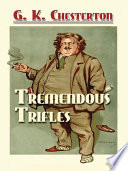
Chesterton's 39 essays result from "sitting still and letting marvels and adventures settle on him like flies." Full of both good sense and nonsense, his commentaries on finding the extraordinary within the ordinary are delightful.
G. K. Chesterton book Tremendous Trifles
Source: Tremendous Trifles (1909), Ch. XXXI: "The Riddle of the Ivy"
“The world will never starve for want of wonders; but only for want of wonder.”
G. K. Chesterton book Tremendous Trifles
Tremendous Trifles (1909), Ch. 1.
“Art is limitation…. The most beautiful part of every picture is the frame.”
G. K. Chesterton book Tremendous Trifles
Tremendous Trifles (1909)
G. K. Chesterton book Tremendous Trifles
Tremendous Trifles (1909)
Context: For my friend said that he opened his intellect as the sun opens the fans of a palm tree, opening for opening's sake, opening infinitely for ever. But I said that I opened my intellect as I opened my mouth, in order to shut it again on something solid. I was doing it at the moment. And as I truly pointed out, it would look uncommonly silly if I went on opening my mouth infinitely, for ever and ever.
G. K. Chesterton book Tremendous Trifles
Tremendous Trifles (1909), XVII: "The Red Angel"<br>Paraphrased Variant: Fairy tales are more than true — not because they tell us dragons exist, but because they tell us dragons can be beaten.<br>The earliest known attribution of this was an epigraph in Coraline (2004) by Neil Gaiman; when questioned on this at his official Tumblr account http://neil-gaiman.tumblr.com/post/42909304300/my-moms-a-librarian-and-planning-to-put-literary, Gaiman admitted to misquoting Chesterton: "It’s my fault. When I started writing Coraline, I wrote my version of the quote in Tremendous Trifles, meaning to go back later and find the actual quote, as I didn’t own the book, and this was before the Internet. And then ten years went by before I finished the book, and in the meantime I had completely forgotten that the Chesterton quote was mine and not his.<br>I’m perfectly happy for anyone to attribute it to either of us. The sentiment is his, the phrasing is mine.<br>Paraphrased variant: Fairytales don’t tell children that dragons exist. Children already know that dragons exist. Fairytales tell children that dragons can be killed.<br>Appeared in Criminal Minds 2007 episode Seven Seconds ( IMDB quote entry http://www.imdb.com/title/tt1103432/quotes?item=qt1184717) <br class="br">Context: Fairy tales, then, are not responsible for producing in children fear, or any of the shapes of fear; fairy tales do not give the child the idea of the evil or the ugly; that is in the child already, because it is in the world already. Fairy tales do not give the child his first idea of bogey. What fairy tales give the child is his first clear idea of the possible defeat of bogey. The baby has known the dragon intimately ever since he had an imagination. What the fairy tale provides for him is a St. George to kill the dragon. Exactly what the fairy tale does is this: it accustoms him for a series of clear pictures to the idea that these limitless terrors had a limit, that these shapeless enemies have enemies in the knights of God, that there is something in the universe more mystical than darkness, and stronger than strong fear.


