Quotes from book
Tractatus Logico-Philosophicus

Tractatus Logico-Philosophicus
Ludwig WittgensteinOriginal title Logisch-Philosophische Abhandlung (German, 1921)

The Tractatus Logico-Philosophicus is the only book-length philosophical work by the Austrian philosopher Ludwig Wittgenstein that was published during his lifetime. The project had a broad goal: to identify the relationship between language and reality and to define the limits of science. It is recognized by philosophers as a significant philosophical work of the twentieth century. G. E. Moore originally suggested the work's Latin title as homage to the Tractatus Theologico-Politicus by Baruch Spinoza.Wittgenstein wrote the notes for the Tractatus while he was a soldier during World War I and completed it during a military leave in the summer of 1918. It was first published in German in 1921 as Logisch-Philosophische Abhandlung. The Tractatus was influential chiefly amongst the logical positivist philosophers of the Vienna Circle, such as Rudolf Carnap and Friedrich Waismann. Bertrand Russell's article "The Philosophy of Logical Atomism" is presented as a working out of ideas that he had learned from Wittgenstein.The Tractatus employs an austere and succinct literary style. The work contains almost no arguments as such, but rather consists of declarative statements, or passages, that are meant to be self-evident. The statements are hierarchically numbered, with seven basic propositions at the primary level , with each sub-level being a comment on or elaboration of the statement at the next higher level . In all, the Tractatus comprises 526 numbered statements.
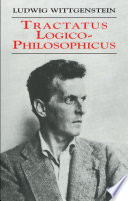

Ludwig Wittgenstein photo

“A tautology's truth is certain, a proposition's possible, a contradiction's impossible.”

Ludwig Wittgenstein book Tractatus Logico-Philosophicus

Certain, possible, impossible: here we have the first indication of the scale that we need in the theory of probability.
4.464
Original German: Die Wahrheit der Tautologie ist gewiss, des Satzes möglich, der Kontradiktion unmöglich
Source: 1920s, Tractatus Logico-Philosophicus (1922)

Ludwig Wittgenstein photo

“It is clear that the causal nexus is not a nexus at all.”

Ludwig Wittgenstein book Tractatus Logico-Philosophicus

Journal entry (12 October 1916), p. 84e
1910s, Notebooks 1914-1916
Source: Tractatus Logico-Philosophicus

Ludwig Wittgenstein photo

“Language disguises thought.”

Ludwig Wittgenstein book Tractatus Logico-Philosophicus

Source: Tractatus Logico-Philosophicus

Ludwig Wittgenstein photo

“Ethics and aesthetics are one.”

Ludwig Wittgenstein book Tractatus Logico-Philosophicus

Source: Tractatus Logico-Philosophicus

Ludwig Wittgenstein photo

“Translated: Whereof one cannot speak, thereof one must be silent.”

Ludwig Wittgenstein book Tractatus Logico-Philosophicus

7
Wovon man nicht sprechen kann, darüber muss man schweigen.
Also: About what one can not speak, one must remain silent. (7)
Source: 1920s, Tractatus Logico-Philosophicus (1922)

Similar authors

Ludwig Wittgenstein photo
Ludwig Wittgenstein228
Austrian-British philosopher 1889–1951
Erwin Schrödinger photo
Erwin Schrödinger67
Austrian physicist None
Friedrich Hayek photo
Friedrich Hayek79
Austrian and British economist and Nobel Prize for Economic… None
Stefan Zweig photo
Stefan Zweig106
Austrian writer None
Elfriede Jelinek photo
Elfriede Jelinek50
Austrian writer None
Ludwig von Mises photo
Ludwig von Mises62
austrian economist None
Rudolf Steiner photo
Rudolf Steiner20
Austrian esotericist None
Martin Buber photo
Martin Buber58
German Jewish Existentialist philosopher and theologian None
Wolfgang Pauli photo
Wolfgang Pauli35
Austrian physicist, Nobel prize winner None
Peter Handke photo
Peter Handke9
Austrian writer, playwright and film director None