
Edmund Burke book Thoughts on the Cause of the Present Discontents
Volume i, p. 526; see #Disputed below.
Thoughts on the Cause of the Present Discontents (1770)
Source: Thoughts on the Cause of the Present Discontents: Volume 1 Paperback: 001
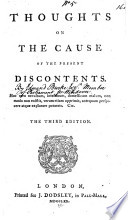
Thoughts on the Cause of the Present Discontents is a political pamphlet by the Anglo-Irish politician and philosopher Edmund Burke, first published on 23 April 1770. The subject is the nepotism of King George III and the influence of the Court on the House of Commons of Great Britain. The essay was influential in defining political parties and their roles within government. In it, Burke argued that parties are "bod[ies] of men united for promoting by their joint endeavours the national interest upon some particular principle in which they are all agreed".
Edmund Burke book Thoughts on the Cause of the Present Discontents
Volume i, p. 526; see #Disputed below.
Thoughts on the Cause of the Present Discontents (1770)
Source: Thoughts on the Cause of the Present Discontents: Volume 1 Paperback: 001
Edmund Burke book Thoughts on the Cause of the Present Discontents
Thoughts on the Cause of the Present Discontents (1770)
“So to be patriots as not to forget we are gentlemen.”
Edmund Burke book Thoughts on the Cause of the Present Discontents
Thoughts on the Cause of the Present Discontents (1770)
“Of this stamp is the cant of, Not men, but measures.”
Edmund Burke book Thoughts on the Cause of the Present Discontents
Volume i, p. 531
Thoughts on the Cause of the Present Discontents (1770)
Edmund Burke book Thoughts on the Cause of the Present Discontents
Thoughts on the Cause of the Present Discontents (1770)
Edmund Burke book Thoughts on the Cause of the Present Discontents
Volume i, p. 516
Thoughts on the Cause of the Present Discontents (1770)
Context: The power of discretionary disqualification by one law of Parliament, and the necessity of paying every debt of the Civil List by another law of Parliament, if suffered to pass unnoticed, must establish such a fund of rewards and terrors as will make Parliament the best appendage and support of arbitrary power that ever was invented by the wit of man. This is felt. The quarrel is begun between the Representatives and the People. The Court Faction have at length committed them. In such a strait the wisest may well be perplexed, and the boldest staggered. The circumstances are in a great measure new. We have hardly any land-marks from the wisdom of our ancestors, to guide us. At best we can only follow the spirit of their proceeding in other cases.


