
“But when mischief mortals bend their will,
How soon they find fit instruments of ill!”
Alexander Pope The Rape of the Lock
Canto III, line 125.
The Rape of the Lock (1712, revised 1714 and 1717)
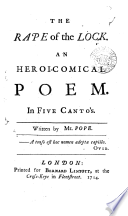
The Rape of the Lock is a mock-heroic narrative poem written by Alexander Pope. One of the most commonly cited examples of high burlesque, it was first published anonymously in Lintot's Miscellaneous Poems and Translations in two cantos ; a revised edition "Written by Mr. Pope" followed in March 1714 as a five-canto version accompanied by six engravings. Pope boasted that this sold more than three thousand copies in its first four days. The final form of the poem appeared in 1717 with the addition of Clarissa's speech on good humour. The poem was much translated and contributed to the growing popularity of mock-heroic in Europe.
“But when mischief mortals bend their will,
How soon they find fit instruments of ill!”
Alexander Pope The Rape of the Lock
Canto III, line 125.
The Rape of the Lock (1712, revised 1714 and 1717)
Alexander Pope The Rape of the Lock
Canto V, line 97.
The Rape of the Lock (1712, revised 1714 and 1717)
“They shift the moving toyshop of their heart.”
Alexander Pope The Rape of the Lock
Canto I, line 100.
The Rape of the Lock (1712, revised 1714 and 1717)
“At every word a reputation dies.”
Alexander Pope The Rape of the Lock
Canto III, line 16.
The Rape of the Lock (1712, revised 1714 and 1717)
“Here thou, great Anna! whom three realms obey,
Dost sometimes counsel take — and sometimes tea.”
Alexander Pope The Rape of the Lock
Canto III, line 7.
The Rape of the Lock (1712, revised 1714 and 1717)
“Bright as the sun, her eyes the gazers strike,
And, like the sun, they shine on all alike.”
Alexander Pope The Rape of the Lock
Canto II, line 13.
The Rape of the Lock (1712, revised 1714 and 1717)
“Belinda smiled, and all the world was gay.”
Alexander Pope The Rape of the Lock
Canto II, line 52.
The Rape of the Lock (1712, revised 1714 and 1717)
“Charms strike the sight, but merit wins the soul.”
Alexander Pope The Rape of the Lock
Canto V, line 33.
Variant: Beauties in vain their pretty eyes may roll;
Charms strike the sight, but merit wins the soul.
Source: The Rape of the Lock (1712, revised 1714 and 1717)
“What dire offence from amorous causes springs,
What mighty contests rise from trivial things!”
Alexander Pope The Rape of the Lock
Canto I, line 1.
Source: The Rape of the Lock (1712, revised 1714 and 1717)
“Let spades be trumps! she said, and trumps they were.”
Alexander Pope The Rape of the Lock
Canto III, line 46.
The Rape of the Lock (1712, revised 1714 and 1717)
“Not louder shrieks to pitying heav'n are cast,
When husbands, or when lapdogs, breathe their last.”
Alexander Pope The Rape of the Lock
Canto III, line 157.
The Rape of the Lock (1712, revised 1714 and 1717)
“Fair tresses man's imperial race ensnare,
And beauty draws us with a single hair.”
Alexander Pope The Rape of the Lock
Canto II, line 27. Compare: "No cord nor cable can so forcibly draw, or hold so fast, as love can do with a twined thread", Robert Burton, Anatomy of Melancholy, Part iii, Section 2, Membrane 1, Subsection 2.
The Rape of the Lock (1712, revised 1714 and 1717)
“If to her share some female errors fall,
Look on her face, and you'll forget 'em all.”
Alexander Pope The Rape of the Lock
Canto II, line 17.
The Rape of the Lock (1712, revised 1714 and 1717)
Alexander Pope The Rape of the Lock
Canto II, line 105.
The Rape of the Lock (1712, revised 1714 and 1717)
“Coffee, which makes the politician wise,
And see through all things with his half-shut eyes.”
Alexander Pope The Rape of the Lock
Canto III, line 117.
The Rape of the Lock (1712, revised 1714 and 1717)
Alexander Pope The Rape of the Lock
Canto III, line 153.
The Rape of the Lock (1712, revised 1714 and 1717)
“Sir Plume, of amber snuff-box justly vain,
And the nice conduct of a clouded cane.”
Alexander Pope The Rape of the Lock
Canto IV, line 123.
The Rape of the Lock (1712, revised 1714 and 1717)
“This casket India's glowing gems unlocks
And all Arabia breathes from yonder box.”
Alexander Pope The Rape of the Lock
Canto I, line 134.
The Rape of the Lock (1712, revised 1714 and 1717)
“The hungry judges soon the sentence sign,
And wretches hang that jurymen may dine.”
Alexander Pope The Rape of the Lock
Canto III, line 21.
The Rape of the Lock (1712, revised 1714 and 1717)
“Now lap-dogs give themselves the rousing shake,
And sleepless lovers, just at twelve, awake.”
Alexander Pope The Rape of the Lock
Canto I, line 15.
The Rape of the Lock (1712, revised 1714 and 1717)


