Quotes from book
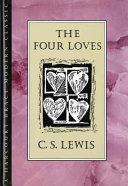
The Four Loves

The Four Loves

The Four Loves is a book by C. S. Lewis which explores the nature of love from a Christian and philosophical perspective through thought experiments. The book was based on a set of radio talks from 1958 which had been criticised in the U.S. at the time for their frankness about sex.


Clive Staples Lewis photo

“The typical expression of opening Friendship would be something like, "What? You too? I thought I was the only one."”

Clive Staples Lewis book The Four Loves

The Four Loves (1960)
Context: Friendship arises out of mere companionship when two or more of the companions discover that they have in common some insight or interest or even taste which the others do not share and which, till that moment, each believed to be his own unique treasure (or burden). The typical expression of opening Friendship would be something like, "What? You too? I thought I was the only one."

Clive Staples Lewis photo

“All that is not eternal is eternally out of date.”

Clive Staples Lewis book The Four Loves

"Charity"
The Four Loves (1960)

Clive Staples Lewis photo

“To love at all is to be vulnerable. Love anything, and your heart will certainly be wrung and possibly be broken.”

Clive Staples Lewis book The Four Loves

The Four Loves (1960)
Context: To love at all is to be vulnerable. Love anything, and your heart will certainly be wrung and possibly be broken. If you want to make sure of keeping it intact, you must give your heart to no one, not even to an animal. Wrap it carefully round with hobbies and little luxuries; avoid all entanglements; lock it up safe in the casket or coffin of your selfishness. But in that casket — safe, dark, motionless, airless — it will change. It will not be broken; it will become unbreakable, impenetrable, irredeemable. The alternative to tragedy, or at least to the risk of tragedy, is damnation. The only place outside of Heaven where you can be perfectly safe from all the dangers and perturbations of love is Hell.

Clive Staples Lewis photo

“The alternative to tragedy, or at least to the risk of tragedy, is damnation. The only place outside of Heaven where you can be perfectly safe from all the dangers and perturbations of love is Hell.”

Clive Staples Lewis book The Four Loves

The Four Loves (1960)
Context: To love at all is to be vulnerable. Love anything, and your heart will certainly be wrung and possibly be broken. If you want to make sure of keeping it intact, you must give your heart to no one, not even to an animal. Wrap it carefully round with hobbies and little luxuries; avoid all entanglements; lock it up safe in the casket or coffin of your selfishness. But in that casket — safe, dark, motionless, airless — it will change. It will not be broken; it will become unbreakable, impenetrable, irredeemable. The alternative to tragedy, or at least to the risk of tragedy, is damnation. The only place outside of Heaven where you can be perfectly safe from all the dangers and perturbations of love is Hell.

Clive Staples Lewis photo

“Appreciative love gazes and holds its breath and is silent, rejoices that such a wonder should exist even if not for him, will not be wholly dejected by losing her, would rather have it so than never to have seen her at all.”

Clive Staples Lewis book The Four Loves

The Four Loves (1960)
Context: Need-love cries to God from our poverty; Gift-love longs to serve, or even to suffer for, God; Appreciative love says: "We give thanks to thee for thy great glory." Need-love says of a woman "I cannot live without her"; Gift-love longs to give her happiness, comfort, protection — if possible, wealth; Appreciative love gazes and holds its breath and is silent, rejoices that such a wonder should exist even if not for him, will not be wholly dejected by losing her, would rather have it so than never to have seen her at all.

Clive Staples Lewis photo

“Need-love cries to God from our poverty; Gift-love longs to serve, or even to suffer for, God; Appreciative love says: "We give thanks to thee for thy great glory."”

Clive Staples Lewis book The Four Loves

Need-love says of a woman "I cannot live without her"; Gift-love longs to give her happiness, comfort, protection — if possible, wealth; Appreciative love gazes and holds its breath and is silent, rejoices that such a wonder should exist even if not for him, will not be wholly dejected by losing her, would rather have it so than never to have seen her at all.
The Four Loves (1960)

Similar authors

Clive Staples Lewis photo
Clive Staples Lewis272
Christian apologist, novelist, and Medievalist 1898–1963
G. K. Chesterton photo
G. K. Chesterton229
English mystery novelist and Christian apologist None
Rick Warren photo
Rick Warren90
Christian religious leader None
Peter Handke photo
Peter Handke9
Austrian writer, playwright and film director None
Henri Barbusse photo
Henri Barbusse197
French novelist None
James Joyce photo
James Joyce191
Irish novelist and poet None
Erich Maria Remarque photo
Erich Maria Remarque63
German novelist None
John Galsworthy photo
John Galsworthy48
English novelist and playwright None
Christopher Morley photo
Christopher Morley30
American journalist, novelist, essayist and poet None
João Guimarães Rosa photo
João Guimarães Rosa1
Brazilian novelist None