Quotes from book
The Art of Loving

The Art of Loving

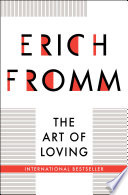
The Art of Loving is a 1956 book by psychoanalyst and social philosopher Erich Fromm, which was published as part of the World Perspectives Series edited by Ruth Nanda Anshen. In this work, Fromm develops his perspective on human nature, from his earlier work, Escape from Freedom and Man for Himself – principles which he revisits in many of his other major works.


Erich Fromm photo

“Our society is run by a managerial bureaucracy, by professional politicians; people are motivated by mass suggestion, their aim is producing more and consuming more, as purposes in themselves.”

The portion of this statement, "Love is the only sane and satisfactory answer to the problem of human existence" has been widely quoted alone, resulting in a less reserved expression, and sometimes the portion following it has been as well: "Any society which excludes, relatively, the development of love, must in the long run perish of its own contradiction with the basic necessities of human nature."
The Art of Loving (1956)
Context: Our society is run by a managerial bureaucracy, by professional politicians; people are motivated by mass suggestion, their aim is producing more and consuming more, as purposes in themselves. All activities are subordinated to economic goals, means have become ends; man is an automaton — well fed, well clad, but without any ultimate concern for that which is his peculiarly human quality and function. If man is to be able to love, he must be put in his supreme place. The economic machine must serve him, rather than he serve it. He must be enabled to share experience, to share work, rather than, at best, share in profits. Society must be organized in such a way that man's social, loving nature is not separated from his social existence, but becomes one with it. If it is true, as I have tried to show, that love is the only sane and satisfactory answer to the problem of human existence, then any society which excludes, relatively, the development of love, must in the long run perish of its own contradiction with the basic necessities of human nature. <!-- p. 111 - 112

Erich Fromm photo

“In the Eastern religions and in mysticism, the love of God is an intense feeling experience of oneness, inseparably linked with the expression of this love in every act of living.”

Source: The Art of Loving (1956), Ch. 2
Context: In the dominant Western religious system, the love of God is essentially the same as the belief in God, in God’s existence, God’s justice, God’s love. The love of God is essentially a thought experience. In the Eastern religions and in mysticism, the love of God is an intense feeling experience of oneness, inseparably linked with the expression of this love in every act of living.

Erich Fromm photo

“Envy, jealousy, ambition, any kind of greed are passions; love is an action, the practice of human power, which can be practiced only in freedom and never as a result of compulsion.”

The Art of Loving (1956)
Context: Envy, jealousy, ambition, any kind of greed are passions; love is an action, the practice of human power, which can be practiced only in freedom and never as a result of compulsion.
Love is an activity, not a passive affect; it is a "standing in," not a "falling for." In the most general way, the active character of love can be described by stating that love is primarily giving, not receiving.

Erich Fromm photo

“To love one person productively means to be related to his human core, to him as representing mankind. Love for one individual, in so far as it is divorced from love for man, can refer only to the superficial and to the accidental; of necessity it remains shallow.”

Source: The Art of Loving (1956), Ch. 2
Context: In spite of the universalistic spirit of the monotheistic Western religions and of the progressive political concepts that are expressed in the idea "that all men are created equal," love for mankind has not become a common experience. Love for mankind is looked upon as an achievement which, at best, follows love for an individual or as an abstract concept to be realized only in the future. But love for man cannot be separated from love for one individual. To love one person productively means to be related to his human core, to him as representing mankind. Love for one individual, in so far as it is divorced from love for man, can refer only to the superficial and to the accidental; of necessity it remains shallow.

Erich Fromm photo

“To have faith in the possibility of love as a social and not only exceptional-individual phenomenon, is a rational faith based on the insight into the very nature of man.”

Source: The Art of Loving (1956)
Context: To speak of love is not "preaching," for the simple reason that it means to speak of the ultimate and real need of every human being. That this need has been obscured does not mean it does not exist. To analyze the nature of love is to discover its general absence today and to criticize the social conditions which are responsible for this absence. To have faith in the possibility of love as a social and not only exceptional-individual phenomenon, is a rational faith based on the insight into the very nature of man.

Erich Fromm photo

“Society must be organized in such a way that man's social, loving nature is not separated from his social existence, but becomes one with it. If it is true, as I have tried to show, that love is the only sane and satisfactory answer to the problem of human existence, then any society which excludes, relatively, the development of love, must in the long run perish of its own contradiction with the basic necessities of human nature.”

The portion of this statement, "Love is the only sane and satisfactory answer to the problem of human existence" has been widely quoted alone, resulting in a less reserved expression, and sometimes the portion following it has been as well: "Any society which excludes, relatively, the development of love, must in the long run perish of its own contradiction with the basic necessities of human nature."
The Art of Loving (1956)
Context: Our society is run by a managerial bureaucracy, by professional politicians; people are motivated by mass suggestion, their aim is producing more and consuming more, as purposes in themselves. All activities are subordinated to economic goals, means have become ends; man is an automaton — well fed, well clad, but without any ultimate concern for that which is his peculiarly human quality and function. If man is to be able to love, he must be put in his supreme place. The economic machine must serve him, rather than he serve it. He must be enabled to share experience, to share work, rather than, at best, share in profits. Society must be organized in such a way that man's social, loving nature is not separated from his social existence, but becomes one with it. If it is true, as I have tried to show, that love is the only sane and satisfactory answer to the problem of human existence, then any society which excludes, relatively, the development of love, must in the long run perish of its own contradiction with the basic necessities of human nature. <!-- p. 111 - 112