
“To obey a rule, to make a report, to give an order, to play a game of chess, are customs”
Ludwig Wittgenstein book Philosophical Investigations
uses, institutions
§ 199
Philosophical Investigations (1953)
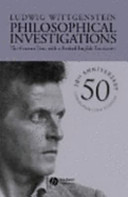
Philosophical Investigations is a work by the philosopher Ludwig Wittgenstein. The book was published posthumously in 1953. Wittgenstein discusses numerous problems and puzzles in the fields of semantics, logic, philosophy of mathematics, philosophy of psychology, philosophy of action, and philosophy of mind, putting forth the view that conceptual confusions surrounding language use are at the root of most philosophical problems. Wittgenstein alleges that the problems are traceable to a set of related assumptions about the nature of language, which themselves presuppose a particular conception of the essence of language. This conception is considered and ultimately rejected for being too general; that is, as an essentialist account of the nature of language it is simply too narrow to be able to account for the variety of things we do with language. This view can be seen to contradict or discard much of what he argued in his earlier work Tractatus Logico-Philosophicus .
“To obey a rule, to make a report, to give an order, to play a game of chess, are customs”
Ludwig Wittgenstein book Philosophical Investigations
uses, institutions
§ 199
Philosophical Investigations (1953)
Ludwig Wittgenstein book Philosophical Investigations
Pt II, p. 217
Philosophical Investigations (1953)
“So we do sometimes think because it has been found to pay.”
Ludwig Wittgenstein book Philosophical Investigations
§ 470
Philosophical Investigations (1953)
“Uttering a word is like striking a note on the keyboard of the imagination.”
Ludwig Wittgenstein book Philosophical Investigations
§ 6
Philosophical Investigations (1953)
“What has to be accepted, the given, is — so one could say — forms of life.”
Ludwig Wittgenstein book Philosophical Investigations
Pt II, p. 226 of the 1968 English edition
Philosophical Investigations (1953)
“The human body is the best picture of the human soul.”
Ludwig Wittgenstein book Philosophical Investigations
Pt II, p. 178
Philosophical Investigations (1953)
Ludwig Wittgenstein book Philosophical Investigations
Pt II, p. 189
Philosophical Investigations (1953)
“When I obey a rule, I do not choose.
I obey the rule blindly.”
Ludwig Wittgenstein book Philosophical Investigations
§ 219
Philosophical Investigations (1953)
“What we do is to bring words back from their metaphysical to their everyday use.”
Ludwig Wittgenstein book Philosophical Investigations
§ 116
Philosophical Investigations (1953)
“If a lion could talk, we could not understand him.”
Ludwig Wittgenstein book Philosophical Investigations
Pt II, p. 223 of the 1968 English edition
Philosophical Investigations (1953)
Ludwig Wittgenstein book Philosophical Investigations
§ 43, this has often been quoted as simply: The meaning of a word is its use in the language.
Philosophical Investigations (1953)


