
“O, what a tangled web we weave,
When first we practise to deceive!”
Canto VI, st. 17.
Variant: Oh what a tangled web we weave when first we practice to deceive
Source: Marmion (1808)
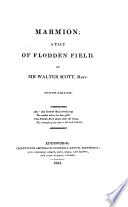
Marmion: A Tale of Flodden Field is a historical romance in verse of 16th-century Britain by Walter Scott, published in 1808. It concludes with the Battle of Flodden in 1513. It was published in Edinburgh, printed by Ballantyne and Co. for Archibald Constable and also in London by William Miller and John Murray.
“O, what a tangled web we weave,
When first we practise to deceive!”
Canto VI, st. 17.
Variant: Oh what a tangled web we weave when first we practice to deceive
Source: Marmion (1808)
“So faithful in love, and so dauntless in war,
There never was knight like the young Lochinvar.”
Canto V, st. 12 (Lochinvar, st. 1).
Marmion (1808)
“In the lost battle,
Borne down by the flying,
Where mingles war's rattle
With groans of the dying.”
Canto III, stanza 11.
Marmion (1808)
Canto V, st. 12 (Lochinvar, st. 5).
Marmion (1808)
“But search the land of living men,
Where wilt thou find their like again?”
Canto I, introduction, st. 11.
Marmion (1808)
“November’s sky is chill and drear,
November’s leaf is red and sear.”
Canto I, introduction, st. 1.
Marmion (1808)
Canto VI, introduction, st. 1.
Marmion (1808)
“Oh, young Lochinvar is come out of the West,
Through all the wide Border his steed was the best.”
Canto V, st. 12 (Lochinvar, st. 1).
Marmion (1808)
“Stood for his country’s glory fast,
And nail’d her colours to the mast!”
Canto I, introduction, st. 10.
Marmion (1808)
“When, musing on companions gone,
We doubly feel ourselves alone.”
Canto II, introduction.
Marmion (1808)
“And come he slow, or come he fast,
It is but Death who comes at last.”
Canto II, introduction, st. 30.
Marmion (1808)
“For a laggard in love, and a dastard in war,
Was to wed the fair Ellen of brave Lochinvar.”
Canto V, st. 12 (Lochinvar, st. 2).
Marmion (1808)
“To all, to each, a fair good-night,
And pleasing dreams, and slumbers light!”
L'Envoy.
Marmion (1808)
“And darest thou then
To beard the lion in his den,
The Douglas in his hall?”
Canto VI, st. 14.
Marmion (1808)
Were the last words of Marmion.
Canto VI, st. 32.
Marmion (1808)


