Quotes from work
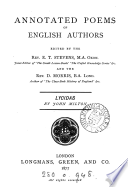
Lycidas

Lycidas

"Lycidas" is a poem by John Milton, written in 1637 as a pastoral elegy. It first appeared in a 1638 collection of elegies, entitled Justa Edouardo King Naufrago, dedicated to the memory of Edward King, friend of Milton's at Cambridge who drowned when his ship sank in the Irish Sea off the coast of Wales in August 1637. The poem is 193 lines in length, and is irregularly rhymed. While many of the other poems in the compilation are in Greek and Latin, "Lycidas" is one of the poems written in English. Milton republished the poem in 1645.


John Milton photo

“Without the meed of some melodious tear.”

John Milton Lycidas

Source: Lycidas (1637), Line 14

John Milton photo
John Milton photo

“He knew
Himself to sing, and build the lofty rhyme.”

John Milton Lycidas

Source: Lycidas (1637), Line 10

John Milton photo

“Look homeward, Angel, now, and melt with ruth.”

John Milton Lycidas

Source: Lycidas (1637), Line 163

John Milton photo
John Milton photo

“Blind mouths! That scarce themselves know how to hold
A sheep-hook.”

John Milton Lycidas

Source: Lycidas (1637), Line 119

John Milton photo
John Milton photo
John Milton photo

“Fame is no plant that grows on mortal soil.”

John Milton Lycidas

Source: Lycidas (1637), Line 78

John Milton photo
John Milton photo
John Milton photo
John Milton photo
John Milton photo

“Alas! what boots it with incessant care
To tend the homely slighted shepherd's trade,
And strictly meditate the thankless Muse?
Were it not better done as others use,
To sport with Amaryllis in the shade,
Or with the tangles of Neaera's hair?
Fame is the spur that the clear spirit doth raise
(That last infirmity of noble mind)
To scorn delights, and live laborious days;
But the fair guerdon when we hope to find,
And think to burst out into sudden blaze,
Comes the blind Fury with th' abhorrèd shears,
And slits the thin-spun life.”

John Milton Lycidas

Source: Lycidas (1637), Line 64; comparable to: "Erant quibus appetentior famæ videretur, quando etiam sapientibus cupido gloriae novissima exuitur" (Translated: "Some might consider him as too fond of fame, for the desire of glory clings even to the best of men longer than any other passion"), Tacitus, Historiae, iv. 6; said of Helvidius Priscus.

John Milton photo
John Milton photo
John Milton photo
John Milton photo

“The gadding vine.”

John Milton Lycidas

Source: Lycidas (1637), Line 40

Similar authors

John Milton photo
John Milton190
English epic poet 1608–1674
John Donne photo
John Donne115
English poet None
Alexander Pope photo
Alexander Pope158
eighteenth century English poet None
Samuel Butler (poet) photo
Samuel Butler (poet)81
poet and satirist None
Samuel Johnson photo
Samuel Johnson362
English writer None
Robert Burns photo
Robert Burns114
Scottish poet and lyricist None
William Shakespeare photo
William Shakespeare699
English playwright and poet None
Matthias Claudius photo
Matthias Claudius1
German poet None
George Herbert photo
George Herbert216
Welsh-born English poet, orator and Anglican priest None
Jonathan Swift photo
Jonathan Swift141
Anglo-Irish satirist, essayist, and poet None