Quotes from book
Capitalism and Freedom

Capitalism and Freedom

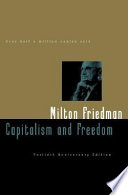
Capitalism and Freedom is a book by Milton Friedman originally published in 1962 by the University of Chicago Press which discusses the role of economic capitalism in liberal society. It sold over 400,000 copies in the first eighteen years and more than half a million since 1962. It has been translated into eighteen languages.


Milton Friedman photo

“Our minds tell us, and history confirms, that the great threat to freedom is the concentration of power. Government is necessary to preserve our freedom, it is an instrument through which we can exercise our freedom; yet by concentrating power in political hands, it is also a threat to freedom. Even though the men who wield this power initially be of good will and even though they be not corrupted by the power they exercise, the power will both attract and form men of a different stamp.”

Milton Friedman book Capitalism and Freedom

Introduction
Capitalism and Freedom (1962)
Context: The free man will ask neither what his country can do for him nor what he can do for his country. He will ask rather "What can I and my compatriots do through government" to help us discharge our individual responsibilities, to achieve our several goals and purposes, and above all, to protect our freedom? And he will accompany this question with another: How can we keep the government we create from becoming a Frankenstein that will destroy the very freedom we establish it to protect? Freedom is a rare and delicate plant. Our minds tell us, and history confirms, that the great threat to freedom is the concentration of power. Government is necessary to preserve our freedom, it is an instrument through which we can exercise our freedom; yet by concentrating power in political hands, it is also a threat to freedom. Even though the men who wield this power initially be of good will and even though they be not corrupted by the power they exercise, the power will both attract and form men of a different stamp.

Milton Friedman photo

“Because we live in a largely free society, we tend to forget how limited is the span of time and the part of the globe for which there has ever been anything like : the typical state of mankind is tyranny, servitude, and misery.”

Milton Friedman book Capitalism and Freedom

Source: Capitalism and Freedom (1962), Ch. 1 The Relation Between Economic Freedom and Political Freedom, 2002 edition, page 10
Context: Because we live in a largely free society, we tend to forget how limited is the span of time and the part of the globe for which there has ever been anything like : the typical state of mankind is tyranny, servitude, and misery. The nineteenth century and early twentieth century in the Western world stand out as striking exceptions to the general trend of historical development. Political freedom in this instance clearly came along with the free market and the development of capitalist institutions. So also did political freedom in the golden age of Greece and in the early days of the Roman era.
History suggests only that capitalism is a necessary condition for political freedom. Clearly it is not a sufficient condition.

Milton Friedman photo

“To the free man, the country is the collection of individuals who compose it, not something over and above them.”

Milton Friedman book Capitalism and Freedom

Introduction
Capitalism and Freedom (1962)
Context: To the free man, the country is the collection of individuals who compose it, not something over and above them. He is proud of a common heritage and loyal to common traditions. But he regards government as a means, an instrumentality, neither a grantor of favors and gifts, nor a master or god to be blindly worshipped and served.

Milton Friedman photo

“The free man will ask neither what his country can do for him nor what he can do for his country. He will ask rather "What can I and my compatriots do through government" to help us discharge our individual responsibilities, to achieve our several goals and purposes, and above all, to protect our freedom?”

Milton Friedman book Capitalism and Freedom

Introduction
Capitalism and Freedom (1962)
Context: The free man will ask neither what his country can do for him nor what he can do for his country. He will ask rather "What can I and my compatriots do through government" to help us discharge our individual responsibilities, to achieve our several goals and purposes, and above all, to protect our freedom? And he will accompany this question with another: How can we keep the government we create from becoming a Frankenstein that will destroy the very freedom we establish it to protect? Freedom is a rare and delicate plant. Our minds tell us, and history confirms, that the great threat to freedom is the concentration of power. Government is necessary to preserve our freedom, it is an instrument through which we can exercise our freedom; yet by concentrating power in political hands, it is also a threat to freedom. Even though the men who wield this power initially be of good will and even though they be not corrupted by the power they exercise, the power will both attract and form men of a different stamp.

Milton Friedman photo

“The existence of a free market does not of course eliminate the need for government.”

Milton Friedman book Capitalism and Freedom

Source: Capitalism and Freedom (1962), Ch. 1 The Relation Between Economic Freedom and Political Freedom, 2002 edition, page 15
Context: The existence of a free market does not of course eliminate the need for government. On the contrary, government is essential both as a forum for determining the "rule of the game" and as an umpire to interpret and enforce the rules decided on.

Milton Friedman photo

“History suggests only that capitalism is a necessary condition for political freedom. Clearly it is not a sufficient condition.”

Milton Friedman book Capitalism and Freedom

Source: Capitalism and Freedom (1962), Ch. 1 The Relation Between Economic Freedom and Political Freedom, 2002 edition, page 10
Context: Because we live in a largely free society, we tend to forget how limited is the span of time and the part of the globe for which there has ever been anything like : the typical state of mankind is tyranny, servitude, and misery. The nineteenth century and early twentieth century in the Western world stand out as striking exceptions to the general trend of historical development. Political freedom in this instance clearly came along with the free market and the development of capitalist institutions. So also did political freedom in the golden age of Greece and in the early days of the Roman era.
History suggests only that capitalism is a necessary condition for political freedom. Clearly it is not a sufficient condition.

Milton Friedman photo

“Only a crisis—actual or perceived—produces real change. When that crisis occurs, the actions that are taken depend on the ideas that are lying around.”

Milton Friedman book Capitalism and Freedom

Preface (1982 edition), p. ix
Capitalism and Freedom (1962)
Context: There is enormous inertia—a tyranny of the status quo—in private and especially governmental arrangements. Only a crisis—actual or perceived—produces real change. When that crisis occurs, the actions that are taken depend on the ideas that are lying around. That, I believe, is our basic function: to develop alternatives to existing policies, to keep them alive and available until the politically impossible becomes politically inevitable.

Milton Friedman photo

Similar authors

Milton Friedman photo
Milton Friedman158
American economist, statistician, and writer 1912–2006
Thomas J. Sargent photo
Thomas J. Sargent10
American economist None
Paul A. Samuelson photo
Paul A. Samuelson47
American economist None
Kenneth Arrow photo
Kenneth Arrow37
American economist None
Theodore Schultz photo
Theodore Schultz15
American economist None
Douglass C. North photo
Douglass C. North18
American Economist None
Paul Krugman photo
Paul Krugman106
American economist None
Jan Tinbergen photo
Jan Tinbergen21
Dutch economist None
John Maynard Keynes photo
John Maynard Keynes122
British economist None
Wassily Leontief photo
Wassily Leontief10
Russian economist None