
“Who to himself is law no law doth need,
Offends no law, and is a king indeed.”
Act II, scene i.
Bussy D'Ambois (1607)
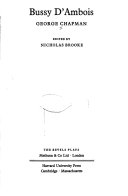
The Tragedy of Bussy D'Ambois is a Jacobean stage play written by George Chapman. Classified as either a tragedy or "contemporary history," Bussy D'Ambois is widely considered Chapman's greatest play, and is the earliest in a series of plays that Chapman wrote about the French political scene in his era, including the sequel The Revenge of Bussy D'Ambois, the two-part The Conspiracy and Tragedy of Charles, Duke of Byron, and The Tragedy of Chabot, Admiral of France.
“Who to himself is law no law doth need,
Offends no law, and is a king indeed.”
Act II, scene i.
Bussy D'Ambois (1607)
“Man is a torch borne in the wind; a dream
But of a shadow, summ'd with all his substance.”
Act I, scene i.
Bussy D'Ambois (1607)
“Each natural agent works but to this end,—
To render that it works on like itself.”
Act III, scene i.
Bussy D'Ambois (1607)
“This was a sleight well mask'd. O, what is man,
Unless he be a Politician?”
Act I, scene i.
Bussy D'Ambois (1607)
Act I, scene i.
Bussy D'Ambois (1607)


