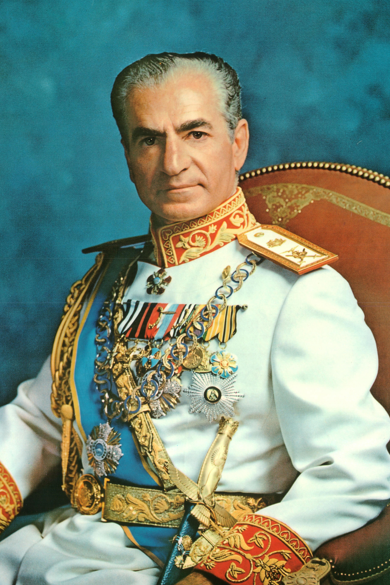
o swej ostatniej żonie Farah Dibie.
Źródło: Jean des Cars, Reza II, ostatni szach w: Ostatnie dni dyktatorów, op. cit., s. 139.
Mohammad Reza Pahlawi: 106 cytatów0 Polubień
Mohammad Reza Pahlawi słynne cytaty
„Chcę tę właśnie. Wiem, że ona jest dla mnie odpowiednia.”
do swojej matki Tadż ol-Moluk, która pokazała mu podczas herbatki zdjęcia różnych kobiet; Pahlawi wybrał Sorajję Esfandijari Bachtijari.
Źródło: Ulrike Grunewald, Słynne rywalki, czyli gra o miłość, pieniądze i władzę, tłum. Roman Niedballa, wyd. Videograf II, Katowice 2009, ISBN 9788371836824, s. 107.
audycja radiowa z 14 marca 1958, przed którą rozstał się z żoną Sorajją Esfandijari Bachtijari.
Źródło: Erich Schaake, Kobiety dyktatorów, tłum. Roman Niedballa, wyd. Videograf II, Katowice 2004, s. 106.
w wywiadzie udzielonym Orianie Fallaci w październiku 1973 w Teheranie.
Źródło: Oriana Fallaci, Wywiad z historią, op. cit., s. 438.
w wywiadzie dla brytyjskiego „Guardiana” latem 1972.
Źródło: Kazimierz Kozub, Politycy z pierwszych stron gazet, wyd. Iskry, Warszawa 1976, s. 307.
Źródło: Erich Schaake, Kobiety dyktatorów, op. cit., s. 91.
gdy Oriana Fallaci spytała, czy może zapalić papierosa.
Źródło: Oriana Fallaci, Wywiad z historią, op. cit., s. 429.
„Nieświęty związek czerwonego i czarnego.”
o opozycji przeciwko jego rządom złożonej z islamistów i komunistów.
Źródło: Jean des Cars, Reza II, ostatni szach w: Ostatnie dni dyktatorów, op. cit., s. 141.
słowa na łożu śmierci skierowane do swego syna.
Źródło: Jean des Cars, Reza II, ostatni szach w: Ostatnie dni dyktatorów, tłum. Anna Maria Nowak, wyd. Znak Horyzont, Kraków 2014, s. 143.
Mohammad Reza Pahlawi Cytaty o historii
w wywiadzie udzielonym Orianie Fallaci w październiku 1973 w Teheranie.
Źródło: Oriana Fallaci, Wywiad z historią, op. cit., s. 441.
Źródło: Oriana Fallaci, Wywiad z historią, tłum. Agnieszka Czepnik, Anna Osmólska-Mętrak, Joanna Ugniewska, wyd. Sfery, Warszawa 2012, ISBN 9788377990391, s. 431.
w wywiadzie udzielonym Orianie Fallaci w październiku 1973 w Teheranie.
Źródło: Oriana Fallaci, Wywiad z historią, op. cit., s. 433.
w wywiadzie udzielonym Orianie Fallaci w październiku 1973 w Teheranie.
Źródło: Oriana Fallaci, Wywiad z historią, op. cit., s. 453.
w wywiadzie udzielonym Orianie Fallaci w październiku 1973 w Teheranie.
Źródło: Oriana Fallaci, Wywiad z historią, op. cit., s. 438.
Mohammad Reza Pahlawi: Cytaty po angielsku
Page 145
Publications, The Shah's Story (1980), On world leaders and statesmen
As quoted in Asadollah Alam (1991), The Shah and I: The Confidential Diary of Iran's Royal Court, 1968-77, page 169
Attributed
As quoted in Asadollah Alam (1991), The Shah and I: The Confidential Diary of Iran's Royal Court, 1968-77, page 330
Attributed
“Better that he take risks than that he ends up a shrinking violet like Ahmad Shah Qajar.”
As quoted in Asadollah Alam (1991), The Shah and I: The Confidential Diary of Iran's Royal Court, 1968-77, page 241
In colloquial Persian, Ahmad Shah Qajar is a byword for ineptitude.
Attributed
David Frost (January 1980), The Shah Speaks http://www.youtube.com/watch?v=iKUQUDf5IBo&feature=related (video) <br class="br">Interviews
“… the Jewish press in the USA is solely responsible for our poor publicity.”
As quoted in Asadollah Alam (1991), The Shah and I: The Confidential Diary of Iran's Royal Court, 1968-77, page 427
Attributed
Page 162
Publications, Mission for my Country (1961)
“Today the name of America has a magic meaning for the most distant communities of the world.”
Shah of Iran state visit to the USA, 1961 http://www.youtube.com/watch?v=K1a5TAepYXs, <br class="br">Interviews
As quoted in Asadollah Alam (1991), The Shah and I: The Confidential Diary of Iran's Royal Court, 1968-77, page 278
Attributed
Page 209
Publications, The Shah's Story (1980), On Islam and the Islamic Revolution
As quoted in Asadollah Alam (1991), The Shah and I: The Confidential Diary of Iran's Royal Court, 1968-77, page 360
Attributed
Page 33
Publications, The Shah's Story (1980), On his father
Page 232
Publications, Mission for my Country (1961)
Opening speech on October 12, 1971, when Iran marked the 2500th anniversary of Cyrus' founding of the Persian Empire
Speeches, 1971
Page 53
Publications, The Shah's Story (1980), On world leaders and statesmen
January 27, 1963, as quoted in The Shah's Story, page 76
Speeches, 1963
Page 59
Publications, The Shah's Story (1980), On oil and nuclear energy
Page 144
Publications, The Shah's Story (1980), On world leaders and statesmen
As quoted in Asadollah Alam (1991), The Shah and I: The Confidential Diary of Iran's Royal Court, 1968-77, page 465
Attributed
Page 167
Publications, The Shah's Story (1980), On Islam and the Islamic Revolution
Message of the Shahanshah of Iran, Now Rouz, 1976 http://members.cybertrails.com/~pahlavi/speech1.html <br class="br">Speeches, 1976
Page 207
Publications, The Shah's Story (1980), On Islam and the Islamic Revolution
“Thank God we in Iran have neither the desire nor the need to suffer from democracy.”
As quoted in Asadollah Alam (1991), The Shah and I: The Confidential Diary of Iran's Royal Court, 1968-77, page 233
Attributed
As quoted in Gérard de Villiers (1975), The Imperial Shah: An Informal Biography, page 273-274
Attributed
As quoted in Asadollah Alam (1991), The Shah and I: The Confidential Diary of Iran's Royal Court, 1968-77, page 236
Attributed
Page 301
Publications, Mission for my Country (1961)
“A crown, a throne could not be based on the not too very solid foundation of blood.”
David Frost (January 1980), The Shah Speaks http://www.youtube.com/watch?v=iKUQUDf5IBo&feature=related (video) <br class="br">Interviews
As quoted in Asadollah Alam (1991), The Shah and I: The Confidential Diary of Iran's Royal Court, 1968-77, page 254
Attributed
As quoted in Asadollah Alam (1991), The Shah and I: The Confidential Diary of Iran's Royal Court, 1968-77, page 474
Attributed
“Pride comes before a fall- although in [Henry Kissinger's] case it's more conceit than pride.”
As quoted in Asadollah Alam (1991), The Shah and I: The Confidential Diary of Iran's Royal Court, 1968-77, page 391
Attributed