“Bravery never goes out of fashion.”
"George II".
Four Georges (1860-1861)
Forrás: Four Georges and the English Humourists
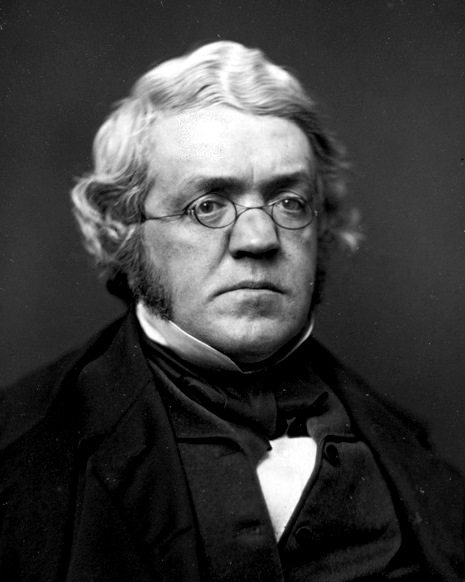
William Makepeace Thackeray angol író.
A világirodalom egyik legjelentősebb írója. Angol regényíró a 19. századból. A maga korában roppant népszerű művei a kapitalizmus életformájának, erkölcseinek kegyetlen szatírái. Legjelentősebb művének, a Hiúság vásárának hősnője, Rebecca Sharp, az egyik legvonzóbb szélhámos valamennyi irodalmi hős közül.
A sznob kifejezés mai értelme tőle származik. Wikipedia
“Bravery never goes out of fashion.”
"George II".
Four Georges (1860-1861)
Forrás: Four Georges and the English Humourists
Forrás: The History of Pendennis (1848-1850), Ch. 6.
Kontextus: It is best to love wisely, no doubt; but to love foolishly is better than not to be able to love at all. Some of us can't: and are proud of our impotence, too.
William Makepeace Thackeray Vanity Fair
Vol. I, ch. 13.
Forrás: Vanity Fair (1847–1848)
William Makepeace Thackeray Vanity Fair
Vol. I, ch. 12.
Forrás: Vanity Fair (1847–1848)
“Tis strange what a man may do, and a woman yet think him an angel.”
William Makepeace Thackeray könyv The History of Henry Esmond
Bk. I, ch. 7.
The History of Henry Esmond (1852)
The Rose and the Ring http://www.gutenberg.org/files/897/897-h/897-h.htm#2H_4_0004 (1855), Ch. 2.
“The true pleasure of life is to live with your inferiors.”
The Newcomes http://www.gutenberg.org/dirs/etext05/newcm10.txt (1853-1855), Ch. 9.
Ballads http://www.gutenberg.org/dirs/etext01/8bwmt10.txt, The Ballad of Bouillabaisse, st. 2 (1855).
Thackeray, William Makepeace. Nov. 1840, A Collection of Letters (1887). Ardent Media. p. 36.
The Age of Wisdom, reported in Bartlett's Familiar Quotations, 10th ed. (1919).
“Yes, I am a fatal man, Madame Fribsbi. To inspire hopeless passion is my destiny.”
Forrás: The History of Pendennis (1848-1850), Ch. 23.
A Credo, reported in Bartlett's Familiar Quotations, 10th ed. (1919).
The Mahogany Tree, reported in Bartlett's Familiar Quotations, 10th ed. (1919).
Forrás: The History of Pendennis (1848-1850), Ch. 42.
“It is to the middle class we must look for the safety of England.”
"George III".
Four Georges (1860-1861)
William Makepeace Thackeray könyv The Virginians
Forrás: The Virginians (1857-1859), Ch. 92.
William Makepeace Thackeray könyv The History of Henry Esmond
Bk. I, ch. 6.
The History of Henry Esmond (1852)
“Next to the very young, I suppose the very old are the most selfish.”
William Makepeace Thackeray könyv The Virginians
Forrás: The Virginians (1857-1859), Ch. 61.
William Makepeace Thackeray Vanity Fair
The narrator, LXII
Vanity Fair (1847–1848)
“Except for the young or very happy, I can't say I am sorry for any one who dies.”
Letter to Mrs. Bryan Waller Procter (26 November 1856), from The Letters and Private Papers of William Makepeace Thackeray, ed. Edgar F. Harden [Garland Publishing, Inc., 1994, ISBN 9780824036461], vol. 1, p. 763.
“The two most engaging powers of an author are to make new things familiar, familiar things new.”
In this work are exhibited in a very high degree the two most engaging powers of an author. New things are made familiar, and familiar things are made new. ~ Samuel Johnson, "The Life of Alexander Pope" from Lives of the English Poets (1781) http://www.gutenberg.org/dirs/etext04/lvpc10.txt <br class="br">Misattributed
William Makepeace Thackeray könyv The Virginians
Forrás: The Virginians (1857-1859), Ch. 4.
“Despair is perfectly compatible with a good dinner, I promise you.”
Lovel the Widower (1860), Ch. 6.
“I think I could be a good woman if I had five thousand a year.”
William Makepeace Thackeray Vanity Fair
Vol. II, ch. 6.
Vanity Fair (1847–1848)
The End of the Play, reported in Bartlett's Familiar Quotations, 10th ed. (1919).
William Makepeace Thackeray Vanity Fair
Vol. I, ch. 9.
Vanity Fair (1847–1848)


