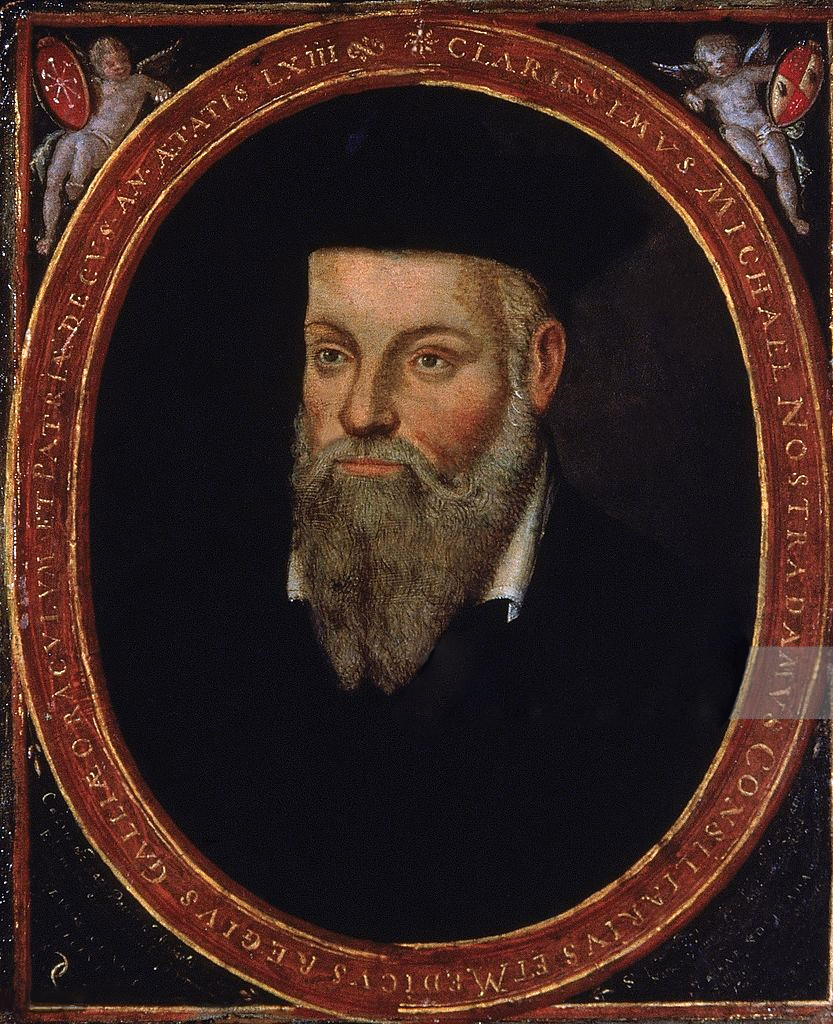
“Pour qu'aucun poltron imbécile ne piétine ma tombe.”
Nostradamus a souhaité être emmuré en position verticale dans l'église de Salon-de-Provence. Il a justifié cette volonté de cette façon.
Citations attribuées
Michel de Nostredame, dit Nostradamus, né le 14 décembre 1503 à Saint-Rémy-de-Provence et mort le 2 juillet 1566 à Salon-de-Provence, était un apothicaire français.
Selon bien des sources, il aurait également été médecin, bien que son expulsion de la faculté de médecine de Montpellier témoigne qu’il n'était pas possible d’être les deux à la fois.
Pratiquant l'astrologie comme tous ses confrères à l'époque de la Renaissance, il est surtout connu pour ses prédictions sur la marche du monde.

“Pour qu'aucun poltron imbécile ne piétine ma tombe.”
Nostradamus a souhaité être emmuré en position verticale dans l'église de Salon-de-Provence. Il a justifié cette volonté de cette façon.
Citations attribuées
“Tomorrow, I shall no longer be here.”
Last words, as quoted in Famous Last Words: The Ultimate Collection of Finales and Farewells (2004) by Laura Ward and Robert Allen; reported to have been said to his secretary Jean de Chavigny
Nostradamus livre Les Prophéties de M. Nostradamus
Estant assis de nuit secret estude,
Seul repousé sur la selle d'ærain,
Flambe exigue sortant de solitude,
Fait prosperer qui n'est à croire vain.
Quatrain 1
Les Propheties (1555), Century I
Nostradamus livre Les Prophéties de M. Nostradamus
Les Propheties (1555), Preface
Contexte: Perfect knowledge of such things cannot be acquired without divine inspiration, given that all prophetic inspiration derives its initial origin from God Almighty, then from chance and nature. Since all these portents are produced impartially, prophecy comes to pass partly as predicted. For understanding created by the intellect cannot be acquired by means of the occult, only by the aid of the zodiac, bringing forth that small flame by whose light part of the future may be discerned. We need god to prosper those without him will not.
Nostradamus livre Les Prophéties de M. Nostradamus
Les Propheties (1555), Preface
Contexte: If I have eschewed the word prophet, I do not wish to attribute to myself such lofty title at the present time, for whoever is called a prophet now was once called a seer; since a prophet, my son, is properly speaking one who sees distant things through a natural knowledge of all creatures. And it can happen that the prophet bringing about the perfect light of prophecy may make manifest things both human and divine, because this cannot be done otherwise, given that the effects of predicting the future extend far off into time.
Letter from Salon to his son Cesar (March 1555) as translated by Peter Lemesurier http://www.propheties.it/nostradamus/letters/cesar.htm
Nostradamus livre Les Prophéties de M. Nostradamus
Q 48
Les Propheties (1555), Century I