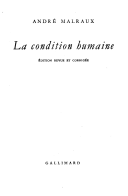
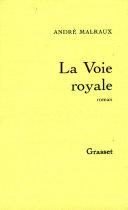
André Malraux livre La Condition humaine
La Condition humaine, 1933
André Malraux, né le 3 novembre 1901 dans le 18e arrondissement de Paris et mort le 23 novembre 1976 à Créteil , est un écrivain, aventurier, homme politique et intellectuel français.
Essentiellement autodidacte et tenté par l'aventure, André Malraux gagne l'Indochine, où il participe à un journal anticolonialiste et est emprisonné en 1923-1924 pour vol et recel d'antiquités sacrées khmères. Revenu en France, il transpose cette aventure dans son roman La Voie royale publié en 1930, et gagne la célébrité dans la francophonie avec la parution en 1933 de La Condition humaine, un roman d'aventure et d'engagement qui s'inspire des soubresauts révolutionnaires de la Chine et obtient le prix Goncourt.
Militant antifasciste, André Malraux combat en 1936-1937 aux côtés des républicains espagnols. Son engagement le conduit à écrire son roman L'Espoir, publié en décembre 1937, et à en tourner une adaptation filmée Espoir, sierra de Teruel en 1938. Il rejoint la Résistance en mars 1944 et participe aux combats lors de la Libération de la France. Après la guerre, il s’attache à la personne du général de Gaulle, joue un rôle politique au RPF, et devient, après le retour au pouvoir du général de Gaulle, ministre d'État, ministre de la Culture de 1959 à 1969.
Il écrit alors de nombreux ouvrages sur l'art comme Le Musée imaginaire ou Les Voix du silence et prononce des oraisons funèbres mémorables comme lors du transfert des cendres de Jean Moulin au Panthéon le 19 décembre 1964 ou lors des funérailles de Le Corbusier le 3 septembre 1965 dans la cour du Louvre, ou de Georges Braque. En 1996, pour le vingtième anniversaire de sa mort survenue le 23 novembre 1976, ce sont les cendres de Malraux qui sont à leur tour transférées au Panthéon. Wikipedia

André Malraux livre La Condition humaine
La Condition humaine, 1933
André Malraux livre La Condition humaine
Man's Fate
“La culture, c'est ce qui répond à l'homme quand il se demande ce qu'il fait sur la terre.”
Discours, articles, entretiens
André Malraux livre La Condition humaine
Man's Fate
André Malraux livre La Condition humaine
Man's Fate
André Malraux livre L'Espoir
L'Espoir
“La liberté n'est pas un échange, c'est la liberté.”
La condition humaine [Man's Fate] (1933)
“En profondeur, tout civilisation est unpénétrable pour une autre.”
André Malraux livre La Voie royale
La Voie Royale, 1930
André Malraux livre La Condition humaine
La Condition humaine, 1933
“What is man? A miserable little pile of secrets.”
André Malraux livre Antimémoires
Antimémoires, preface (1967)
This preface paraphrases a line of dialogue from his own earlier work: "A man is what he hides: a miserable little pile of secrets."
Original: (fr) L'homme est ce qu'il cache : un misérable petit tas de secrets.
André Malraux, TV program: Promenades imaginaires dans Florence, 1975.
Part III, Chapter VI
Les voix du silence [Voices of Silence] (1951)
Contexte: Once the masterpiece has emerged, the lesser works surrounding it fall into place; and it then gives the impression of having been led up to and foreseeable, though actually it is inconceivable — or, rather, it can only be conceived of once it is there for us to see it. It is not a scene that has come alive, but a latent potentiality that has materialized. Suppose that one of the world's masterpieces were to disappear, leaving no trace behind it, not even a reproduction; even the completest knowledge of its maker's other works would not enable the next generation to visualize it. All the rest of Leonardo's oeuvre would not enable us to visualize the Mona Lisa; all Rembrandt's, the Three Crosses or The Prodigal Son; all Vermeer's, The Love Letter; all Titian's, the Venice Pietà; all medieval sculpture, the Chartres Kings or the Naumburg Uta. What would another picture by the Master of Villeneuve look like? How could even the most careful study of The Embarkation for Cythera, or indeed that of all Watteau's other works conjure up L'Enseigne de Gersaint, had it disappeared?
Part IV, Chapter VII
Les voix du silence [Voices of Silence] (1951)
Contexte: Our characteristic response to the mutilated statue, the bronze dug up from the earth, is revealing. It is not that we prefer time-worn bas-reliefs, or rusted statuettes as such, nor is it the vestiges of death that grip us in them, but those of life. Mutilation is the scar left by the struggle with Time, and a reminder of it — Time which is as much a part of ancient works of art as the material they are made of, and thrusts up through the fissures, from a dark underworld, where all is at once chaos and determinism.
Part IV, Chapter I
Les voix du silence [Voices of Silence] (1951)
Contexte: An individualism which has got beyond the stage of hedonism tends to yield to the lure of the grandiose. It was not man, the individual, nor even the Supreme Being, that Robespierre set up against Christ; it was that Leviathan, the Nation.
“Neither revolution nor war consists in doing what one pleases.”
Part 2, Section 2, Chapter 12
L'espoir [Man's Hope] (1938)
Contexte: There are not fifty ways of fighting, there is only one, and that is to win. Neither revolution nor war consists in doing what one pleases.
André Malraux, Les voix du silence [Voices of Silence] (1951) Part IV, Chapter VI
Les voix du silence [Voices of Silence] (1951)
Contexte: The great Christian art did not die because all possible forms had been used up; it died because faith was being transformed into piety. Now, the same conquest of the outside world that brought in our modern individualism, so different from that of the Renaissance, is by way of relativizing the individual. It is plain to see that man's faculty of transformation, which began by a remaking of the natural world, has ended by calling man himself into question.
“The attempt to force human beings to despise themselves… is what I call hell.”
Section 2
La condition humaine [Man's Fate] (1933)
Part IV, Chapter V
Les voix du silence [Voices of Silence] (1951)
“Chanel, General De Gaulle and Picasso are the three most important figures of our time.”
As quoted in Paris, Paris : Journey Into the City of Light (2005) by David Downie, p. 87
“Art is a revolt against fate.”
Part IV, Chapter VII
Les voix du silence [Voices of Silence] (1951)
La condition humaine [Man's Fate] (1933)
Part IV, Chapter I
Les voix du silence [Voices of Silence] (1951)
“One cannot create an art that speaks to me when one has nothing to say.”
L'espoir [Man's Hope] (1938)
Part II, Chapter III
Les voix du silence [Voices of Silence] (1951)
“Freedom is not an exchange — it is freedom.”
La liberté n'est pas un échange, c'est la liberté.
La condition humaine [Man's Fate] (1933)
Part III, Chapter VI
Les voix du silence [Voices of Silence] (1951)
Part I, Chapter V
Les voix du silence [Voices of Silence] (1951)
“If a man is not ready to risk his life, where is his dignity?”
La condition humaine [Man's Fate] (1933)
Part I, Chapter III
Les voix du silence [Voices of Silence] (1951)
André Malraux, Préface du Temps du mépris (1935), Malraux citations sur www. fondationandremalraux. org http://fondationandremalraux.org/index.php/citations/
Part IV, Chapter I
Les voix du silence [Voices of Silence] (1951)
Part IV, Chapter VI
Les voix du silence [Voices of Silence] (1951)
Part III, Chapter VI
Les voix du silence [Voices of Silence] (1951)


