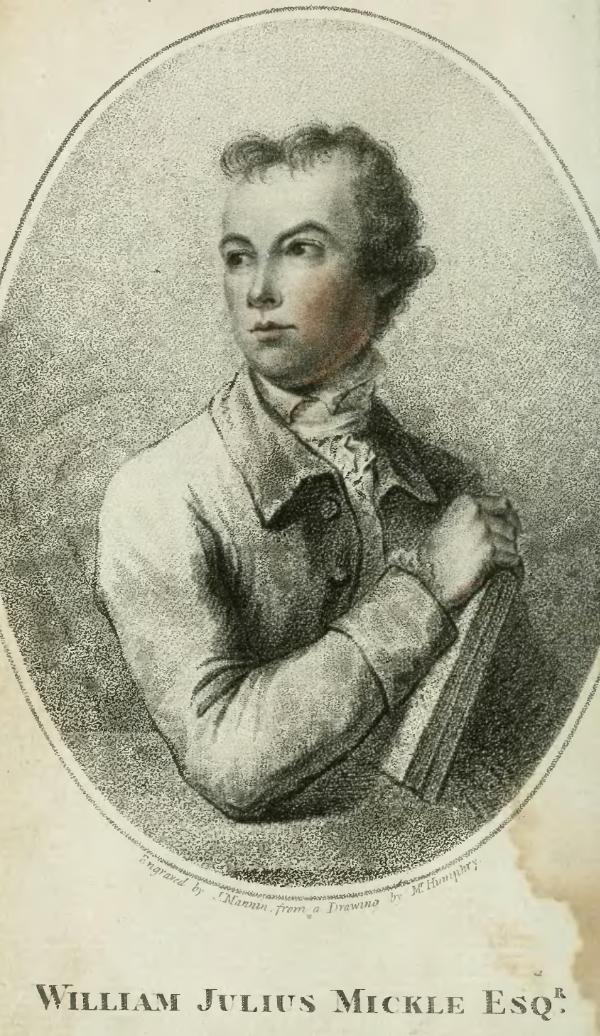
William Julius Mickle Quotes

William Julius Mickle was a Scottish poet.

Son of the minister of Langholm, Dumfriesshire, he was for some time a brewer in Edinburgh, but failed. He moved to England where he worked as a corrector for the Clarendon Press at Oxford. In 1771–75 Mickle lodged at the manor house in Forest Hill, Oxfordshire. Mickle had various literary failures and minor successes until, while at Forest Hill, he produced his translation of the Lusiad, from the Portuguese of Luís de Camões. This was a success that brought him both fame and money.

In 1777 he went to Portugal, where he was received with distinction. In 1784 he published the ballad of Cumnor Hall, which suggested to Scott the writing of Kenilworth. He is perhaps best remembered, however, by the beautiful lyric, "There's nae luck aboot the Hoose", which, although claimed by others, is almost certainly his.

In 1781 Mickle married Mary Tomkins, the daughter of his former landlord in Forest Hill, and settled in Wheatley. He died in 1788 while on a visit to his in-laws, and is buried in Forest Hill churchyard. Wikipedia  

✵ 29. September 1734 – 28. October 1788
William Julius Mickle photo

Works

Cumnor Hall
William Julius Mickle
Sir Martyn
William Julius Mickle
Cumnor Hall
William Julius Mickle
Sir Martyn
William Julius Mickle
William Julius Mickle: 17 quotes0 likes

Famous William Julius Mickle Quotes

“The present moment is our ain,
The neist we never saw!”

William Julius Mickle

St. 6
The Mariner's Wife (1769)

William Julius Mickle Quotes

“His very foot has music in't
As he comes up the stairs”

William Julius Mickle

St. 5
The Mariner's Wife (1769)
Context: Sae true's his words, sae smooth's his speech,
His breath like caller air,
His very foot has music in't
As he comes up the stairs:
And will I see his face again!
And will I hear him speak!

“Dull as a twice-told tale.”

William Julius Mickle

A Night Piece (c. 1761)

“The dews of summer night did fall;
The moon, sweet regent of the sky,
Silvered the walls of Cumnor Hall
And many an oak that grew thereby.”

William Julius Mickle Cumnor Hall

Stanza 1, quoted in Walter Scott's Kenilworth (1821), Ch. 6. Compare: "Jove, thou regent of the skies", Alexander Pope, The Odyssey, book ii, line 42; "Now Cynthia, named fair regent of the night", John Gay, Trivia, book iii; "And hail their queen, fair regent of the night", Erasmus Darwin, The Botanic Garden, part i, canto ii, line 90.
Cumnor Hall (1784)

“None but a poet can translate a poet.”

William Julius Mickle

Introduction (p. cl)
The Lusiad; Or, The Discovery of India: an Epic Poem (1776)

Similar authors

Richard Brinsley Sheridan photo
Richard Brinsley Sheridan58
Irish-British politician, playwright and writer None
Philip Stanhope, 4th Earl of Chesterfield photo
Philip Stanhope, 4th Earl of Chesterfield65
British statesman and man of letters None
Nicolas Chamfort photo
Nicolas Chamfort54
French writer None
Samuel Johnson photo
Samuel Johnson362
English writer None
Daniel Defoe photo
Daniel Defoe43
English trader, writer and journalist None
Voltaire photo
Voltaire167
French writer, historian, and philosopher None
Luc de Clapiers, Marquis de Vauvenargues photo
Luc de Clapiers, Marquis de Vauvenargues60
French writer, a moralist None
Baltasar Gracián photo
Baltasar Gracián31
Spanish Jesuit and baroque prose writer and philosopher None
Gotthold Ephraim Lessing photo
Gotthold Ephraim Lessing18
writer, philosopher, publicist, and art critic None
Jean De La Fontaine photo
Jean De La Fontaine47
French poet, fabulist and writer. None