“Study hard, for the well is deep, and our brains are shallow.”
Source: The Reformed Pastor
Richard Baxter was an English Puritan church leader, poet, hymnodist, theologian, and controversialist. Dean Stanley called him "the chief of English Protestant Schoolmen". After some false starts, he made his reputation by his ministry at Kidderminster, and at around the same time began a long and prolific career as theological writer. After the Restoration he refused preferment, while retaining a non-separatist Presbyterian approach, and became one of the most influential leaders of the Nonconformists, spending time in prison. His views on justification and sanctification are somewhat controversial and unconventional within the Calvinist tradition because his teachings seem, to some, to undermine salvation by faith, in that he emphasizes the necessity of repentance and faithfulness. Wikipedia

“Study hard, for the well is deep, and our brains are shallow.”
Source: The Reformed Pastor
“Special mercy arouses more gratitude than universal mercy.”
The Saints' Everlasting Rest (1650), "The Splendor of the Saints' Rest"
The Saints' Everlasting Rest (1650), "The Nature of the Saints' Rest"
A Sermon Preached at the Funeral of Mr. John Corbet
The Saints' Everlasting Rest (1650), "The Nature of the Saints' Rest"
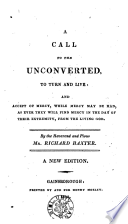
Richard Baxter book A Call to the Unconverted to Turn and Live
A Call to the Unconverted to Turn and Live, Preface.
Richard Baxter book A Call to the Unconverted to Turn and Live
A Call to the Unconverted to Turn and Live, Sermon 1
Reported in Josiah Hotchkiss Gilbert, Dictionary of Burning Words of Brilliant Writers (1895), p. 36.
The Saints' Everlasting Rest (1650), "The People Who Receive the Saints' Rest"
“Christ leads me through no darker rooms Than He went through before.”
Reported in Josiah Hotchkiss Gilbert, Dictionary of Burning Words of Brilliant Writers (1895), p. 11.
Richard Baxter book A Call to the Unconverted to Turn and Live
A Call to the Unconverted to Turn and Live, Sermon 1
"Even so, come, Lord Jesus."
Reported in Josiah Hotchkiss Gilbert, Dictionary of Burning Words of Brilliant Writers (1895), p. 102.


