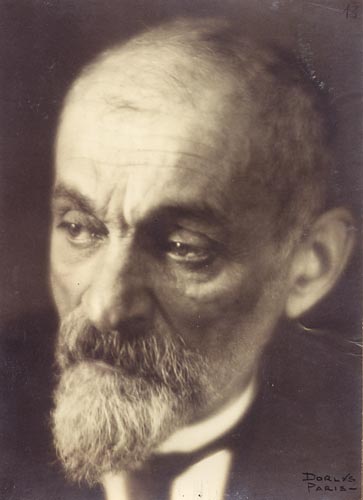
Lev Shestov Quotes

Lev Isaakovich Shestov was a Russian existentialist and religious philosopher. He is best known for his critiques of both philosophic rationalism and positivism. His work advocated a movement beyond reason and metaphysics, arguing that these are incapable of conclusively establishing truth about ultimate problems, including the nature of God or existence. Contemporary scholars have associated his work with the label "anti-philosophy."Shestov wrote extensively on philosophers such as Nietzsche and Kierkegaard, as well as Russian writers such as Dostoyevsky, Tolstoy, and Chekhov. His published books include Apotheosis of Groundlessness and his magnum opus Athens and Jerusalem . After emigrating to France in 1921, he befriended and influenced thinkers such as Edmund Husserl, Benjamin Fondane, Rachel Bespaloff, and Georges Bataille. He lived in Paris until his death in 1938. Wikipedia  

✵ 24. January 1866 – 19. November 1938
Lev Shestov photo
Lev Shestov: 7 quotes1 like

Famous Lev Shestov Quotes

“Philosophy can never reconcile itself with science. Science aims at self-evident truths and finds in them that "natural necessity" which, after having proclaimed itself for ever eternal, claims to serve as the foundation of all knowledge and strives to rule over all wanton "suddenly."”

Lev Shestov

But philosophy has always been, and will always be, a fight with and a conquest of self-evident truths; philosophy is not looking for any "natural necessity", it sees in naturalness and in necessity alike an evil magic, which, if one cannot quite shake it off (for in this no mortal has ever yet succeeded), yet one must at least call by its right name; and even this is an important step! p. 342
Source: In Job's Balances: on the sources of the eternal truths, Words That Are Swallowed Up - Plotinus's Ecstasies

“The first commandment of modern philosophy runs: Thou shalt emancipate thyself from all postulates. The postulate has been declared a deadly sin, and he who makes one is the enemy of truth.”

Lev Shestov

Source: In Job's Balances: on the sources of the eternal truths, On The Philosophy of History p. 247

“There are no ideals exalting the soul, but only chains, invisible indeed, but binding man more securely than iron. And no act of heroism, no “good work” can open the doors to man’s “perpetual confinement.””

Lev Shestov

Dostoievsky’s barrack vows of “improvement” now appeared to him as a sacrilege. He experience which he underwent was much the same as Luther’s when he remembered with such unfeigned horror and disgust the vows which he had pronounced on entering the convent. P. 10
Source: In Job's Balances: on the sources of the eternal truths, The Conquest of the Self-Evident; Dostoievsky’s Philosophy

“What can be more terrible than not to know whether one is alive or dead? “Justice” should insist that this knowledge or this ignorance should be the prerogative of every human being.”

Lev Shestov

Source: In Job's Balances: on the sources of the eternal truths, The Conquest of the Self-Evident; Dostoievsky’s Philosophy p. 3

Similar authors

Vitaly Ginzburg photo
Vitaly Ginzburg2
Russian Physicist None
Borís Pasternak photo
Borís Pasternak40
Russian writer None
Hans Urs Von Balthasar photo
Hans Urs Von Balthasar17
Swedish Catholic theologian None
Aleksandr Solzhenitsyn photo
Aleksandr Solzhenitsyn120
Russian writer None
Wassily Leontief photo
Wassily Leontief10
Russian economist None
Maxim Gorky photo
Maxim Gorky10
Russian and Soviet writer None
Reinhold Niebuhr photo
Reinhold Niebuhr65
American protestant theologian None
Vladimir Nabokov photo
Vladimir Nabokov193
Russian-American novelist, lepidopterist, professor None
Vladimir Lenin photo
Vladimir Lenin336
Russian politician, led the October Revolution None
Anna Akhmatova photo
Anna Akhmatova99
Russian modernist poet None