“It is difficult not to write satire.”
Difficile est saturam non scribere.
I, line 30.
Satires, Satire I
Decimus Iunius Iuvenalis , known in English as Juvenal , was a Roman poet active in the late first and early second century AD. He is the author of the collection of satirical poems known as the Satires. The details of the author's life are unclear, although references within his text to known persons of the late first and early second centuries AD fix his earliest date of composition. One recent scholar argues that his first book was published in 100 or 101. Because of a reference to a recent political figure, his fifth and final surviving book must date from after 127.
Juvenal wrote at least 16 poems in the verse form dactylic hexameter. These poems cover a range of Roman topics. This follows Lucilius—the originator of the Roman satire genre, and it fits within a poetic tradition that also includes Horace and Persius. The Satires are a vital source for the study of ancient Rome from a number of perspectives, although their comic mode of expression makes it problematic to accept the content as strictly factual. At first glance the Satires could be read as a critique of pagan Rome. That critique may have ensured their survival in the Christian monastic scriptoria although the majority of ancient texts did not survive. Wikipedia
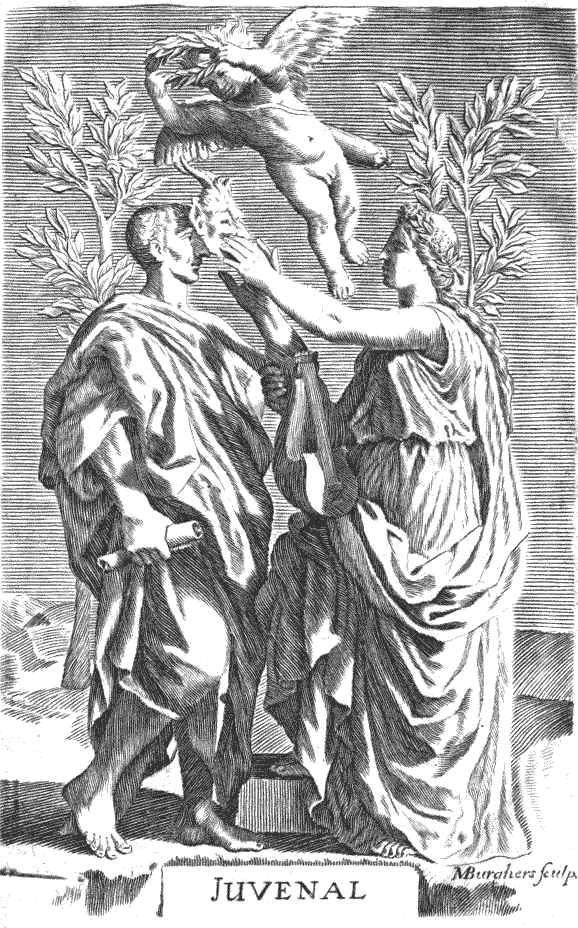
“It is difficult not to write satire.”
Difficile est saturam non scribere.
I, line 30.
Satires, Satire I
“Dedicate one’s life to truth.”
Vitam impendere vero.
IV, line 91.
Satires, Satire IV
“The traveller with empty pockets will sing in the thief's face.”
Cantabit vacuus coram latrone viator.
X, line 22.
Satires, Satire X
III, lines 75-78, John Dryden, trans.
Satires, Satire III
“But you will soon pay for it, my friend, when you take off your clothes, and with distended stomach carry your peacock into the bath undigested! Hence a sudden death, and an intestate old age; the new and merry tale runs the round of every dinner-table, and the corpse is carried forth to burial amid the cheers of enraged friends!”
Poena tamen praesens, cum tu deponis amictus
turgidus et crudum pavonem in balnea portas.
hinc subitae mortes atque intestata senectus;
it nova nec tristis per cunctas fabula cenas:
ducitur iratis plaudendum funus amicis.
Poena tamen praesens, cum tu deponis amictus
turgidus et crudum pavonem in balnea portas.
hinc subitae mortes atque intestata senectus;
it nova nec tristis per cunctas fabula cenas:
ducitur iratis plaudendum funus amicis.
I, line 142.
Satires, Satire I
“Censure pardons the raven, but is visited upon the dove.”
Dat veniam corvis, vexat censura columbas.
II, line 63.
Satires, Satire II
“It is not easy for men to rise whose qualities are thwarted by poverty.”
Haut facile emergunt quorum virtutibus opstat
res angusta domi.
Haut facile emergunt quorum virtutibus opstat
res angusta domi.
III, line 164.
Variant translation: Slow rises Worth, by Poverty deprest.
As translated by Samuel Johnson
Satires, Satire III
“Bitter poverty has no harder pang than that it makes men ridiculous.”
Nil habet infelix paupertas durius in se,
quam quod ridiculos homines facit.
Nil habet infelix paupertas durius in se,
quam quod ridiculos homines facit.
III, line 152-3.
Variant translations:
Of all the Griefs that harrass the Distrest,
Sure the most bitter is a scornful Jest.
As translated by Samuel Johnson
The hardest thing to bear in poverty is the fact that it makes men ridiculous.
Wretched poverty offers nothing harsher than this: it makes men ridiculous.
Satires, Satire III
“MENS SANA IN CORPORE SANO”
Mens sana in corpore sano.
“Virtue is the one and only nobility.”
Nobilitas sola est atque unica virtus.
VIII, line 20.
Compare : We'll shine in more substantial honours, And to be noble we'll be good.
Thomas Percy, Winifreda (1720).
Satires, Satire VI
Variant: Nobility is the one only virtue.
“We are now suffering the evils of a long peace. Luxury, more deadly than war, broods over the city, and avenges a conquered world.”
Nunc patimur longae pacis mala, saevior armis
luxuria incubuit victumque ulciscitur orbem.
VI, line 292.
Satires, Satire VI
“No man will get my help in robbery, and therefore no governor will take me on his staff”
me nemo ministro fur erit, atque ideo nulli comes exeo
III, line 46.
Satires, Satire III
“The Indian tiger lives in perfect peace with the fierce
Tigress, and savage bears live together in harmony.”
Indica tigris agit rabida cum tigride pacem
perpetuam, saevis inter se convenit ursis.
XV, lines 163-164; translation by A.S. Kilne
Satires, Satire XV
“Honesty is praised and starves.”
Probitas laudatur et alget
I, line 74.
Variant translation: Honesty is praised and is left out in the cold.
Satires, Satire I
“The people that once bestowed commands, consulships, legions, and all else, now meddles no more and longs eagerly for just two things — bread and circuses!”
Nam qui dabat olim
imperium, fasces, legiones, omnia, nunc se
continet atque duas tantum res anxius optat,
panem et circenses.
Nam qui dabat olim
imperium, fasces, legiones, omnia, nunc se
continet atque duas tantum res anxius optat,
panem et circenses.
X, line 78; see bread and circuses.
Satires, Satire X
“Count it the greatest sin to prefer life to honor, and for the sake of living to lose what makes life worth living.”
Summum crede nefas animam praeferre pudori
et propter vitam vivendi perdere causas.
VIII, line 83.
Satires, Satire VIII
“But who will guard the guardians themselves?”
Sed quis custodiet ipsos custodes?
VI, line 347
Variant translations:
But who is to guard the guards themselves?
Translated by Lewis Evans, in The Satires of Juvenal, Persius, Sulpicia, and Lucilius (1861), p. 51
Who watches the watchmen?
Famous variant used in the graphic novel, Watchmen by Alan Moore and Dave Gibbons.
The original context is that a husband might lock his wife in the house to prevent her adulteries, but she is cunning and will start with the guards; hence, who guards the guards? The phrase has come to be applied broadly to people or organisations acting against dishonesty or corruption, esp. in public life. See Quis custodiet ipsos custodes? at Wikipedia.
Satires, Satire VI
“You should pray for a sound mind in a sound body.”
Orandum est ut sit mens sana in corpore sano.
X, line 356; see mens sana in corpore sano.
Variant translation: One should pray to have a sound mind in a sound body.
Satires, Satire X
“No man ever became extremely wicked all at once.”
Nemo repente fuit turpissimus.
II, line 83.
Compare: "There is a method in man’s wickedness, — It grows up by degrees
Beaumont and Fletcher, A King and No King, Act v, scene 4.
Satires, Satire II
“We all live in a state of ambitious poverty.”
Hic vivimus ambitiosa paupertate omnes.
III, line 182.
Satires, Satire III
“The greatest reverence is due the young.”
Maxima debetur puero reverentia.
XIV, line 47
Variant translations:
The most profound respect is due to children.
The greatest reverence is due to a child.
Satires, Satire XIV
III, lines 234-242, John Dryden, trans.
Satires, Satire III
Nam si tibi sidera cessant,
nil faciet longi mensura incognita nervi,
quamvis te nudum spumanti Virro labello
viderit et blandae adsidue densaeque tabellae
sollicitent, autos gar ephelketai andra kinaidos.
IX, line 33.
Satires, Satire IX
“Dat veniam corvis, vexat censura columbas.”
Censure pardons the raven, but is visited upon the dove.
II, line 63.
Satires, Satire II


