Joseph Story book Commentaries on the Constitution of the United States
Commentaries on the Constitution of the United States, Volume 3, Joseph Story, Hilliard, Grey (1833), § 1784, p. 661
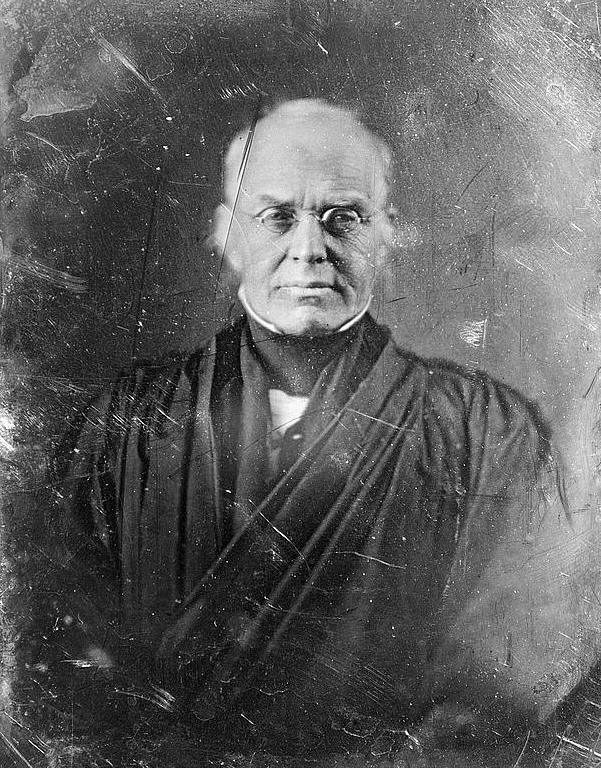
Joseph Story was an American lawyer and jurist who served on the Supreme Court of the United States from 1812 to 1845, during the Marshall Court and early-Taney Court eras. He is most remembered for his opinions in Martin v. Hunter's Lessee and The Amistad case, and especially for his magisterial Commentaries on the Constitution of the United States, first published in 1833. Dominating the field in the 19th century, this work is a cornerstone of early American jurisprudence. It is the second comprehensive treatise on the provisions of the U.S. Constitution and remains a critical source of historical information about the forming of the American republic and the early struggles to define its law.
Story opposed Jacksonian democracy, saying it was "oppression" of property rights by republican governments when popular majorities began to restrict and erode the property rights of the minority of rich men. R. Kent Newmyer presents Story as a "Statesman of the Old Republic" who tried to be above democratic politics and to shape the law in accordance with the republicanism of Alexander Hamilton and John Marshall and the New England Whigs of the 1820s and 1830s, including Daniel Webster. Historians agree that Justice Joseph Story reshaped American law—as much or more than Marshall or anyone else—in a conservative direction that protected property rights.He was uniquely honored in the historical Steven Spielberg film Amistad when he was portrayed by retired Associate Justice of the U. S. Supreme Court Harry Blackmun. Justice Blackmun portrays Justice Story reading the Supreme Court's decision in the case in which the film was based, and for which Justice Story is most widely remembered, United States v. The Amistad Africans, et al. This is the only time in known film history that an Associate Justice of the Supreme Court has portrayed another Associate Justice. Wikipedia
Joseph Story book Commentaries on the Constitution of the United States
Commentaries on the Constitution of the United States, Volume 3, Joseph Story, Hilliard, Grey (1833), § 1784, p. 661
In 1819, as quoted in Fateful Lightning: A New History of the Civil War and Reconstruction https://books.google.com/books?id=Tpb7HAIhWHgC&printsec=frontcover&dq=9780199843282&hl=en&sa=X&ved=0ahUKEwjz1ILxqfLcAhVDnuAKHda9Ai0Q6AEIKDAA#v=onepage&q=9780199843282&f=false (2012), by Allen C. Guelzo, Chapter One
"Advice to a Young Lawyer", The American jurist and law magazine: Volume 5 (1831), p. 298.
Bell v. Morrison, 1 Peters, Sup. C. Rep. (U. S.) 360 (1828).
Joseph Story book Commentaries on the Constitution of the United States
Commentaries on the Constitution of the United States, 2d ed. (1851), vol. 2, chapter 45, p. 617. This passage was not in the first edition, but in all later editions.
Webb v. Portland Manufacturing Co., 3 Sumn. Rep. 189 (1838).
Joseph Story book Commentaries on the Constitution of the United States
Commentaries on the Constitution of the United States (1833), p. 708 http://books.google.com/books?id=Ennw5lvHmcoC&pg=PA708&dq=%22The+right+of+the+citizens+to+keep%22.
Motto of the Salem Register. Adopted 1802. Reported in William W. Story's Life of Joseph Story, Volume I, Chapter VI.
A Discourse Pronounced upon the Inauguration of the Author, as Dane Professor of Law in Harvard University on the Twenty-fifth Day of August, 1829 (1829), p. 29.


