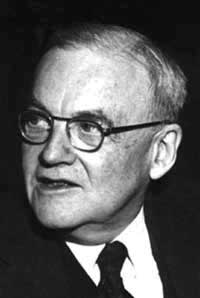
John Foster Dulles was an American diplomat. A Republican, he served as United States Secretary of State under President Dwight D. Eisenhower from 1953 to 1959. He was a significant figure in the early Cold War era, advocating an aggressive stance against communism throughout the world.
Born in Washington, D.C., Dulles joined the New York City law firm of Sullivan & Cromwell after graduating from George Washington University Law School. His grandfather, John W. Foster, and his uncle, Robert Lansing, both served as United States Secretary of State, while his brother, Allen Dulles, served as the Director of Central Intelligence from 1953 to 1961. John Foster Dulles served on the War Industries Board during World War I and he was a U.S. legal counsel at the 1919 Paris Peace Conference. He became a member of the League of Free Nations Association, which supported American membership in the League of Nations. Dulles also helped design the Dawes Plan, which sought to stabilize Europe by reducing German war reparations.
Dulles served as the chief foreign policy adviser to Thomas E. Dewey, the Republican presidential nominee in 1944 and 1948. He also helped draft the preamble to the United Nations Charter and served as a delegate to the United Nations General Assembly. In 1949, Dewey appointed Dulles to fill the Senate vacancy caused by the resignation of Sen. Robert F. Wagner. He served for four months but left office after being defeated in a special election by Herbert H. Lehman.
After Eisenhower won the 1952 presidential election, he chose Dulles as Secretary of State. As Secretary of State, Dulles concentrated on building and strengthening Cold War alliances, most prominently the North Atlantic Treaty Organization. He was the architect of the Southeast Asia Treaty Organization, an anti-Communist defensive alliance between the United States and several nations in and near Southeast Asia. He also helped instigate the 1953 Iranian coup d'état and the 1954 Guatemalan coup d'état. He favored a strategy of massive retaliation in response to Soviet aggression. He advocated support of the French in their war against the Viet Minh in Indochina but rejected the Geneva Accords that France and the communists agreed to, and instead supported South Vietnam after the Geneva Conference in 1954. Suffering from colon cancer, Dulles resigned from office in 1959 and died later that year. Wikipedia
✵ 25. February 1888 – 24. May 1959