
“All men should strive to learn before they die what they are running from, and to, and why.”
"The Shore and the Sea", Further Fables for Our Time (first publication, 1956)
From Fables for Our Time and Further Fables for Our Time
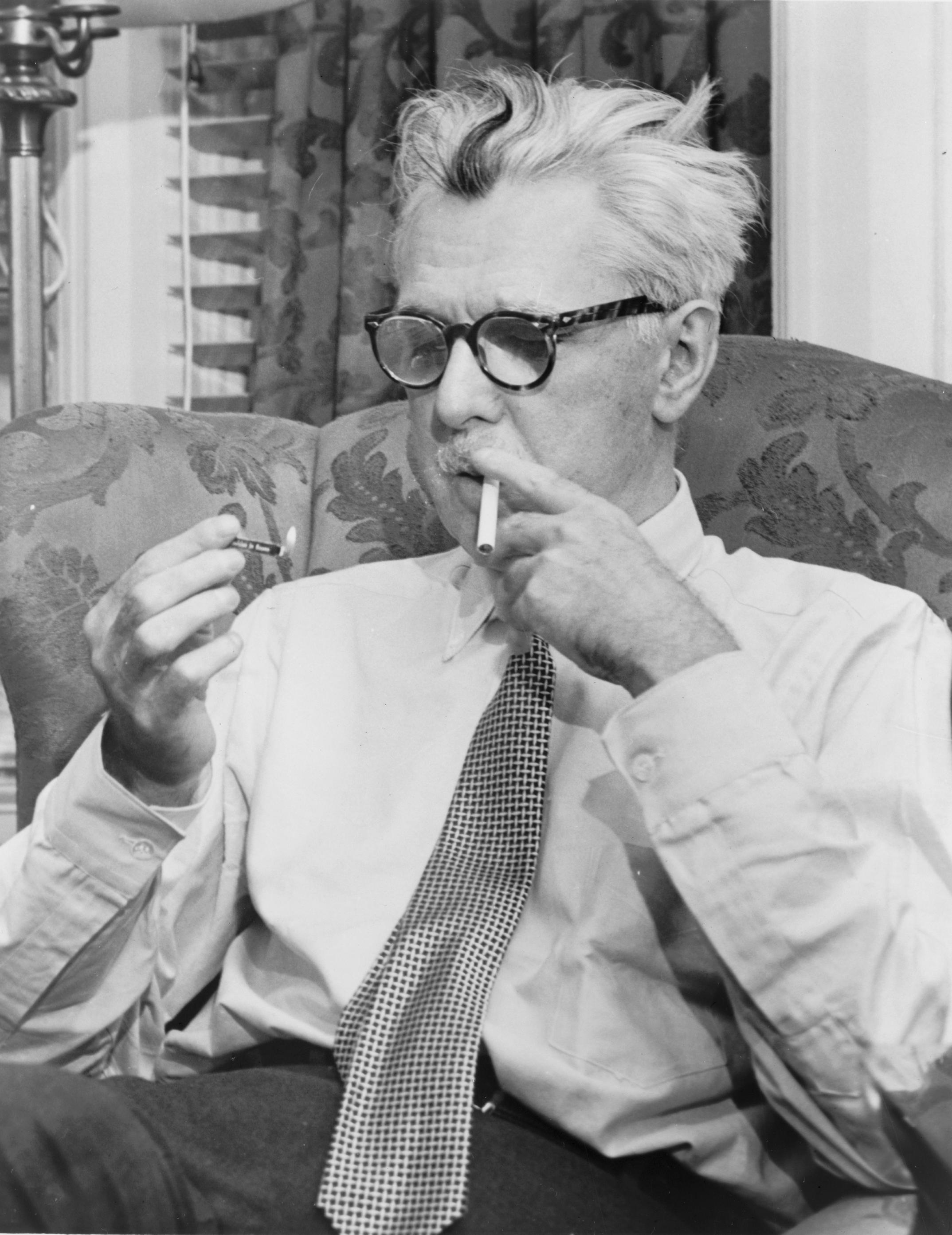
James Grover Thurber was an American cartoonist, author, humorist, journalist, playwright, children's book author, and celebrated wit. He was best known for his cartoons and short stories published mainly in The New Yorker magazine, such as "The Catbird Seat", and collected in his numerous books. He was one of the most popular humorists of his time, as he celebrated the comic frustrations and eccentricities of ordinary people. He wrote the Broadway comedy The Male Animal in collaboration with his college friend Elliott Nugent; it was later adapted into a film starring Henry Fonda and Olivia de Havilland. His short story "The Secret Life of Walter Mitty" has been adapted for film twice, once in 1947 and again in 2013. Wikipedia
“All men should strive to learn before they die what they are running from, and to, and why.”
"The Shore and the Sea", Further Fables for Our Time (first publication, 1956)
From Fables for Our Time and Further Fables for Our Time
“Beautiful things don't ask for attention.”
James Thurber book The Secret Life of Walter Mitty
Source: The Secret Life of Walter Mitty
“Don't get it right, just get it written.”
"The Sheep in Wolf's Clothing", The New Yorker (29 April 1939); Fables for Our Time & Famous Poems Illustrated (1940). The moral is ironic with respect to the fable, in which sheep do insufficient research before writing about wolves, resulting in the sheep being easy prey.
From Fables for Our Time and Further Fables for Our Time
Variant: Don't get it right, just get it written.
The Thirteen Clocks (1951) page 32
From other fiction
“Nowadays most men lead lives of noisy desperation.”
"The Grizzly and the Gadgets", The New Yorker (date unknown); Further Fables for Our Time (1956); This statement is derived from one of Henry David Thoreau: "The mass of men lead lives of quiet desperation."
From Fables for Our Time and Further Fables for Our Time
“All men kill the thing they hate, too, unless, of course, it kills them first.”
"The Crow and the Scarecrow", The New Yorker (date unknown); Further Fables for Our Time (1956). This is derived from Oscar Wilde's statement "All men kill the thing they love..."
From Fables for Our Time and Further Fables for Our Time
“The Book-End,” Columbus Dispatch (1923) Collecting Himself (1989).
From other writings
"The Duchess and the Bugs", 'Lanterns & Lances (1961).
From Lanterns and Lances
The Years with Ross (Little Brown & Co, 1957, pg.267)
Variant: From one casual of mine he picked this sentence. “After dinner, the men moved into the living room.” I explained to the professor that this was Ross’s way of giving the men time to push back their chairs and stand up. There must, as we know, be a comma after every move, made by men, on this earth.
Memo to The New Yorker (1959); reprinted in New York Times Book Review (4 December 1988); Harold Ross was the editor of The New Yorker from its inception until 1951, and well-known for the overuse of commas
From other writings
“Women are wiser than men, because they know less and understand more.”
Quoted in: Kabir, Hajara Muhammad (2010). Northern women development. [Nigeria]. ISBN 978-978-906-469-4. OCLC 890820657. <br class="br"> https://allauthor.com/quotes/42366/ <br class="br">From other writings
said of the Kennedy-Nixon TV debates in an unpublished manuscript, (dated 20 March 1961); Collecting Himself (1989).
From other writings
"Foreword", Lanterns & Lances (1961)
From other writings
Quoted from an an interview with Glenna Syse in Time Magazine (New York, 15 August 1960); Times editors corrected Thurber's arithmetic
Letters and interviews
Cartoon caption (1944), in which a dinner host is speaking to his guests about the wine, reproduced in The Thurber Carnival (1945).
Cartoon captions
“Humor is emotional chaos remembered in tranquility.”
Quoted in New York Post (29 February 1960)
Letters and interviews
“It is better to ask some of the questions than to know all the answers.”
"The Scotty Who Knew Too Much", The New Yorker (18 February 1939)
From Fables for Our Time and Further Fables for Our Time
“There are two kinds of light — the glow that illumines, and the glare that obscures.”
Lanterns and Lances (1961), p. 146; also misquoted as "There are two kinds of light — the glow that illuminates, and the glare that obscures."
From Lanterns and Lances
"The Darlings at the Top of the Stairs", Lanterns & Lances (1961); previously appeared in The Queen and in Harper's Magazine.
From Lanterns and Lances
"An Introduction", The Fireside Book of Dog Stories (Simon and Schuster, 1943); reprinted in Thurber's Dogs (1955)
From other writings
"Carpe Noctem, If You Can", Credos and Curios (1962)
From other writings
“Remember laughter. You'll need it even in the blessed isles of Ever After.”
James Thurber book The 13 Clocks
Source: The 13 Clocks
“Well, if I called the wrong number, why did you answer the phone?”
Cartoon caption, The New Yorker (5 June 1937); "Word Dance--Part One", A Thurber Carnival (1960)
Cartoon captions
Source: Collecting Himself: James Thurber On Writing And Writers, Humor And Himself
“One (martini) is all right, two is too many, three is not enough.”
Quoted in Time Magazine (New York, 15 August 1960) from an an interview with Glenna Syse of the Chicago Sun-Times
Letters and interviews
“You can fool too many of the people too much of the time.”
"The Owl who was God", The New Yorker (29 April 1939); Fables for Our Time & Famous Poems Illustrated (1940). Parody of "You can fool all the people some of the time and some of the people all of the time, but you cannot fool all the people all the time."
From Fables for Our Time and Further Fables for Our Time
"My Senegalese Birds and Siamese Cats", Holiday Magazine; reprinted in Lanterns & Lances (1961).
From Lanterns and Lances
“Early to rise and early to bed makes a male healthy and wealthy and dead.”
"The Shrike and the Chipmunks", The New Yorker (18 February 1939); Fables for Our Time & Famous Poems Illustrated (1940). Because it is derived from Benjamin Franklin's famous saying this is often misquoted as: Early to rise and early to bed makes a man healthy, wealthy, and dead.
From Fables for Our Time and Further Fables for Our Time
“There is no safety in numbers, or in anything else.”
"The Fairly Intelligent Fly", The New Yorker (4 February 1939), a tale of a fly who avoided getting caught in an empty spider web, but then disregarding a warning by a bee, settled down among other flies he believed to be "dancing", and "became stuck to the flypaper with all the other flies."; Fables for Our Time & Famous Poems Illustrated (1940); Quote Investigator notes that this statement was referred to as "Thurber’s Law", in 1,001 Logical Laws (1979) https://quoteinvestigator.com/2019/07/21/safety/<br><br>Ref: en.wikiquote.org - James Thurber / Quotes / Fables for Our Time and Further Fables for Our Time <br class="br">From Fables for Our Time and Further Fables for Our Time
"The Trouble with Man is Man", The New Yorker; reprinted in Lanterns & Lances (1961).
From Lanterns and Lances
“You might as well fall flat on your face as lean over too far backward.”
"The Bear Who Let It Alone", The New Yorker (29 April 1939); Fables for Our Time & Famous Poems Illustrated (1940)
From Fables for Our Time and Further Fables for Our Time
"The Duchess and the Bugs", 'Lanterns & Lances (1961).
From Lanterns and Lances
Lanterns and Lances (1961), p. 44
From Lanterns and Lances
James Thurber book The Secret Life of Walter Mitty
The Secret Life of Walter Mitty (1942)
From other fiction
Memo to The New Yorker (1959); reprinted in New York Times Book Review (4 December 1988)
Letters and interviews
Letter, March 11, 1954, to Malcolm Cowley. Collecting Himself (1989)
Letters and interviews
“A burden in the bush is worth two on your hands.”
"The Hunter and the Elephant", The New Yorker (18 February 1939)
From Fables for Our Time and Further Fables for Our Time
“All right, have it your way — you heard a seal bark!”
Cartoon caption, The New Yorker (30 January 1932); "Women and Men", The Seal in the Bedroom and Other Predicaments (1932); also used in "The Lady on the Bookcase", Alarms and Diversions (1957).
Cartoon captions
Interview, Life Magazine (New York, March 14, 1960).
Letters and interviews
Memo to The New Yorker (1959); reprinted in New York Times Book Review (4 December 1988)
Letters and interviews
Quoted in The New York Times (21 February 1960)
Letters and interviews
Quoted in The Observer (London, 5 February 1961).
Letters and interviews
Memo to The New Yorker (1959); reprinted in New York Times Book Review (4 December 1988)
Letters and interviews
“Don't count your boobies until they are hatched.”
James Thurber book The Unicorn in the Garden
"The Unicorn in the Garden", The New Yorker (31 October 1939); Fables for Our Time & Famous Poems Illustrated (1940)
From Fables for Our Time and Further Fables for Our Time
"The Case for Comedy", Lanterns & Lances http://books.google.com/books?id=m0RZAAAAYAAJ&q=%22humor+and+pathos+tears+and+laughter+are+in+the+highest+expression+of+human+character+and+achievement+inseparable%22&pg=PA143#v=onepage (1961); previously appeared in The Atlantic Monthly November 1960 http://books.google.com/books?id=6q8GAQAAIAAJ&q=%22and+pathos+tears+and+laughter+are+in+the+highest+expression+of+human+character+and+achievement+inseparable%22&pg=PA98#v=onepage <br class="br">From Lanterns and Lances
“A word to the wise is not sufficient if it doesn't make any sense.”
"The Weaver and the Worm", The New Yorker ( 11 August 1956 http://www.newyorker.com/archive/1956/08/11/1956_08_11_019_TNY_CARDS_000252308); Further Fables for Our Time (1956) <br class="br">From Fables for Our Time and Further Fables for Our Time
“It is better to have loafed and lost, than never to have loafed at all.”
"The Courtship of Arthur and Al", The New Yorker (26 August 1939); Fables for Our Time & Famous Poems Illustrated (1940). Parody of Alfred Lord Tennyson's "Better to have loved and lost/than never to have loved at all."
From Fables for Our Time and Further Fables for Our Time
“Discussion in America means dissent.”
"The Duchess and the Bugs", 'Lanterns & Lances (1961).
From Lanterns and Lances
Quoted in New York Times (21 February 1960).
Letters and interviews
Television interview with Edward R. Murrow on TV show Small World, CBS-TV (25 March 1959); transcript published in New York Post
Letters and interviews
James Thurber book The Unicorn in the Garden
"The Unicorn in the Garden", The New Yorker (31 October 1939); Fables for Our Time & Famous Poems Illustrated (1940). This is a fable where a man sees a Unicorn in his garden, and his wife reports the matter to have him taken away, to the "booby-hatch". Online text with illustration by Thurber http://english.glendale.cc.ca.us/unicorn1.html <br class="br">From Fables for Our Time and Further Fables for Our Time
“A drawing is always dragged down to the level of its caption.”
The New Yorker (2 August 1930)
From other writings
James Thurber book My Life and Hard Times
My Life and Hard Times (1933) page 33, Harper & Row, New York.
From other writings


