Fritz Mauthner Quotes

Fritz Mauthner was an Austro-Hungarian novelist, theatre critic and satirist. He was an exponent of philosophical scepticism derived from a critique of human knowledge and of philosophy of language.

Mauthner was born on 22 November 1849 into an assimilated, well-to-do Jewish family from Horzitz in Bohemia . He was the fourth of the six children of Emmanuel and Amalie Mauthner.:viiiHe became editor of the Berliner Tageblatt in 1895, but is remembered mainly for his Beiträge zu einer Kritik der Sprache , published in three parts in 1901 and 1902. Ludwig Wittgenstein took several of his ideas from Mauthner, and acknowledges him in his Tractatus Logico-Philosophicus .Mauthner died in Meersburg am Bodensee on 29 June 1923.:viii Wikipedia  

✵ 22. November 1849 – 29. June 1923
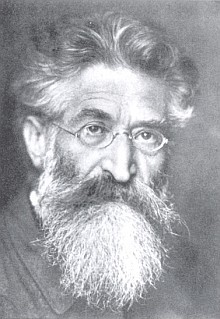
Fritz Mauthner photo
Fritz Mauthner: 1 quote0 likes

Fritz Mauthner Quotes

“Men learned to speak in order to understand one another. Cultural languages have lost the ability to help men to advance beyond the most rudimentary level and attain understanding. It seems that the time has come to learn to be silent once again.”

Fritz Mauthner

Beiträge zu einer Kritik der Sprache (1923), I, p. 56; as quoted in "Wittgenstein versus Mauthner: Two critiques of language, two mysticisms" (2007) by Elena Nájera http://wittgensteinrepository.org/agora-alws/article/view/2659/3042

Similar authors

Marie von Ebner-Eschenbach photo
Marie von Ebner-Eschenbach81
Austrian writer None
Bettina von Arnim photo
Bettina von Arnim1
German writer None
Ludwig Börne photo
Ludwig Börne1
German writer None
Guy De Maupassant photo
Guy De Maupassant59
French writer None
Stendhal photo
Stendhal50
French writer None
Ivan Turgenev photo
Ivan Turgenev7
Russian writer None
Honoré de Balzac photo
Honoré de Balzac157
French writer None
José Maria Eça de Queiroz photo
José Maria Eça de Queiroz14
Portuguese writer None
Jan Neruda photo
Jan Neruda7
Czech poet, theater reviewer, publicist and writer None
Gustave Flaubert photo
Gustave Flaubert98
French writer (1821–1880) None