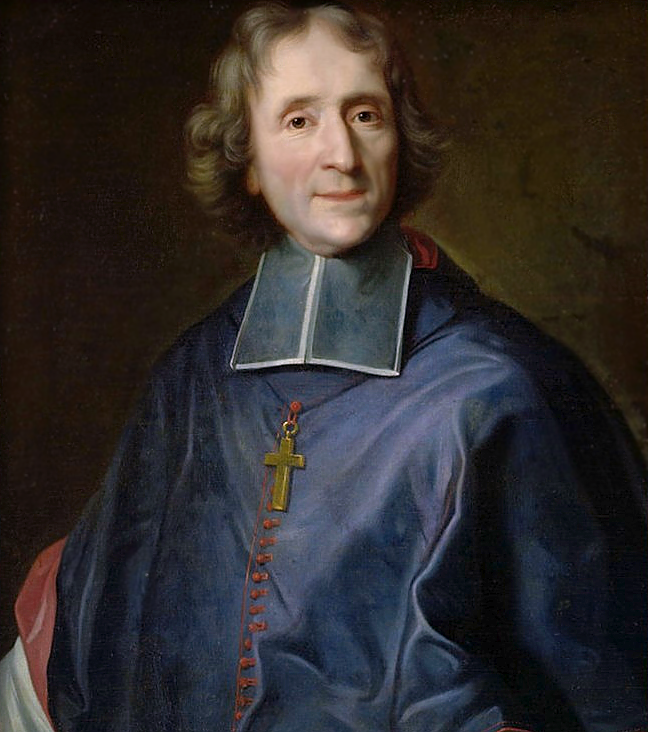
François Fénelon Quotes

François de Salignac de la Mothe-Fénelon , more commonly known as François Fénelon , was a French Roman Catholic archbishop, theologian, poet and writer. He today is remembered mostly as the author of The Adventures of Telemachus, first published in 1699. Wikipedia  

✵ 6. August 1651 – 7. January 1715
François Fénelon photo
François Fénelon: 43 quotes3 likes

Famous François Fénelon Quotes

“All wars are civil ones; for it is still man spilling his own blood, tearing out his own bowels.”

François Fénelon

Toutes les guerres sont civiles; car c'est toujours l'homme contre l'homme qui répand son propre sang, qui déchire ses propres entrailles.
Dialogues des morts, ch. 17, cited from De l'éducation des filles, Dialogues des morts et opuscules divers (Paris: Firmin Didot, 1857) p. 149; translation from Mr. Elphingston (trans.) Dialogues of the Dead, Together with Some Fable Composed for the Education of a Prince (Glasgow: Robert and Andrew Foulis, 1754) vol. 1, p. 87. (1700).

“If we love Him infinitely more than we do ourselves, we make an unconditional sacr”

François Fénelon

Dictionary of Burning Words of Brilliant Writers (1895)

François Fénelon Quotes about God

“The presence of God calms the soul, and gives it quiet and repose.”

François Fénelon

Source: Dictionary of Burning Words of Brilliant Writers (1895), P. 276.

François Fénelon Quotes about love

François Fénelon Quotes

“God never makes us sensible of our weakness except to give us of His strength.”

François Fénelon

Source: Dictionary of Burning Words of Brilliant Writers (1895), P. 283.

“Above all, do not allow yourself to be bewitched by the evil charms of geometry.”

François Fénelon

Sur-tout ne vous laissez point ensorceler par les attraits diaboliques de la géométrie.
Lettres Spirituelles, no. 59, cited from Correspondance de Fénelon, archevêque de Cambrai (Paris: Ferra Jeune, 1827) vol. 5, p. 514; translation from Georges Duby and Michelle Perrot (eds.) A History of Women in the West (Cambridge, Mass.: Belknap Press of Harvard University Press, 1994) vol. 3, p. 405.Œuvres complètes De François de Salignac De La Mothe Fénélon. TOME V Briand 1810 LETTRE CXLII (142) p.106.

“I protest that no one admires Cicero more than I do. He enriches all that he touches.”

François Fénelon

Je proteste que personne n'admire Cicéron plus que je fais: il embellit tout ce qu’il touche.
Lettre sur les Occupations de l'Académie Française, sect. 4, cited from Œuvres de Fénelon (Paris: Lefèvre, 1835) vol. 3, p. 227; translation from Paul Bertie Bull Preaching and Sermon Construction (New York: Macmillan, 1922) p. 256. (1714)
Cf. Dr. Johnson's epitaph for Oliver Goldsmith: "…qui nullum fere scribendi genus non tetigit, nullum quod tetigit non ornavit," ("…who left no species of writing untouched by his pen, and touched none that he did not adorn").

“Peace treaties signed by the vanquished are not freely signed. Men sign with a knife at their throat, they sign in spite of themselves, in order to avoid still greater losses; they sign as men surrender their purse when it is a case of your money or your life.”

François Fénelon

Les traités de paix ne couvrent rien, lorsque vous êtes le plus fort, & que vous réduisez vos voisins à signer le traité pour éviter de plus grands maux: alors il signe comme un particulier donne sa bourse à un voleur qui lui tient le pistolet sur la gorge.
Directions pour la conscience d'un roi (Paris: Estienne, 1775) p. 60; translation by A. Lentin, cited from Margaret Lucille Kekewich (ed.) Princes and Peoples: France and the British Isles, 1620-1714 (Manchester: Manchester University Press, 1994) p. 226. (c. 1694).

“Whoever is capable of lying, is unworthy of being reckoned in the number of men; and whoever knows not to be silent, is unworthy of ruling.”

François Fénelon

Quiconque est capable de mentir est indigne d'être compté au nombre des hommes; et quiconque ne sait pas se taire est indigne de gouverner.
Bk. 3, p. 14; translation pp. 34-5.
Les aventures de Télémaque (1699)

“The greatest defect of common education is, that we are in the habit of putting pleasure all on one side, and weariness on the other; all weariness in study, all pleasure in idleness.”

François Fénelon

Remarquez un grand défaut des éducations ordinaires: on met tout le plaisir d'un côté , et tout l'ennui de l'autre; tout l'ennui dans l'étude, tout le plaisir dans les divertissements.
De l'éducation des filles, ch. 5, cited from De l’éducation des filles, dialogues des morts et opuscules divers (Paris: Firmin Didot, 1857) p. 21; translation from Selections from the Writings of Fénelon (Boston: Hilliard, Gray, Little and Wilkins, 1829) p. 72.

“In general, those who govern children forgive nothing in them, but everything in themselves.”

François Fénelon

D'ordinaire, ceux qui gouvernent les enfants ne leur pardonnent rien, et se pardonnent tout à eux-mêmes.
Traité de l'éducation des filles, ch. 5, cited from De l'éducation des filles, dialogues des morts et opuscules divers (Paris: Firmin Didot, 1857) p. 15; translation from Selections from the Writings of Fénelon (Boston: Hilliard, Gray, Little and Wilkins, 1829) p. 137. (1687).

“…nothing will make us so tender and indulgent to the faults of others as a view of our own.”

François Fénelon

L&#x27;humilité produit le support d&#x27;autrui. La vue seule de nos misères peut nous rendre compatissants et indulgents pour celles d&#x27;autrui <br class="br"> Œuvres complètes de François de Salignac de La Mothe Fénelon http://www.passtheword.org/DIALOGS-FROM-THE-PAST/innerlife.htm.

“Men are very much to be pitied in that they are to be governed by a king who is but a man like them; for it would require Gods to reform men. But kings are not less to be pitied, since being but men, that are weak and imperfect, they are to govern this innumerable multitude of corrupt and deceitful men.”

François Fénelon

Les hommes sont fort à plaindre d'avoir à être gouvernés par un roi, qui n'est qu'homme semblable à eux; car il faudroit des dieux pour redresser les hommes. Mais les rois ne sont pas moins à plaindre, n'étant qu'hommes, c'est-à-dire foibles et imparfaits, d'avoir à gouverner cette multitude innombrable d'hommes corrompus et trompeurs.
Bk. 10, p. 72; translation p. 174.
Les aventures de Télémaque (1699)

“The good historian is not for any time or any country: while he loves his fatherland, he never flatters it in anything.”

François Fénelon

Le bon historien n'est d'aucun temps ni d'aucun pays: quoiqu'il aime sa patrie, il ne la flatte jamais en rien.
Lettre sur les Occupations de l'Académie Française, sect. 8, cited from Œuvres de Fénelon (Paris: Lefèvre, 1835) vol. 3, p. 240; translation by Patrick Riley, from Hans Blom et al. (eds.) Monarchisms in the Age of Enlightenment (Toronto: University of Toronto Press, 2007) p. 86.

“In the light of eternity we shall see that what we desired would have been fatal to us, and that what we would have avoided was essential to our well-being.”

François Fénelon

Nous verrons à sa lumière, dans l'éternité, que ce que nous désirions nous eût été funeste, et que ce que nous voulions éviter était essentiel à notre bonheur.
Instructions et avis sur divers points de la morale et de la perfection chrétienne, ch. 18, cited from Œuvres de Fénelon (Paris: Firmin Didot, 1845) vol. 1, p. 325; translation from Selections from the Writings of Fénelon (Boston: Samuel G. Simpkins, 1844) p. 82.

“All the human kind is but one family, dispersed over the face of the whole earth; all men are brothers, and ought to love each other as such.”

François Fénelon

Tout le genre humain n’est qu’une famille dispersée sur la face de toute la terre. Tous les peuples sont frères, et doivent s’aimer comme tels.
Bk. 9, p. 67; translation p. 162.
Les aventures de Télémaque (1699)

Similar authors

Alphonsus Maria de' Liguori photo
Alphonsus Maria de' Liguori2
Italian Catholic bishop, spiritual writer, composer, musici… None
Francis de Sales photo
Francis de Sales12
French bishop, saint, writer and Doctor of the Church j None
Teresa of Ávila photo
Teresa of Ávila55
Roman Catholic saint None
Desiderius Erasmus photo
Desiderius Erasmus36
Dutch Renaissance humanist, Catholic priest, and theologian None
John of the Cross photo
John of the Cross48
Spanish mystic and Roman Catholic saint None
Ignatius of Loyola photo
Ignatius of Loyola9
Catholic Saint, founder of the Society of Jesus (the Jesuit… None
Vincent de Paul photo
Vincent de Paul4
French priest, founder and saint None
Marguerite Bourgeoys photo
Marguerite Bourgeoys6
French colonist and foundress None
Thomas More photo
Thomas More26
English Renaissance humanist None
Thomas Cranmer photo
Thomas Cranmer2
leader of the English Reformation and Archbishop of Canterb… None